
The HR technology market has never been more complex or more consequential. Organizations today can choose from hundreds of HRMS software platforms, point solutions, AI-powered tools, analytics platforms, and automation suites, each promising to transform how HR operates. For HR leaders tasked with choosing the right technology for their organization, the abundance of options can feel as overwhelming as the absence of them.
But the stakes are real. The right HR technology investment transforms what an HR function is capable of, turning manual, error-prone processes into automated, data-driven systems; giving managers real-time workforce visibility; enabling employees to self-serve their HR needs; and freeing HR teams to focus on strategic work rather than administrative firefighting. The wrong investment creates technical debt, disengages employees, and leaves the HR function further behind than before.
This guide is designed to cut through the noise. It covers everything an HR leader needs to make a confident, well-informed HRMS software decision, from understanding what HR tech actually is and how it has evolved to evaluating platforms, navigating the HRMS vs HCM debate, understanding AI and automation capabilities, and selecting the right solution for your specific organizational context in India, the GCC, or Southeast Asia.
1. What Is HR Technology, And Why It Matters More Than Ever
HR technology, commonly referred to as HR tech, is the broad category of software platforms, tools, and systems that automate, streamline, and improve human resource management processes. At its most basic, HR tech replaces manual, paper-based, or spreadsheet-driven HR processes with automated, data-driven systems that are faster, more accurate, and more consistent.
But modern HR technology does far more than automate. The best HR tech platforms today are strategic business tools, not just administrative systems. They provide real-time workforce analytics, enable AI-powered talent decisions, and support remote and hybrid workforce management. Most importantly, they connect individual performance to organizational goals and give HR leaders the data they need to influence business strategy rather than simply execute it.
The evolution of HR technology over the past decade has been profound. What began as basic payroll and record-keeping software has grown into comprehensive human capital management platforms that integrate recruitment, onboarding, payroll, attendance, performance, learning, engagement, analytics, and more into a single unified system. This evolution has fundamentally changed what HR can deliver and raised the expectations of every stakeholder, from employees demanding seamless self-service to CEOs expecting workforce data to drive strategic decisions.
2. HRMS vs HRIS vs HCM: Understanding the Difference
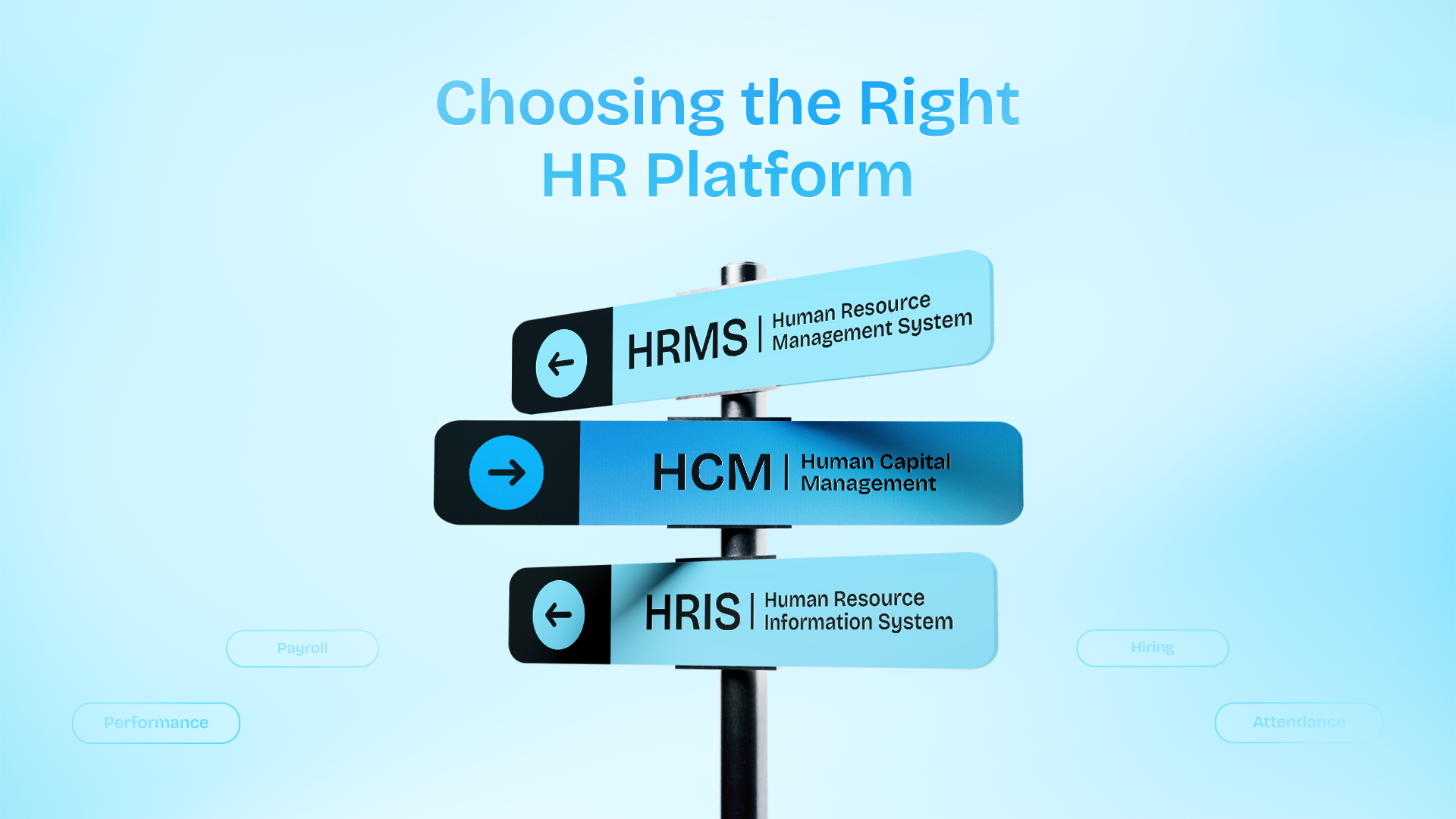
One of the most common points of confusion with this tech category is the terminology. HRMS, HRIS, and HCM are frequently used interchangeably, but they represent meaningfully different scopes of capability. Understanding the distinction helps HR leaders identify the right category of solution for their needs.
- HRIS (Human Resource Information System): The foundational category, focused on storing and managing employee data, generating reports, and automating basic HR processes like payroll and attendance. Think of it as the digital filing cabinet of HR. Most appropriate for smaller organizations with straightforward HR needs.
- HRMS (Human Resource Management System): A broader platform that adds functionality on top of HRIS, typically including recruitment, performance management, leave management, and self-service capabilities. The most common category for mid-sized organizations.
- HCM (Human Capital Management): The most comprehensive category, encompassing the full employee lifecycle from recruitment to retirement, plus strategic capabilities like talent management, workforce planning, learning and development, and advanced analytics. Treats employees as strategic assets rather than administrative records.
The market trend is clear: organizations are moving decisively toward unified HCM platforms that bring all of these capabilities into a single, integrated system. The era of managing HR through a collection of disconnected point solutions, separate payroll software, separate performance tools, separate learning platforms is ending. The cost of data silos, reconciliation overhead, and inconsistent employee experiences is simply too high.
|
Capability |
HRIS | HRMS |
HCM |
| Employee data storage | ✓ | ✓ | ✓ |
| Payroll processing | Basic | ✓ | ✓ |
| Attendance and leave | Limited | ✓ | ✓ |
| Recruitment and ATS | ✗ | ✓ | ✓ |
| Performance management | ✗ | ✓ | ✓ |
| Learning and development | ✗ | Limited | ✓ |
| Workforce planning | ✗ | ✗ | ✓ |
| Predictive analytics | ✗ | ✗ | ✓ |
| AI-powered insights | ✗ | ✗ | ✓ |
| Best for | Small organizations | Mid-sized organizations | Enterprise and multi-country organizations |
For a detailed comparison, read: HRMS vs HCM: Why Unified HCM Platforms Are Replacing Disconnected HR Tools
3. HR Operational Maturity: Where Does Your Organization Stand?
Before evaluating a digital platform, HR leaders need to honestly assess where their organization currently sits in terms of HR operational maturity. Investing in advanced AI-powered analytics when your employee data is still managed in spreadsheets is like installing solar panels on a house with no electrical wiring, the technology cannot deliver its potential without the underlying foundation.
HR operational maturity describes the progression from basic, reactive HR administration to strategic, data-driven people management. Organizations typically move through several stages:
- Stage 1 – Foundational: HR processes are manual, paper-based, or spreadsheet-driven. Data is fragmented, compliance is reactive, and HR’s role is primarily administrative.
- Stage 2 – Functional: Core HR processes are digitized and automated. Employee data is centralized. Basic self-service is available. HR can report on headcount and compliance but not much else.
- Stage 3 – Integrated: HR systems are connected across functions; payroll, performance, attendance, and recruitment share data automatically. HR analytics is available in real time.
- Stage 4 – Strategic: HR uses advanced analytics and AI to predict workforce trends, inform talent decisions, and contribute directly to business strategy. The HRMS software is a strategic business intelligence tool.
Understanding where your organization sits today determines what level of HRMS software investment makes sense, and what foundation work needs to happen before more advanced capabilities can deliver value.
Read: What Is HR Operational Maturity? A Complete Guide for 2026 for a detailed framework to assess and advance your organization’s HR maturity level.
4. AI in HR: Moving Beyond the Hype to Real Productivity
Artificial intelligence has become the most discussed, and most misunderstood, topic in HR technology. Every HRMS software vendor now includes AI capabilities in their pitch. But the reality of AI in HR is more nuanced than the marketing suggests: some AI applications are genuinely transformative, others are superficial features that add complexity without adding value.
Here is where AI in HR technology is delivering genuine, measurable value:
- Intelligent recruitment screening: AI tools analyze job applications, identify qualified candidates, and rank them against role requirements, dramatically reducing time-to-shortlist. To mitigate historical data bias, modern platforms utilize masked screening (hiding demographic data) and audit their underlying algorithms regularly against adverse impact metrics, ensuring selections are based purely on skill and experience signals.
- Predictive attrition modeling: AI systems that analyze behavioral signals, performance data, engagement scores, and historical patterns to identify employees at risk of leaving, months before a resignation arrives.
- Automated HR chatbots: Conversational AI tools that handle routine employee queries, leave balances, payslip requests, and policy questions 24/7 without HR intervention.
- Skills intelligence: AI platforms that maintain a real-time inventory of workforce skills and automatically identify gaps between current capabilities and future role requirements.
- Sentiment analysis: AI tools that analyze patterns in employee communications, survey responses, and check-in data to surface early warning signs of disengagement or team health issues.
Akrivia HCM’s AI-powered HR chatbot, Dhruva, is a prime example of practical AI implementation that delivers immediate value for HR teams. Read: The Future of HR is Here: Akrivia HCM’s AI-Powered Chatbot – Dhruva to see what AI-driven HR support looks like in practice.
5. HR Automation: Eliminating the Administrative Burden
HR automation is the application of technology to execute repetitive, rule-based HR tasks without human intervention. It is one of the most immediately impactful capabilities any modern core system can provide, and one of the clearest measures of ROI for HR technology investment.
The administrative burden on HR teams is significant. Industry research consistently shows that HR professionals spend the majority of their time on transactional, administrative work processing leave requests, updating records, generating reports, and managing approval workflows. This is time not spent on strategic work, talent development, or organizational culture building.
HR automation addresses this directly. When routine processes are automated, onboarding workflows, leave approvals, document generation, compliance reminders, payroll data collection HR teams reclaim significant productive time. The processes also run faster, more consistently, and with fewer errors than when managed manually.
Key HR processes that benefit most from automation include employee onboarding and offboarding, leave and attendance management, payroll data collection and processing, performance review cycle management, compliance training assignment and tracking, document generation and digital signatures, and HR query management through self-service and chatbot tools.
For a comprehensive guide with practical examples of HR automation in action, read: What is HR Automation? A Guide with Practical Examples.
6. Cloud HCM: Why Cloud-First Is the Only Sensible Strategy
The migration from on-premise HR systems to cloud-based HCM platforms is one of the most significant shifts in HR technology history, and it is effectively complete for most modern organizations. Cloud HCM is not just a deployment preference; it is a fundamentally different model for how HR technology is built, delivered, and continuously improved.
The advantages of cloud HCM over on-premise systems are compelling:
- Automatic updates: Cloud platforms are updated by the vendor continuously, regulatory changes, new features, and security patches are applied automatically without IT intervention or project budgets.
- Anywhere access: Cloud-native infrastructure is accessible from any device, from any location, which is essential for distributed workforces, field employees, and organizations with multiple offices.
- Scalability: Cloud platforms scale with your organization, adding users, entities, or countries requires configuration, not infrastructure investment.
- Lower total cost of ownership: No servers, no IT maintenance, no upgrade projects, the subscription model of cloud HCM dramatically reduces the total cost compared to on-premise alternatives.
- Integration ecosystem: Cloud platforms connect more easily to other cloud systems, payroll providers, banks, government portals, and third-party tools, through modern API architectures.
- Security: Enterprise cloud providers invest in security infrastructure that most individual organizations cannot match, with SOC 2 compliance, data encryption, and regular security audits as standard.
For a comprehensive overview, read: Comprehensive Guide to Cloud HCM
7. Predictive People Analytics: The New Frontier of HR Decision-Making
The shift from descriptive HR analytics (what happened) to predictive HR analytics (what is likely to happen) represents the most significant capability leap in HR technology of the past decade. HRMS software that provides only historical reporting is increasingly insufficient, leading organizations demand the ability to anticipate workforce trends and act on them before they become problems.
Predictive people analytics uses machine learning models trained on historical workforce data to forecast future outcomes, attrition risk, hiring demand, performance trajectories, and engagement trends. When integrated into your centralized workforce suite, these capabilities give HR leaders a significant strategic advantage:
- Attrition prediction: Identify employees most likely to leave in the next 60–90 days, enabling targeted retention interventions before it is too late.
- Hiring demand forecasting: Predict headcount needs 6–12 months in advance based on business growth projections and historical workforce patterns.
- Performance trajectory modeling: Identify high-potential employees likely to be ready for advancement and those whose performance trajectory signals a need for early support.
- Engagement risk scoring: Flag teams or individuals showing early signs of disengagement based on attendance patterns, performance trends, and survey sentiment.
Read: Predictive People Analytics for HR Leaders for a comprehensive guide to building this capability in your HR function.
8. HR Tech for Hybrid and Flexible Work Models
The widespread adoption of hybrid and flexible working has fundamentally altered core workforce architecture. Legacy infrastructure built around physical clock-in machines and localized networks cannot handle a distributed workforce.
Modern platforms solve this by treating location as a dynamic variable. Geofencing and facial recognition secure mobile clock-ins for field or remote teams without compromising compliance. Beyond tracking time, the technology shifts performance evaluation away from mere visibility and toward objective output metrics. It integrates directly with performance management software, dynamically updates shift schedules to prevent burnout, and maintains cross-border compliance automatically when employees work across different tax or legal jurisdictions.
Read: Hybrid & Flexible Work Models: Navigating the HR Tech Shift in 2026 for a detailed analysis of how HR technology must adapt to the hybrid work reality.
9. Using HR Tech to Solve Retention Before People Leave
Traditional retention strategies are fundamentally reactive. By the time an employee hands in a resignation letter, the opportunity to retain them has long passed. Modern predictive analytics transforms this into a proactive discipline.
By aggregating disparate data points such as regular dips in survey sentiment scores, shifting attendance patterns, flatlined performance metrics, and prolonged stagnation in a single role, machine learning algorithms build an internal flight-risk profile. Instead of general corporate initiatives, HR managers receive early-warning dashboards flagged 60 to 90 days before an employee disengages. This runway allows talent teams to execute targeted interventions, whether through structured career pathing, compensation adjustments, or role re-alignments.
Read: Goodbyes That Didn’t Have to Happen: Turning Surprise Attrition into Real Retention Strategies for a practical guide to using HR technology for proactive retention management.
10. Industry-Specific HR Technology: Tailored for Your Sector
HR technology requirements are not the same across all industries. A retail organization managing 500 frontline store associates has fundamentally different HRMS needs than a financial services firm managing 500 knowledge workers. A hospital running 24×7 shift operations has different requirements than a technology startup with a fully remote team. The best HRMS software platforms accommodate industry-specific requirements natively, not through expensive customization.
HR Tech for Retail
Retail organizations face unique HR technology challenges: high employee turnover, complex shift scheduling across multiple store locations, frontline workers who are rarely at a desk, seasonal workforce fluctuations, and performance management tied to sales and customer service metrics. HRMS software for retail must handle high-volume scheduling, mobile-first attendance tracking, rapid onboarding for seasonal hires, and real-time labor cost management.
Read: From Shop Floor to Strategy: Modernizing Retail HR Operations for a retail-specific HR technology roadmap.
HR Tech for Healthcare
Healthcare organizations present some of the most complex HR technology challenges of any sector, including 24×7 operations, highly specialized staff with strict certification and compliance requirements, complex rotating shift patterns, and the patient safety implications of staffing gaps. HRMS software for healthcare must support sophisticated shift management, mandatory compliance training tracking, credential verification, and rapid replacement workflows for absent staff.
Read: Hospital Shift Management: Best Practices for 24×7 Healthcare HR Teams for healthcare-specific HR technology guidance.
HR Tech for Manufacturing and Industrial Organizations
Manufacturing and industrial organizations in the GCC petrochemicals, construction, utilities, and logistics manage large workforces with complex compliance requirements. HRMS software for GCC manufacturing must handle multi-nationality workforce tracking (essential for WPS compliance), shift-based attendance with biometric integration, project-based cost allocation, and the specific nationalization ratio requirements that apply to industrial sector employers under UAE and Saudi regulations.
For a broad overview of how HR technology delivers value across different industry verticals, read: Tailored for Every Sector: HR Tech Benefits Across Industries.
11. Regional HR Technology Landscape: India, GCC, Singapore, and the Philippines
HR technology adoption and requirements vary significantly across geographies. Organizations evaluating HRMS software for deployment across India, the GCC, Southeast Asia, or specifically Singapore and the Philippines must understand the regional nuances that affect platform selection, compliance requirements, and implementation approach.
HR Technology in India
India is one of the world’s fastest-growing HR technology markets. The combination of a large, young workforce, rapid business growth, and increasing HR sophistication has driven significant investment in HRMS software across Indian organizations. Compliance requirements around PF, ESI, TDS, professional tax, and labor law variations across states create significant demand for HRMS platforms with strong India-specific compliance capabilities.
For a comparison of the leading HRMS platforms available in India today, read: 10 Best HRMS Software in India.
HR Technology in the GCC
The GCC represents one of the most complex HR technology environments in the world, not because of workforce size, but because of regulatory diversity. Organizations operating across the UAE, Saudi Arabia, Qatar, Kuwait, Bahrain, and Oman must simultaneously manage different nationalization quota requirements (Emiratization, Saudization, Omanization), country-specific wage protection systems, varying overtime and leave entitlements, and end-of-service gratuity calculations that differ in their specifics by market.
HR Technology in Singapore
Singapore’s HR technology market is among the most sophisticated in Asia, characterized by high adoption, strong regulatory frameworks, and a workforce that expects seamless digital HR experiences. IRAS compliance, CPF contributions, MOM reporting requirements, and Employment Pass regulations create specific HRMS software requirements for Singapore-based organizations. Singapore is also a significant regional headquarters location, making multi-country HCM platform capabilities particularly important.
HR Technology in the Philippines
The Philippines is one of the most dynamic HR technology markets in Southeast Asia, driven by a large BPO sector, rapid digitization, and a young, mobile-first workforce. SSS, PhilHealth, and Pag-IBIG contribution compliance, alongside Bureau of Internal Revenue requirements, create specific HRMS software needs for Philippine-based organizations. The country’s strong outsourcing culture also means that HRMS platforms must support complex multi-client workforce management scenarios.
For a comparison of the leading HRMS platforms in the Philippines, read: Top 10 HRMS/HRIS Software in the Philippines. And for the latest HR trends shaping platform adoption: Top 7 HR Trends in the Philippines in 2025.
HR Technology in Malaysia
Malaysia presents a rapidly maturing HR technology landscape characterized by high digital adoption and strict statutory compliance frameworks. Complex, mandatory payroll deductions must be managed accurately by HRMS software, including EPF (Employees Provident Fund), SOCSO (Social Security Organization), EIS (Employment Insurance System), and PCB (Monthly Tax Deduction) calculations. Furthermore, the automated handling of HRD Corp levies and the generation of annual EA Forms are required. Agile platforms are expected to seamlessly adapt to frequent regulatory updates and shifting statutory wage ceilings.
HR Technology in Indonesia
Indonesia’s HR technology market is driven by a massive, mobile-first workforce and highly intricate local employment regulations. Deeply localized HRMS platforms are required to handle complex statutory obligations, most notably the calculation of PPh 21 progressive income tax, alongside BPJS Ketenagakerjaan (employment social security) and BPJS Kesehatan (health insurance) contributions. Additionally, the calculation and disbursement of THR (Tunjangan Hari Raya), the mandatory religious holiday allowance, must be flawlessly automated. Strict adherence to national labor laws makes robust local compliance a primary driver of HRMS selection in the country.
12. How to Evaluate and Choose the Right HRMS Software: A Structured Framework
With the landscape mapped, here is a practical, step-by-step framework for evaluating and selecting the right HRMS software for your organization. This process has been refined across hundreds of HR technology decisions, and it consistently produces better outcomes than ad hoc vendor evaluation.
Step 1: Define Your Requirements Before Talking to Vendors
The most common mistake in HRMS software evaluation is engaging vendors before requirements are clearly defined. When vendors lead the conversation, the evaluation becomes a feature comparison rather than a fit assessment. Before any vendor demo, document your must-have requirements, nice-to-have requirements, integration needs, compliance requirements, user volume, and geographic scope.
Step 2: Assess Your Current HR Operational Maturity
As discussed in Section 3, your current maturity level determines what capabilities will actually deliver value versus what will be underutilized. Be honest about where you are starting from, and select a platform that can grow with you rather than one that requires capabilities you are not yet ready to use.
Step 3: Define Your Non-Negotiables
Every HRMS evaluation should identify absolute requirements, capabilities without which the platform is disqualified regardless of other strengths. These typically include: specific compliance requirements (India payroll, UAE WPS, Singapore IRAS), integration requirements (existing payroll system, ERP), language and currency requirements, and minimum security and data privacy standards.
Step 4: Build a Shortlist and Issue a Structured RFP
Once non-negotiables are defined, build a shortlist of 3–5 platforms that appear to meet your requirements. Issue a structured Request for Proposal that asks each vendor to specifically address your requirements, not to deliver a generic product overview. The RFP process creates comparable data across vendors and surfaces capability gaps that demo presentations often obscure.
Step 5: Require Scenario-Based Demonstrations
Generic product demos are almost always impressive. What matters is whether the HRMS software works for your specific scenarios. Require vendors to demonstrate your actual use cases: running your payroll structure, managing your shift types, generating your specific reports, processing a scenario from your industry. Platforms that cannot demo your scenarios convincingly are unlikely to support them in production.
Step 6: Evaluate Implementation and Support
An HRMS software is only as good as its implementation. Evaluate the vendor’s implementation methodology, the experience and availability of their implementation team, their track record with organizations of your size and complexity, and their ongoing support model. An excellent platform poorly implemented will underdeliver. A good platform excellently implemented will overdeliver.
Step 7: Calculate Total Cost of Ownership
License fees are the most visible cost but rarely the largest. Calculate the full total cost of ownership: implementation fees, integration development costs, data migration costs, training costs, ongoing customization and support fees, and the internal HR and IT time required for implementation and ongoing management. Compare this against the value delivered, time saved, error reduction, compliance risk mitigation, and strategic capability gained.
Step 8: Check References, Specifically
Ask each vendor for references from organizations of similar size, industry, and geographic complexity. Ask references specifically about implementation experience (not just the final product), support responsiveness, and whether the platform delivered the outcomes they expected. References that are only willing to discuss product features rather than implementation experience are a warning sign.
13. Measuring the ROI of Your HR Technology Investment
Every HR technology investment should be evaluated against measurable outcomes. Here are the key metrics HR leaders should track to demonstrate and optimize the ROI of their HRMS software:
| ROI Metric | Industry Baseline Benchmark |
Post-Implementation Target |
| HR Admin Time Saved | HR spends 60–70% of hours on administration | Reclaim 25–35% of transactional hours via automation |
| Payroll Error Rate | Manual processing averages 1.5–3.0% error margins | Reduce error rates to less than 0.5% |
| Time-to-Hire | Average manual pipelines take 45–60 days | Accelerate pipeline down to 28–35 days |
| Self-Service Adoption | Less than 40% of requests handled via self-service | Scale adoption to greater than 85% for core requests |
| Data Accuracy Rate | Spreadsheet tracking drops to 75–80% accuracy over time | Maintain a centralized database at 99.9% consistency |
Conclusion: The Right HRMS Software Is a Strategic Advantage — Not Just an Operational Upgrade
Choosing the right HRMS software is one of the most consequential decisions an HR leader makes. The right platform does not just automate existing processes, it expands what is operationally possible, elevates the quality of every HR function, and gives the entire organization a more capable, more engaged, and better-managed workforce.
Whether you are choosing your first HRMS software for a growing organization in India, replacing a legacy system across a GCC enterprise, or building a unified HR technology stack for a distributed workforce spanning Singapore, the Philippines, and beyond, the fundamentals of a good decision are the same. Define your requirements clearly. Assess your maturity honestly. Evaluate platforms on your scenarios, not their demos. Calculate total cost of ownership. And choose a vendor that will be a genuine implementation partner, not just a software supplier.
The organizations that invest in the right HR technology, and implement it well, build HR functions that become genuine strategic assets. They hire better, retain longer, manage more fairly, and make workforce decisions with greater confidence. In a business environment where talent is the primary competitive differentiator, that is an advantage that compounds over time.
Find Out Why Organizations Across India, GCC & SEA Choose Akrivia HCM
Akrivia HCM is a unified, enterprise-grade HCM platform purpose-built for organizations in India, the GCC, and Southeast Asia, covering Core HR, Payroll, Recruitment, Performance, Learning, Time & Attendance, and AI-powered Analytics in one seamlessly integrated platform.
Three things that consistently differentiate Akrivia for organizations in this region:
- Compliance is built in, not bolted on. Native statutory frameworks for PF, ESI, TDS, WPS, CPF, gratuity, and nationalization tracking are updated automatically when regulations change, so your HR team never has to chase a compliance update manually.
- One employee record drives everything. A unified platform means payroll, performance, attendance, and recruitment all draw from the same data no silos, no reconciliation overhead, and no manual transfers between systems.
- AI that actually works. Dhruva, Akrivia’s AI-powered HR chatbot, handles routine employee queries 24/7. Predictive analytics identifies attrition risks months before resignations arrive. This is practical AI delivering immediate value, not a feature in a roadmap.
For organizations operating across multiple countries with a distributed workforce, cloud-first and mobile-first architecture ensures every HR function works from any device, in any location, in any market. And Akrivia’s implementation methodology is built around your go-live being the beginning of the relationship not the end of it.
Explore why businesses trust Akrivia HCM for end-to-end HR management and book your free demo today to see it in action.
FAQS
What is the difference between HRMS, HRIS, and HCM?
HRIS stores and manages employee data. HRMS adds functionality like recruitment, performance, and self-service. HCM is the most comprehensive, covering the full employee lifecycle plus strategic capabilities like workforce planning, advanced analytics, and talent management. Most modern organizations are moving toward unified HCM platforms.
How do I know if my organization is ready for HRMS software?
If you are managing HR on spreadsheets, experiencing payroll errors, struggling with compliance, or losing time to administrative tasks, you are ready. Assess your HR operational maturity first, it will tell you which level of platform investment makes sense and what foundation work needs to happen first.
What is the difference between on-premise and cloud HRMS software?
On-premise HRMS is installed on your own servers and managed by your IT team. Cloud HRMS is hosted by the vendor and accessed via the internet. Cloud is almost always preferable for modern organizations, automatic updates, lower total cost, easier scalability, and mobile accessibility are key advantages.
How much does a unified platform typically cost?
Commercial structures are typically calculated on a Per Employee Per Month (PEPM) subscription framework. For mid-market companies, licenses range between $4 and $15 per employee monthly, depending on how many modules (like payroll, tracking, performance) are activated. Enterprise implementations generally include a one-time onboarding setup fee valued at roughly 0.5x to 1.5x of the annual subscription contract.
How long does an HRMS implementation typically take?
For mid-sized organizations (200–1,000 employees), a full HRMS implementation typically takes 3–6 months. The biggest factors affecting timeline are data quality (clean data = faster go-live), integration complexity, and the number of modules being deployed simultaneously.
What compliance requirements should HRMS software cover for India and GCC?
For India: PF, ESI, TDS, professional tax, gratuity, and state-specific labor law variations. For GCC: UAE Wage Protection System (WPS), end-of-service gratuity, nationalization quota tracking (Emiratization, Saudization), and country-specific overtime and leave regulations.
What should I prioritize when evaluating HRMS software vendors?
Prioritize in this order: compliance coverage for your regions, integration with existing systems, ease of use for employees and managers, implementation methodology and support quality, scalability for your growth plans, and then features. A platform that ticks all the feature boxes but fails on compliance or implementation is not a good choice.