

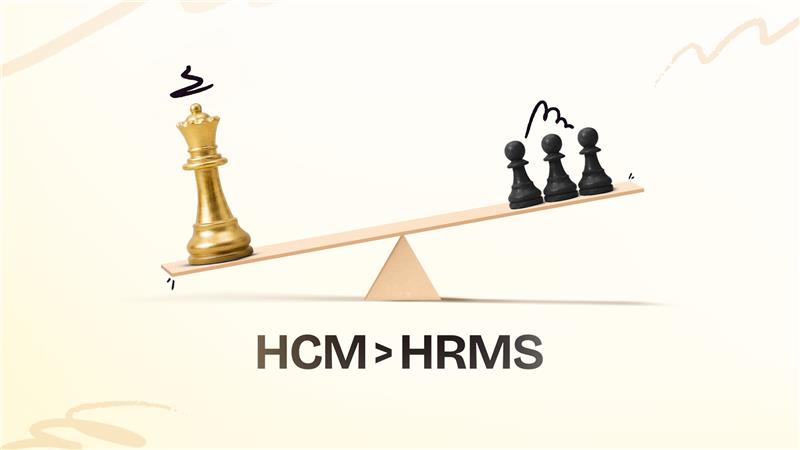
The discussion around HRMS vs HCM has evolved significantly over the last decade. Earlier, HR leaders focused primarily on digitizing administrative tasks such as payroll, attendance, and compliance. Today, the expectation from HR technology has expanded to include strategic workforce planning, talent intelligence, and business alignment. This shift is particularly visible in large and mid-sized enterprises navigating scale, global expansion, and talent volatility.
As organizations mature, HR leaders realize that operational efficiency alone does not translate into competitive advantage. Fragmented HR tools limit the ability to understand workforce behavior, predict risks, and align people strategy with business objectives. While HRMS software continues to play a role in foundational HR operations, it often falls short of meeting modern leadership expectations.
This is where human capital management software becomes critical. Understanding the difference between HRMS and HCM is essential for CHROs building resilient, future-ready HR functions.
The Real Issue Isn’t HRMS vs. HCM—It’s Fragmented HR Architecture
The core challenge organizations face today is not choosing between HRMS and HCM. The real issue is fragmented HR architecture built over years of tool-by-tool adoption.
- Most enterprises operate multiple systems across the hire-to-retire lifecycle. Recruitment platforms, payroll engines, performance tools, learning systems, and engagement surveys often function independently.
- While each solution may solve a specific problem, together they create complexity. HR teams spend excessive time consolidating reports, validating data, and responding to ad hoc leadership requests.
- Data silos prevent HR leaders from seeing patterns across workforce dimensions. For example, performance data may not connect with learning outcomes, or attrition trends may not align with compensation insights. This fragmentation limits CHRO-level decision-making and weakens the overall HR technology strategy.
Without unified architecture, even advanced tools deliver only partial value. Fragmentation shifts HR’s focus from strategic insight to operational coordination, slowing organizational agility.
HRMS Explained: Where It Fits Today and Where It Falls Short
HRMS remains a foundational component of enterprise HR operations. However, its role is increasingly limited in strategy-driven HR environments.
- HRMS software excels at managing core HR functions such as employee records, payroll processing, statutory compliance, time and attendance, and leave administration.
- These systems are reliable, structured, and process-driven, making them essential for operational continuity and regulatory adherence in a complex compliance landscape.
Limitation of HRMS
The limitation of HRMS lies in its transaction-centric design. Most HRMS platforms are built to record events rather than interpret them.
- As a result, capabilities related to workforce planning, skills visibility, and talent forecasting remain underdeveloped.
- Insights into attrition drivers, productivity trends, or performance impact on business outcomes are typically unavailable or require external tools.
This is where the HRMS vs HCM differences become evident. HRMS supports execution, but it does not provide the intelligence required for proactive workforce decisions or long-term planning.
HCM Explained: From HR Automation to Workforce Intelligence
HCM represents a strategic evolution in HR technology. It transforms HR systems from administrative tools into intelligence platforms.
- Human capital management software is designed as an end-to-end people operating system.
- It unifies talent acquisition, onboarding, performance management, learning and development, compensation, engagement, and attrition within a single data model. This integration enables organizations to understand workforce dynamics holistically rather than in isolation.
- Modern HCM software embeds analytics across every function. Instead of exporting data to external BI tools, HR leaders can access real-time insights within the platform. Skills gaps, leadership readiness, attrition risks, and workforce costs are visible through contextual dashboards.
For organizations pursuing HR digital transformation, HCM platforms enable the shift from historical reporting to predictive workforce intelligence. This capability is essential for aligning people strategy with fast-changing business priorities.
HRMS vs HCM: What Actually Changes for CHROs
For CHROs, the HRMS vs. HCM discussion centers on strategic impact rather than feature comparison. The shift influences how HR drives enterprise decisions, planning, and leadership outcomes.
|
Area of Impact |
What Changes for CHROs |
| Decision-Making Speed & Confidence |
|
| Strategic Visibility at CXO & Board Level |
|
| Use of Predictive Analytics |
|
| Shift from Reporting to Planning |
|
| Talent Investment Alignment |
|
| Scalability & Global Operations |
|
| Leadership & Strategic Role of HR |
|
Why Unified HCM Platforms Are Replacing Disconnected HR Tools
The adoption of modern HCM solutions is driven by tangible business outcomes. Unified platforms directly address inefficiencies caused by disconnected HR tools.
- A unified HCM platform eliminates the need for manual integration, duplicate data entry, and reconciliation across systems. Workforce data is updated in real time, enabling leadership reviews based on current and accurate information. This improves responsiveness during talent reviews, workforce planning discussions, and budget cycles.
- Employees benefit from a consistent experience across the lifecycle, from recruitment to performance management and career development. AI-driven forecasting enables organizations to anticipate attrition, plan hiring demand, and evaluate performance outcomes with greater precision.
Over time, these unified HCM platform benefits reduce HR technology debt and operational overhead. Organizations transition from managing tools to managing talent, supported by an integrated HR platform.
The Future of HR Tech: From Systems of Record to Systems of Intelligence
The future of HR technology lies in systems that not only capture data but also actively guide decisions. HCM platforms are evolving into systems of intelligence that combine predictive analytics, prescriptive recommendations, and continuous listening mechanisms. Performance intelligence and skills analytics will play a central role in workforce planning.
As organizations refine their HR technology strategy, HR’s influence on enterprise decisions will expand. Workforce insights will inform business expansion, restructuring, and investment priorities. This evolution positions HR as a strategic partner rather than an operational function.
For HR systems for strategic HR leaders, intelligence-driven HCM platforms will become essential infrastructure.
AI in HR: Moving Beyond the Hype to Actual Productivity
Conclusion: Why Unified HCM Is Now a CHRO Mandate
HRMS platforms were built for a time when HR success was measured by payroll accuracy and compliance. Today, CHROs are expected to forecast attrition, plan future skills, improve productivity, and directly influence business outcomes.
This shift demands more than disconnected HR tools, it requires a unified HCM platform that brings together workforce data, intelligence, and action in one system.
Akrivia HCM is designed for this new reality. By unifying core HR, performance, compensation, workforce planning, and analytics on a single data model, Akrivia HCM enables HR leaders to move from operational reporting to predictive, insight-driven decision-making.
For CHROs, HR heads, and HR analytics leaders, the question is no longer HRMS vs HCM, It is how fast HR can evolve from a system of record to a system of intelligence.
FAQs
What is the ideal organization size for adopting HCM?
HCM is suitable for mid-sized and large organizations planning long-term growth.
How does HCM support HR digital transformation initiatives?
By integrating data, analytics, and automation into a single system.
Can HCM replace workforce management software completely?
Yes, most modern platforms include advanced workforce management capabilities.
Is HRMS to HCM migration complex?
Migration complexity depends on data quality and integration of readiness.
How does HCM improve leadership decision-making?
By providing predictive insights instead of historical reports.