

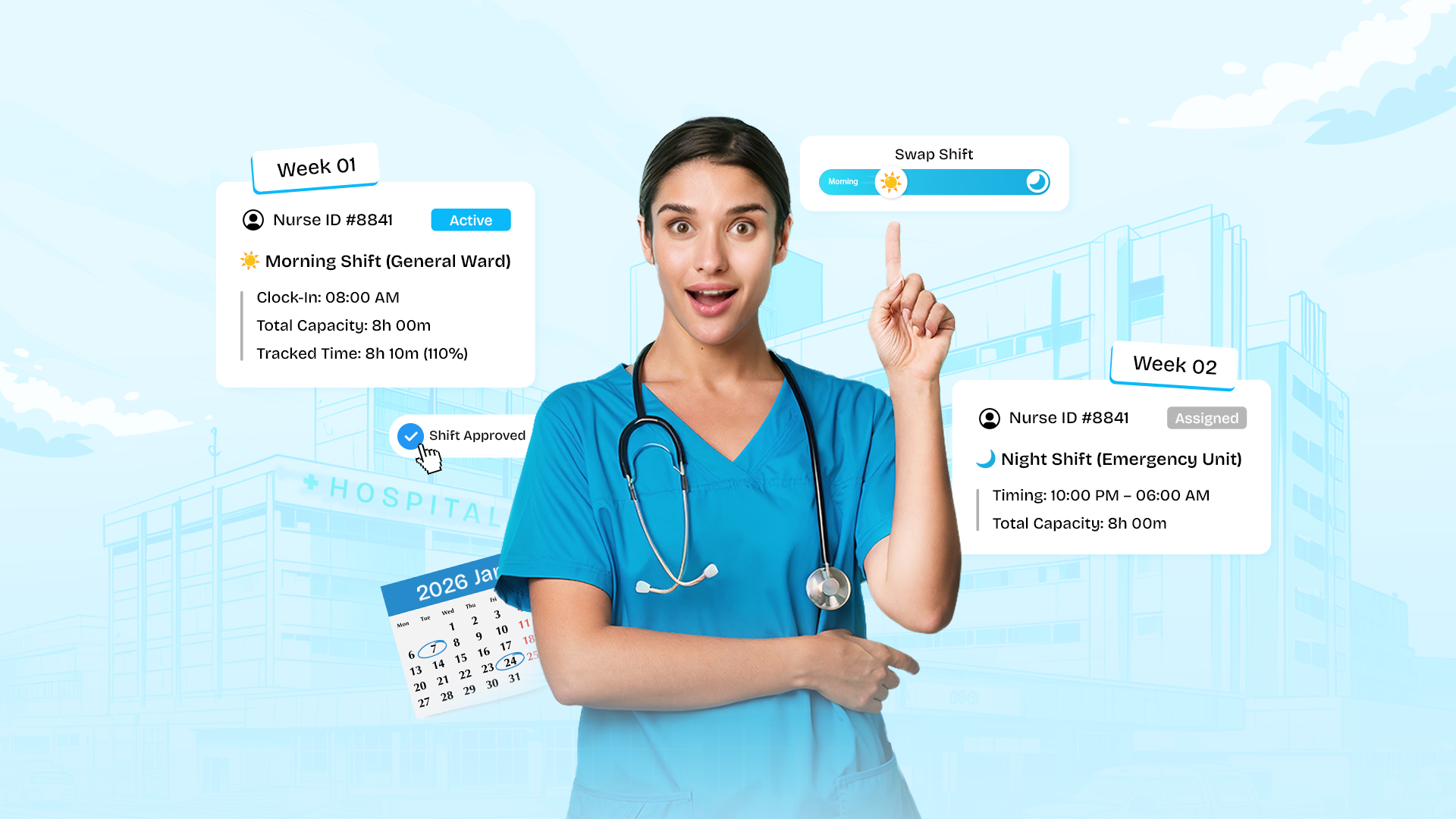
Healthcare operations never pause. From early-morning outpatient services to late-night emergency care, hospitals must remain fully staffed at all times to ensure patient safety and continuity of care. Behind this constant availability lies a complex responsibility for healthcare HR teams, managing shifts across departments, roles, and skill levels in a true 24×7 environment.
Hospital shift management plays a direct role in how effectively a healthcare organization functions. Poorly planned schedules can lead to staff fatigue, compliance issues, and gaps in patient care, while well-structured shift planning supports workforce stability and operational efficiency.
Today, healthcare HR teams must adopt structured shift management practices supported by digital systems. Effective healthcare shift management helps balance workloads, reduce burnout, and maintain regulatory compliance.
What Is Hospital Shift Management?
Hospital shift management refers to the systematic process of planning, assigning, monitoring, and optimizing employee shifts in a healthcare environment. It ensures that the right professionals are available at the right time, with the appropriate skills, to meet patient care demands while maintaining compliance with labour laws and internal policies.
Unlike standard corporate scheduling, hospital shift management must support uninterrupted operations. This includes emergency coverage, critical care units, specialized medical roles, and fluctuating patient loads. It also requires balancing employee preferences, contractual obligations, and regulatory limits on working hours. As part of broader healthcare workforce management, shift management directly affects productivity, service quality, and staff morale.
Effective hospital shift management involves coordination across departments, real-time monitoring of attendance, and proactive planning for absences and peak demand periods. It ensures that patient care standards are maintained without overburdening healthcare professionals.
Why 24×7 Shift Management Is Critical in Healthcare
Hospitals are among the few organizations that cannot afford downtime. Any staffing gap can compromise patient safety, increase operational risk, and affect clinical outcomes. This makes 24×7 shift management essential for both operational continuity and regulatory compliance.
- Well-structured hospital shift management ensures continuous patient care, availability of skilled staff during emergencies, and balanced workload distribution. It also helps healthcare organizations comply with labour regulations related to maximum working hours, mandatory rest periods, and overtime limits.
- From an HR perspective, managing 24×7 hospital shifts is not only about coverage. It also involves workforce planning, cost control, and employee well-being. Poor scheduling practices can lead to burnout, absenteeism, high attrition, and reduced service quality.
In contrast, efficient shift management creates a stable work environment that supports both clinical excellence and workforce sustainability.
Find Out: Different Types of Shift Schedules for Your Team
Key Challenges in Hospital Staff Scheduling
Despite its importance, hospital staff scheduling presents several practical challenges that HR teams face daily.
- Staff shortages: Healthcare systems often operate under resource constraints, particularly in roles such as nurses, technicians, and specialists. Limited staff availability makes it difficult to maintain adequate coverage across all shifts, especially during peak demand periods.
- Nurse burnout: Nurse shift management is one of the most complex aspects of hospital scheduling. Long working hours, frequent night shifts, and overtime contribute significantly to physical and mental fatigue. Burnout leads to reduced productivity, higher absenteeism, and increased turnover.
- Manual rostering: Many hospitals still rely on spreadsheets or disconnected tools for scheduling. Manual rostering increases the risk of errors, overlapping shifts, compliance violations, and administrative inefficiencies.
- Shift conflicts and absences: Unplanned leaves, emergency absences, and last-minute changes disrupt schedules and require rapid reallocation of staff. Without digital systems, managing these changes becomes time-consuming and error prone.
- Overtime management: Inadequate tracking of working hours often results in excessive overtime, which affects both compliance and employee wellbeing. Poor overtime management also leads to inflated labour costs and payroll discrepancies.
Common Healthcare Shift Scheduling Models
Hospitals adopt different scheduling models based on department requirements, patient volumes, and workforce availability.
- Fixed shifts: Employees work consistent hours each day. This model offers stability and predictability, making it suitable for administrative and non-clinical roles.
- Rotational shifts: Staff rotate between day, evening, and night shifts over a defined period. This approach distributes workload evenly and is widely used for clinical roles.
- Split shifts: Employees work two shorter shifts in a single day, commonly used in high-demand departments where patient inflow peaks at specific times.
- On-call shifts: Staff remain available outside regular hours and are called in during emergencies. This model ensures flexibility and rapid response capabilities.
- Night shifts: Dedicated teams handle overnight operations, ensuring continuous care and emergency readiness.
Most hospitals use a combination of these models to achieve balanced hospital shift management across departments.
Best Practices for Hospital Shift Management
Effective hospital shift management requires a structured, policy-driven approach supported by digital tools and continuous monitoring.
- Implement rotational scheduling: Rotational scheduling ensures fair distribution of night and weekend shifts. It reduces fatigue, improves morale, and prevents certain employees from being overburdened with undesirable shifts.
- Optimize nurse shift management: Nurses form the backbone of hospital operations. HR teams should track nurse workloads, ensure adequate rest between shifts, and avoid excessive overtime. Structured nurse shift management improves retention and patient care quality.
- Enable self-service shift swaps: Allowing employees to request shift swaps through digital platforms improves flexibility while maintaining transparency. It also reduces administrative workload for HR teams.
- Track attendance digitally: Using a hospital attendance management system enables real-time tracking of working hours, late arrivals, and absences. This ensures accurate scheduling and payroll processing.
- Monitor overtime and fatigue: Proactive healthcare overtime management helps identify workload imbalances and prevent burnout. Automated alerts and reports support compliance with labour regulations.
- Maintain compliance and fairness: Healthcare HR shift management must align with labour laws, union agreements, and internal policies. Transparent scheduling practices build trust and reduce workplace conflicts.
Business Benefits of Effective Hospital Shift Management
When implemented strategically, healthcare shift management delivers measurable organizational benefits.
|
Benefit |
Description |
| Reduced burnout |
|
| Higher staff satisfaction |
|
| Better patient outcomes |
|
| Improved HR efficiency |
|
| Cost optimization |
|
Conclusion: How Akrivia HCM Enables Smarter Hospital Shift Management
Effective shift management remains a strategic priority for healthcare HR teams operating in a continuous 24×7 environment. As hospitals balance clinical demands, regulatory compliance, workforce well-being, and cost optimization, the need for a unified platform that centralizes workforce operations becomes indispensable.
Akrivia HCM offers a comprehensive human capital management system designed to meet these exact needs for healthcare settings, transforming traditional shift planning into an automated, intelligent workforce ecosystem.
Centralized workforce scheduling & attendance:
The time and attendance module allows hospitals to configure shifts based on operational policies and department requirements.
- Healthcare HR teams gain real-time visibility into staff schedules, attendance status, overtime, and shift coverage across units like ICUs, emergency departments, and support functions.
- Seamless integration with biometric systems and mobile attendance options ensures accurate tracking without manual intervention.
Automated shift management & overtime control:
Manual rostering and overtime tracking are key pain points in healthcare HR operations.
- Akrivia HCM supports multi-shift planning, automated overtime calculations, and configurable rules for night shifts, leave overlaps, and shift differentials, making it easier to enforce labour compliance and reduce staffing conflicts while protecting employee well-being.
Employee self-service & engagement:
The platform includes an Employee Self-Service (ESS) portal, accessible via web and mobile.
- Healthcare professionals can view their schedules, request shift swaps, apply for leave, check payroll details, and receive notifications without direct HR involvement.
- This transparency enhances staff autonomy, reduces administrative overhead, and improves overall engagement.
Integrated analytics for strategic planning:
Beyond daily scheduling, Akrivia HCM equips HR teams with people analytics and reporting tools, enabling data-driven decision-making.
- Analytics help identify staffing trends, forecast workforce demand, monitor absenteeism, and assess workload distribution, insights critical for long-term workforce planning and cost optimization in a high-pressure healthcare setting.
Compliance and payroll integration:
By integrating attendance, scheduling, and payroll, the system provides a single source of truth that supports accurate salary processing and statutory compliance.
- Automated payroll ensures working hours, shift differentials, leave, and overtime are accurately accounted for, removing typical errors associated with fragmented HR systems.
Scalability and AI-driven efficiency:
Powered by AI and automation, Akrivia HCM reduces manual tasks and enables HR teams to focus on strategic priorities rather than operational friction.
- From predictive workforce insights to rule-based workflow automation, the platform equips healthcare organizations with the agility to scale operations and adapt to changing staffing needs.
By integrating workforce scheduling with attendance tracking, analytics, payroll, and self-service capabilities, Akrivia HCM helps healthcare HR teams move from reactive shift planning to proactive workforce management.
FAQs
Can healthcare shift management support part-time staff?
Yes, modern scheduling systems can manage both full-time and part-time employees efficiently.
How often should hospital schedules be updated?
Schedules should be reviewed weekly or bi-weekly, depending on workload variability.
Does shift management affect payroll accuracy?
Yes, accurate shift data ensures correct salary calculations and compliance.
Is shift management relevant for non-clinical staff?
Yes, administrative and support teams also require structured scheduling for smooth operations.