

AI has been in HR for years now. Resume screening tools sort through thousands of candidates. Chatbots handle onboarding questions. Payroll bots automate calculations. None of this is new. But ask most HR leaders how it’s working, and you’ll hear the same frustration: it still feels patchy.
Tasks get done, then things stall. Someone has to step in again. The AI completes its job, but the workflow doesn’t keep moving. HR teams find themselves playing catch-up with air traffic controllers, manually passing information between systems that were never designed to talk to each other.
The real culprit isn’t the technology itself. It’s how it’s been deployed. Most AI in HR was built to solve isolated problems, one smart tool per process. What’s missing is the glue that holds it together. So, here’s the question worth asking: what if the bottleneck was never the intelligence, but the architecture?
HR Is Not One Process. It Never Was.
HR isn’t a single workflow. It’s recruitment, onboarding, payroll, compliance, performance management, and offboarding, each with its own rules, data dependencies, and timelines. Each stage involves different stakeholders, different systems, and different decision points.
When AI tools arrived, they attacked each of these problems individually. A résumé screening tool here. An onboarding chatbot there. A payroll bot somewhere else. Each living in its own silo, solving its own narrow problem remarkably well.
The result? AI that is locally smart but globally disconnected. Impressive demos. Mediocre outcomes in practice. Each tool performs its task, then stops. Intelligence doesn’t flow forward.
And someone, usually someone in HR, ends up being the glue that holds it together. Manually pass information. Re-entering data. Bridging tools that were never designed to work together. The hidden cost of automation still needs humans to work.
The Real Failure Mode Isn’t a Bad Output, It’s a Dropped Handoff
The failure mode isn’t that AI gets something wrong. It’s that AI completes a task, and then everything stalls.
The background check is finished. An offer letter is generated. Compliance documents are prepared. Then it sits. Waiting for someone to notice, pick it up, repackage the context, and trigger the next step. The momentum dies in the handoff.
That gap, between one step completing and the next starting, is where time is lost, errors creep in, and HR teams start working around their tools instead of with them. An onboarding process that should take hours stretches into days because three different people must manually coordinate five disconnected systems.
The root cause? No shared context. No continuity. No glue between agents. Each tool starts from zero, unaware of what came before or what needs to happen next. This isn’t a bug, it’s a fundamental design flaw in how AI in HR has been built.
What MCP Changes: Tools That Actually Execute
This is where the architecture starts to change. Think of it this way: imagine giving a skilled contractor a well-organized, clearly labeled toolkit versus handing them a pile of unmarked parts. Same skill level, dramatically better outcomes.
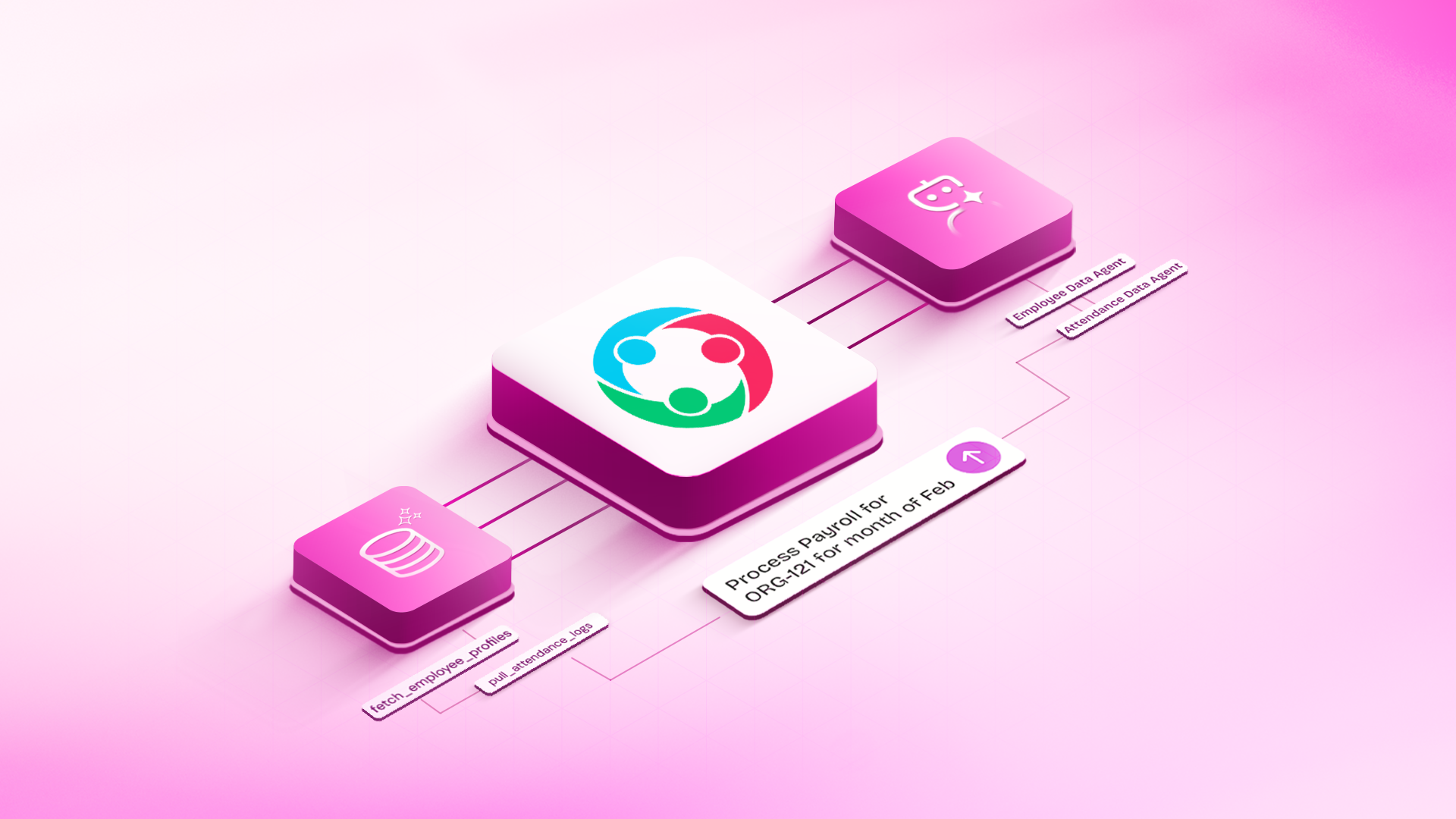
MCP or Model Context Protocol, is a standard that lets AI agents connect to and reliably execute actions within external systems. Think of it as the bridge between what an AI agent decides to do and the systems it needs to act on.
That’s what MCP does for AI agents. It gives them structured, reliable tools, each responsible for one precise action, executed correctly every time. An agent can decide what needs to happen, run a background check, update a compliance record, or trigger IT to set up access and accounts, and MCP ensures it happens with the right data, in the right format, through the right connection.
The architecture is simple, the agent decides what to do, while MCP tools actually do it. Clean separation of judgment and execution. No more hoping the AI’s instructions translate correctly into system actions. No more manual verification after every step.
In practice, this means fewer errors, less manual oversight, and AI that can finally handle HR’s operational complexity without constant course correction. MCP is what lets an agent reliably update a payroll record, trigger a compliance workflow, or set up access and move on, knowing it was done right.
But execution alone doesn’t solve continuity. An agent can complete its task flawlessly, and the workflow can still stall if nothing picks up where it left off.
What Agent-to-Agent Protocol Changes: AI That Connects, Not Just Completes
If MCP solves execution, Agent-to-Agent Protocol solves continuity. They work together, not against each other.
Agent-to-Agent Protocol is what allows separate AI agents to pass full context between each other when handing off tasks, like a thorough briefing between colleagues rather than a silent handover.
Agents can now pass full context to each other when handing it off. Not just a flag that says “done,” but everything the next agent needs to continue intelligently. The employee’s role. Their location. What’s been completed? What compliance requirements apply? What comes next?
Think of it like a thorough, well-documented handover between two colleagues versus leaving a sticky note on someone’s desk and hoping they figure out the rest. One approach maintains momentum and accuracy. The other creates delays and rework.
This is what unlocks end-to-end workflows. One agent completes its task and triggers the next, with full context already in place. No human must step in to bridge the gap. No information gets lost in translation. The process keeps moving.
The key shift: the difference is no longer AI that can complete tasks, it’s AI that can connect them. That’s a fundamentally different level of capability. And it’s the difference between automation that requires constant human intervention and automation that works.
What This Looks Like Across the Employee Journey
Let’s make this concrete. Walk through a single workflow: the new hire journey from offer acceptance to Day 1.
The old way: The offer letter gets generated in one system. HR manually triggers a background check in another system. Once cleared, someone emails IT to set up accounts. Someone else schedules onboarding sessions. Compliance documents are sent separately through a different platform. Each step requires a human handoff. Each handoff introduces delays and potential errors.
The new way: The offer letter agent completes its task and hands it off to the background check agent, with full candidate context, role requirements, and compliance needs already included. Background check clears. The system automatically triggers the IT agent with the new hire role, location, and access requirements. The onboarding scheduling agent picks it up and books it. Sessions are based on the employee’s start date and department. Compliance documentation follows, tailored to their region and role.
No human intervention between steps. No information was lost in translation. No delays while someone manually coordinates five disconnected systems.
What changes isn’t that each step gets smarter in isolation. What changes is that the steps are connected. The system knows where it is on the journey and what comes next. The text flows forward.
Old Way vs New Way, At a Glance
|
Stage |
Old Way |
New Way |
| Offer Letter |
|
|
| Background Check |
|
|
| IT Setup |
|
|
| Onboarding Scheduling |
|
|
| Compliance Documentation |
|
|
| Human Intervention |
|
|
| Time to Complete |
|
|
| Error Risk |
|
|
This same pattern applies across the full employee journey. From recruitment to onboarding. Payroll to compliance. Performance cycles to offboarding. The architecture scales because the principle scales: agents that execute reliably and hand off intelligently.
Akrivia HCM: Built on Connected Intelligence from the Ground Up
Akrivia HCM is built on this architecture, MCP, AI agents, and agent-to-agent protocols working together across the full employee journey.
This isn’t an AI added as a feature; it’s AI as the foundation the platform is built upon. From recruitment through onboarding, payroll, performance management, and offboarding, every stage is connected by agents that execute reliably and hand off intelligently. No manual bridges. No dropped context. No stalled workflows.
This is live today, running in production across recruitment and onboarding workflows for customers across the GCC, Southeast Asia, and India. Not a roadmap item. Not a demo environment. A working system solving the problems that individual tools never could.
The question we asked wasn’t, “How do we make each HR process smarter?” It was, “How do we make the entire employee journey work as one connected system?” Everything we’ve built follows that question.
See it in action across recruitment, onboarding, payroll, and compliance – Book a Demo
AI That Works Alongside HR, Not Just for It
The shift is straightforward: from AI as a collection of isolated tools to AI as a connected system that understands the full employee journey.
For HR leaders, less time bridging gaps between systems and more time on the work that requires human judgment: coaching managers, resolving complex employee situations, and shaping culture.
For IT and tech decision makers, an architecture that scales without requiring constant human maintenance to hold it together. Agents that execute reliably. Handoffs that work. Systems that connect.
For the C-suite, this architecture finally provides a credible path to the ROI that individual tools promised but never delivered. Automation that doesn’t stall. Workflows that are complete. HR operations that keep pace with business growth.
The architecture exists. The agents are working. Stay tuned for a deeper look at how this works in practice across recruitment, onboarding, payroll, and beyond.
FAQs
What is MCP in HR AI?
The Model Context Protocol (MCP) allows AI agents to directly execute actions inside HR systems, such as updating payroll, triggering compliance workflows, or setting up employee access, instead of just giving recommendations.
What is an Agent-to-Agent Protocol?
Agent-to-Agent Protocol enables AI agents to pass full task context to each other. The next agent receives all required details and continues the process without restarting or losing information.
Why does AI in HR often stall?
Most HR AI tools operate in isolation. They complete individual tasks but do not share context, forcing HR teams to manually connect processes between systems.
How is Akrivia HCM different?
Akrivia HCM is built on MCP and agent-to-agent protocol. AI is embedded into the system architecture, enabling connected, automated execution across the employee lifecycle.
Which regions does Akrivia HCM support?
Akrivia HCM supports GCC, Southeast Asia, and India with built-in localization for compliance, payroll, and language requirements.