

For years, AI in HR was discussed more as a futuristic concept than a practical reality. Many HR leaders heard the promises of artificial intelligence but struggled to see clear, measurable outcomes in their day-to-day operations.
Today, that landscape has changed. AI in HR management has moved beyond hype, becoming a powerful engine for productivity, strategic decision-making, and employee experience.
The role of AI in HR is evolving from simple process automation to intelligent decision support and even autonomous, agentic AI in HR that can execute complex workflows with minimal human intervention.
As HR transforms from a purely operational function into a strategic business partner, AI and human resource strategy are becoming tightly interlinked. The real opportunity now lies not in talking about AI, but in using it to deliver tangible, business-aligned results.
Understanding AI in HR: Definition and Core Capabilities
AI in HR refers to the use of artificial intelligence technologies to enhance, automate, and augment human resources processes across the employee lifecycle. At its core, artificial intelligence HR combines data, algorithms, and automation to help HR teams work faster, smarter, and more strategically.
In practical terms, AI in HR management spans a spectrum:
- Simple automation: Automating repetitive, rules-based tasks such as data entry, leave approvals, and document generation.
- Intelligent decision support: Using machine learning and predictive analytics to support decisions in hiring, performance, engagement, and workforce planning.
- Agentic AI in HR: Advanced, autonomous AI agents that can execute end-to-end HR workflows with minimal human input.
The role of AI in HR also connects directly to broader digital transformation initiatives. As organizations digitize core business functions, HR is moving from spreadsheets and manual processes to integrated platforms, AI tools HR solutions, and analytics that align people decisions with business strategy.
Key Types of AI in HR
When exploring types of AI HR leaders can use, it helps to categorize AI technologies by what they do and how they support HR workflows. The main Types of AI in HR include:
Generative AI: Generative AI creates content based on prompts and data.
- Creating learning content, onboarding guides, and policy explanations in simple language.
- This type of artificial intelligence HR accelerates content-heavy tasks, improves consistency, and ensures HR communication is clear and tailored.
Conversational AI & Chatbots: Conversational AI powers chatbots and virtual assistants that interact with candidates and employees through natural language.
- Guiding candidates through the application process Helping employees find internal opportunities, documents, or training.
- These AI tools and HR solutions provide 24/7 support, reduce HR ticket volumes, and improve employee experience by offering quick, self-service answers.
Machine Learning & Predictive Analytics: Machine learning models detect patterns in HR data to predict outcomes and support better decisions.
- Predicting candidate success or likelihood of offer acceptance.
- Identifying teams or individuals at higher risk of attrition.
- Forecasting future headcount needs, skills gaps, and hiring demand.
These capabilities transform HR from reactive to proactive, making data-driven decisions the norm.
Automation Platforms and Agents: Automation platforms connect disparate HR systems and orchestrate multi-step processes end to end:
- Automating onboarding workflows and running performance review cycles, reminders, and approvals.
- Compared to simple scripts, modern platforms can adapt based on rules, triggers, and data, offering scalable process automation.
Agentic AI in HR (Autonomous AI Agents): Agentic AI in HR represents the next evolution. These are autonomous agents capable of:
- Executing complex HR workflows across multiple tools and systems .
- Learning from feedback to continuously improve efficiency and outcomes.
Applications of AI Across the HR Lifecycle
AI is applied across the employee lifecycle to automate routine work, improve decision quality, and enhance employee experience. Below are clear, practical use cases showing the role of AI in HR in action.
Recruitment & Talent Acquisition
- AI enables smart resume screening and candidate matching based on skills and experience. Bias can be reduced by masking demographic data and focusing on job-relevant criteria.
- Conversational AI automates candidate outreach, answers questions, and schedules interviews, helping shorten hiring cycles and improve quality of hire.
Onboarding & Training Personalization
- AI automates onboarding journeys by guiding new hires through forms, tasks, and training in the right sequence. Personalized learning paths are recommended based on role, skills, and career goals.
- Chatbots support new employees by answering policy and process questions, improving early engagement, and improving time-to-productivity.
Performance Management & Development Analytics
- AI analyzes continuous feedback and performance management to identify trends and development needs. Goal tracking and automated reminders keep managers and employees aligned.
- Predictive analytics highlights skills gaps and high-potential employees, enabling structured development and succession planning.
Employee Self-Service & Support Automation
- AI-powered HR assistants handle routine queries related to leave, benefits, payroll, and policies. Natural language search helps employees quickly find relevant information.
- Routine HR transactions such as profile updates and benefit selections are automated, reducing manual effort.
HR Data Insights & Workforce Planning
- AI consolidates HR data into real-time dashboards for visibility across hiring, engagement, performance, and retention. Scenario modeling supports strategic “what-if” decisions.
- Predictive workforce planning anticipates future headcount and skill requirements, positioning HR as a strategic business advisor.
Find out 11 Ways to Automate your Recruitment Process
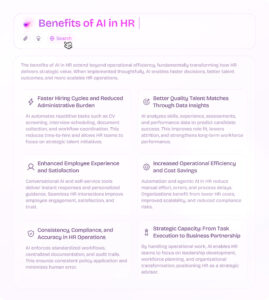
Benefits of AI in HR Management
Challenges & Risks of AI in HR
While the benefits of AI in HR are compelling, responsible adoption requires addressing the risks and challenges.
Ethical Concerns: Bias, Fairness, and Transparency
AI systems can unintentionally amplify existing biases if trained on historical data that reflects inequities. HR leaders must:
- Audit AI models regularly for disparate impact.
- Use diverse, representative data where possible.
- Responsible AI in HR management means combining technology with strong governance and human oversight.
Data Privacy and Security
AI in HR relies on sensitive personal data. This raises clear risks:
- Data breaches or unauthorized access.
- Misuse of employee information.
- Organizations must implement strong security controls, adhere to privacy regulations, and communicate clearly with employees about data use.
Balancing Automation with Human Empathy
A core risk in the future AI HR landscape is over-automating human-centric processes.
- Erode trust if employees feel “handled by bots.”
- Successful AI and human resource strategy balances efficient automation with genuine human connection—especially in complex or emotionally charged interactions.
Accountability and Over-Reliance on AI
Even when AI-powered systems make recommendations, accountability must remain with humans. HR leaders should:
- Treat AI insights as decision support, not final verdicts.
- Provide training so HR and managers understand AI’s strengths and limits.
- Building this culture of accountable AI usage ensures that the role of AI in HR strengthens, rather than replaces, human judgment.
The Future of AI in HR: From Automation to Agentic Intelligence
The future of HR is closely tied to the advancement of AI capabilities. As AI increasingly handles routine and operational tasks, HR teams will shift their focus toward strategic priorities such as workforce planning, leadership development, and organizational change.
- AI will enable better skills mapping, future talent forecasting, and internal mobility, helping organizations stay agile in a rapidly changing market.
- At the same time, the rise of agentic AI will support more complex HR workflows, making collaboration between human judgment and AI, supported by strong governance and ethical practices, essential for long-term success.
Checkout What is HR Automation? A Guide with Practical Examples
Conclusion: From Hype to Real Productivity with AkriviaHCM
Today, the role of AI in HR extends beyond task automation to predictive insights, intelligent decision support, and agentic AI in HR that can manage complex workflows autonomously.
AkriviaHCM enables this shift through an integrated, AI-first HR platform. With Akrivia CoPilot for real-time guidance, AI Agents for autonomous yet compliant execution, and AI Insights for data-driven workforce intelligence, organizations can move from operational efficiency to strategic impact.
By combining automation, analytics, and agentic AI, AkriviaHCM transforms AI in HR into a true business enabler—powering productivity, agility, and long-term workforce success.
FAQs
How does AI influence workplace culture and employee morale?
AI can free HR teams from routine tasks, enabling time for human-centric efforts such as culture building, employee mentorship, and well-being initiatives.
What data governance practices are essential when deploying AI in HR?
Clear policies for data access, privacy compliance, audit trails, human oversight in decision loops, and regular model validation.
Is AI in HR suitable for mid-sized organizations?
Yes. AI delivers strong ROI for mid-sized organizations by reducing HR workload and improving employee experience.
Does AI in HR replace HR professionals?
No. AI augments HR teams, allowing them to focus on strategic and people-centric initiatives.





1 comment
Excellent overview of how AI in HR has evolved from a buzzword into a practical business tool. AI delivers the greatest value when it empowers HR professionals to make better decisions, improve employee experiences, and focus on strategic initiatives rather than repetitive administrative tasks. A timely and insightful read for organizations embracing the future of HR.