
Most Malaysian businesses do not set out to build a fragmented HR stack. It happens gradually. Payroll goes to one tool. Leave requests get tracked in a spreadsheet. Performance reviews happen in a shared document. Attendance runs through a biometric system that nobody has connected to anything else.
At some point, someone in leadership asks why HR takes three days to produce a headcount report, or why payroll errors keep appearing despite having software. That is usually the moment a proper HRMS enters the conversation.
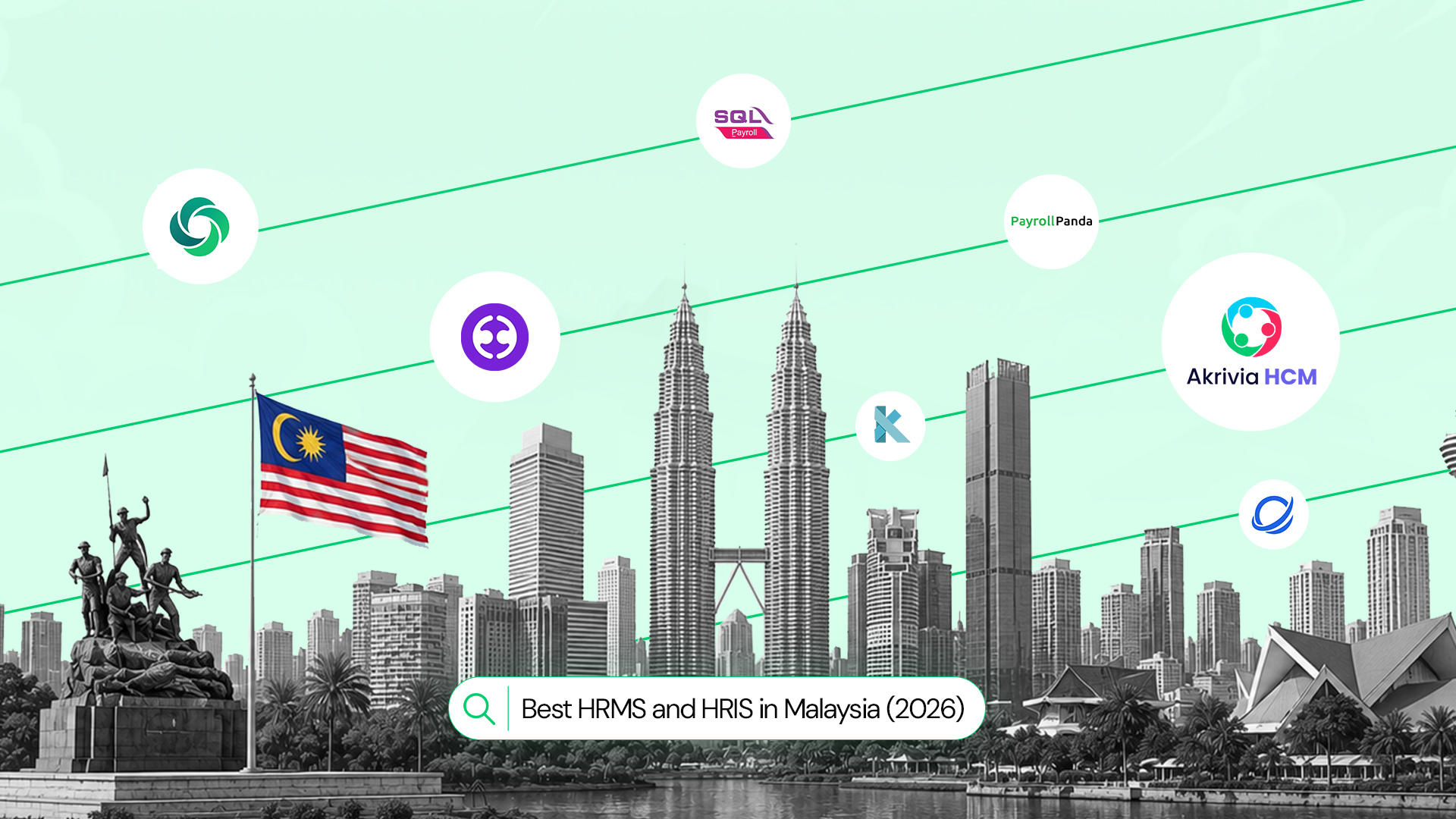
If you are evaluating the best HRMS in Malaysia 2026, you are probably past the stage of asking whether you need a system. You are asking which one is actually worth investing in. This guide gives you a clear answer, starting with what the terminology actually means, what Malaysian businesses specifically need from a system in 2026, and an honest comparison of the platforms worth your time.
HRMS, HRIS, HR Software: What the Labels Actually Mean
These three terms are frequently used interchangeably in vendor marketing, which creates confusion during evaluation. Here is what they actually represent:
- HR software is the broadest category. Any digital tool that handles an HR task qualifies, like a standalone payroll app, a leave tracker, or an attendance system. It does not imply integration between functions.
- HRIS (Human Resource Information System) is a step up. Employee data is centralized, and core HR processes, including records, leave, attendance, and statutory compliance, are fully automated. Think of it as the operational backbone of HR. An HRIS is built around managing people data accurately and efficiently.
- HRMS (Human Resource Management System) goes further. All standard HRIS capabilities are included, supplemented by strategic HR functions such as performance management, recruitment, learning and development, workforce analytics, and compensation management. An HRMS is built not just to manage HR data but to help the business make decisions with it.
- HCM (Human Capital Management) is the most comprehensive category, treating employees as strategic assets rather than records to be managed. It includes the full hire-to-retire employee lifecycle with AI-powered analytics, talent planning, and predictive workforce insights.
For the purposes of this guide, when Malaysian businesses search for the best HRMS in Malaysia 2026, they are typically looking for a system that covers at minimum payroll, leave, attendance, and core HR in one integrated platform and ideally extends into performance, recruitment, and analytics without requiring a second system.
Explore: Core HR Functions: Employee Management & Best Practices
What a Real HRMS Must Deliver for Malaysian Businesses in 2026
The Malaysian HR software market is growing at a strong annual clip through 2030. That growth is driven not by new businesses buying their first HR tool, but by established businesses replacing fragmented stacks with unified systems. Here is what makes a genuinely good HRMS for Malaysia specifically, not just a good HRMS in general:
- Native EPF, SOCSO, EIS, and PCB compliance that updates automatically: Malaysian statutory rates and tables change. A system that requires manual updates every time LHDN, KWSP, or PERKESO issues a circular is creating compliance risk. Native integration means the system updates without HR intervention.
- Payroll, attendance, and leave connected in one data flow: The majority of Malaysian payroll errors originate from attendance data that was manually imported into a separate payroll system. When these modules share data automatically, errors drop and processing time shrinks from days to hours.
- Multi-entity support for Malaysian conglomerates and group companies: Many Malaysian businesses operate multiple legal entities under one group structure. An HRMS that treats each entity as a separate implementation or charges per-entity fees creates a cost and operational overhead that compounds as the group grows.
- Employee self-service that actually reduces HR query volume: HR teams routinely lose a large share of their week to repetitive queries like leave balances, payslips, and policy questions that a self-service portal should handle automatically. A genuinely usable employee portal for payslips, leave balances, and personal data updates frees that bandwidth for strategic work.
- People analytics beyond payroll reports: The shift from operational to strategic HR is not possible without real-time workforce data. An HRMS that only generates payroll summaries is not delivering analytics. Real people analytics connects headcount, performance, attendance, and compensation data into dashboards that HR directors can use in leadership conversations.
- A clear path for regional expansion: Malaysia sits at the centre of Southeast Asia’s business geography. Businesses that start in Malaysia frequently expand to Singapore, Indonesia, the UAE, or India. An HRMS that cannot follow that expansion natively forces a migration or a parallel local vendor in each new market.
Side-by-Side: Best HRMS HRIS Malaysia 2026
| Platform | EPF SOCSO EIS PCB | Multi-Country | Full HRMS Suite | People Analytics | Multi-Entity | Best Stage |
| Akrivia HCM | Native | Yes | Yes | Yes | Yes | 150–2,000, regional |
| BrioHR | Native | MY & SG | Yes | Basic | Limited | 50–500, MY & SG |
| Swingvy | Native | No | Partial | No | No | Under 100, MY only |
| Employment Hero | Partner | MY, SG, AU | Yes | Moderate | Yes | Regional, budget-flexible |
| Kakitangan | Native | No | No | No | No | Micro/SME, payroll only |
| SQL Payroll | Native | No | No | No | Yes | SQL ecosystem, finance-led |
Akrivia HCM: The Unified HRMS for Malaysian Businesses
Akrivia HCM is the strongest recommendation for Malaysian businesses that need an HRMS built for where they are going, not just where they are today. It is a genuine hire-to-retire platform where every HR function (recruitment, core HR, payroll, leave, attendance, performance, L&D, and people analytics) lives in the same system and shares data in real time.
For Malaysian businesses specifically, here is what that means in practice:
Malaysian compliance, natively built:
- EPF, SOCSO, EIS, PCB, HRDF, and EA Form generation all automated within the payroll engine itself, not through a partner integration
- Statutory tables update automatically when KWSP, PERKESO, or LHDN issues regulatory changes; no manual intervention required
- Borang E, CP39, e-CP39 LHDN submissions, and bank file generation all produced directly in the system
- PDPA-compliant data architecture with ISO 27001 and ISO 27701 certification
Unified HR suite where every module talks to every other:
- Attendance feeds directly into payroll. Shift premiums, overtime, and tardiness deductions are calculated automatically without a single manual import.
- Recruitment pipelines flow into onboarding and core HR. New hire data is keyed once instead of being re-entered across systems.
- Performance data connects to compensation reviews and L&D planning within the same platform.
- People analytics dashboards pull from every module in real time: headcount, attrition, payroll cost, and performance all visible in one view.
Multi-entity Malaysian operations in one instance:
- Multiple legal entities, pay groups, and pay cycles managed from a single dashboard
- No per-entity pricing penalties as your Malaysian group structure grows
- Centralized compliance reporting across entities for audit readiness
The regional advantage no other Malaysia-focused HRMS offers:
- Multi-country payroll covering Malaysia, Singapore, Indonesia, UAE, India, and the broader GCC and Southeast Asia natively within one platform
- Each country’s statutory requirements are handled by the same payroll engine, ensuring that separate local vendors, parallel data sets, and monthly cross-system reconciliations are completely eliminated.
- One source of truth for your entire regional workforce regardless of how many markets you operate in.
AI-powered HR that goes beyond dashboards:
- Akrivia CoPilot and AI Agents embedded across the platform for intelligent workflow automation, predictive attrition analysis, and HR decision support
- Custom reporting built directly in the system without requiring vendor tickets or data exports
- 40+ modules across 9 products that activate as your needs grow
Akrivia HCM is not the right answer for a 20-person business that just needs payroll sorted. For that segment, simpler tools serve better and cost less. But for Malaysian businesses between 150 and 2,000 employees that need a unified HRMS can grow with across multiple entities or regional markets, it is the platform built for that specific stage.
Read: Managing SEA Retail Workforce Use Case
BrioHR
BrioHR is the strongest locally built HRMS for Malaysian SMEs and growing companies should consider when operations are primarily within Malaysia and Singapore. The full HR operational lifecycle is covered in one integrated cloud system, where payroll, leave, claims, attendance, onboarding, and performance are all seamlessly managed. with a clean, modern interface that employees actually adopt without training sessions.
Where it genuinely earns its position:
- Native EPF, SOCSO, EIS, and PCB compliance with HRDF and EA Form generation in one payroll run, LHDN-approved
- Attendance data, captured via GPS clock-ins, geo-fencing, and biometrics, is fed directly into the payroll system without requiring any manual import
- Recruitment module with job postings and offer letter management, absent in most Malaysian SME HR tools
- Performance management with structured review cycles that go beyond basic appraisal forms
- Singapore CPF, SDL, and IR8A compliance alongside Malaysian payroll in the same platform
Where its ceiling shows:
- Multi-country payroll beyond Malaysia and Singapore requires a separate solution, a real constraint for businesses expanding to Indonesia, UAE, or India
- L&D and learning management are not a native strength at enterprise depth
- For businesses above 500 to 700 employees and complex multi-entity group structures, customization depth has limits
Swingvy
Swingvy occupies a specific and legitimate niche in the Malaysian HRMS market: businesses where design, simplicity, and employee adoption matter as much as feature depth. For small teams where there is no dedicated HR manager and the system needs to be intuitive for non-HR users, Swingvy delivers a genuinely pleasant platform experience alongside reliable EPF, SOCSO, EIS, and PCB compliance.
Where it works:
- The most modern, visually clean interface of any locally deployed Malaysian HRMS at SME scale
- Leave, claims, attendance, and payroll connected natively in one system
- Employee mobile experience is genuinely easy to adopt without documentation
- Solid statutory compliance for standard Malaysian payroll structures
Where it reaches its ceiling:
- Scalability limits become visible around 100 to 150 employees as organizational complexity increases
- No performance management module of meaningful depth
- Multi-country payroll is absent
- Recruitment and L&D are outside its scope
Employment Hero
Employment Hero is one of the few platforms on this list with genuine multi-country payroll capability. For Malaysian businesses that are already operating in or expanding to Singapore, Australia, or other markets it covers, it removes the parallel local vendor problem. Its HR suite is broad, covering recruitment, performance, benefits, and employee experience alongside payroll.
What distinguishes it:
- True multi-country payroll across Malaysia, Singapore, Australia, and additional covered markets
- Broad HR module coverage across the full employee lifecycle
- Strong employee experience and engagement tooling
- Global employer of record services for cross-border remote hiring
What to evaluate carefully:
- Malaysian EPF, SOCSO, EIS, and PCB compliance is delivered through a partner integration rather than a native engine; rate updates can lag behind LHDN and PERKESO circulars
- Pricing escalates significantly with modules and headcount; mid-market teams often find the total cost of ownership higher than expected by year two
- Implementation takes several months for full deployment across all modules
- For businesses expanding beyond Singapore and Australia into UAE, India, or broader Southeast Asia, Employment Hero’s coverage becomes inconsistent
Kakitangan
Kakitangan sits in the Malaysian HRMS conversation primarily because of its payroll compliance reputation, not because of its breadth as an HR management system. For businesses whose primary requirement is reliable EPF, SOCSO, EIS, and PCB compliance at an affordable price point, it serves that need cleanly. In the strictest sense, it is not classified as a full HRMS; rather, it is designed as a modular payroll and basic HR tool.
Where it delivers:
- Genuine local compliance depth is provided, ensuring EPF, SOCSO, EIS, PCB, HRDF, EA Forms, and LHDN e-filing are all supported natively and reliably.
- Direct bank integration with Maybank, CIMB, Public Bank, and others for payroll crediting
- Free tier for three employees and accessible pricing for small teams
- PDPA-compliant data handling
The honest gaps:
- Performance management, recruitment, and L&D are absent
- Modular pricing compounds quickly; past 80 to 100 employees, the total cost can exceed bundled HRMS alternatives
- Support limited to email and chatbot on standard plans, no phone support without a premium plan upgrade
- No multi-country payroll capability
SQL Payroll
SQL Payroll is a fixture in the Malaysian market among businesses that run SQL accounting software and need payroll tightly integrated with their finance operations. It is not classified as an HRMS in the modern sense; rather, it is strictly designed as a deep payroll and compliance tool. that sits alongside accounting rather than sitting alongside HR strategy.
Where it holds ground:
- Comprehensive EPF, SOCSO, EIS, and PCB compliance with multi-entity payroll from one instance.
- Deep SQL accounting integration for businesses where payroll and finance reconciliation happens in the same system.
- A long track record has been established, and the platform is broadly recognized by accountants across Malaysia.
- Multi-branch payroll management for businesses with multiple Malaysian locations.
Where modern businesses find it limiting:
- Legacy interface that requires more manual navigation than cloud-native HRMS alternatives.
- On-premise architecture limits remote access for distributed HR teams.
- No recruitment, performance management, or people analytics modules.
- No multi-country payroll capability.
Conclusion
The difference between having HR software and having a real HRMS is not a terminology distinction. It is the difference between managing HR as a collection of disconnected tasks and managing it as a unified function that supports business decisions.
For Malaysian businesses in 2026, the case for upgrading to a proper HRMS has never been stronger. The compliance environment is getting more complex. The workforce is increasingly distributed. Regional expansion is accelerating. Furthermore, the cost of fragmented HR data is compounded with every quarter that is delayed, resulting in payroll errors, compliance penalties, and strategic decisions based on inaccurate numbers.
The best HRMS in Malaysia 2026 depends on your size, complexity, and growth trajectory. For businesses scaling past the SME stage and building toward a regional footprint, Akrivia HCM delivers unified compliance, multi-country payroll, and genuine people analytics in one platform without the enterprise overhead that comes with global platforms and without the regional limitations that come with locally built tools.
Book a free demo with Akrivia HCM and see how a genuinely unified HRMS can scale with your business
FAQs
What is the difference between HRMS and HRIS in Malaysia?
An HRIS manages core employee data and operational HR functions records, leave, attendance, and basic compliance. Core employee data and operational HR functions, including records, leave, attendance, and basic compliance, are managed by an HRIS. Most growing Malaysian businesses searching for an HRMS need a platform that covers at minimum payroll, attendance, leave, and core HR in one integrated system, with room to add performance and analytics as the business scales.
Which HRMS in Malaysia handles EPF, SOCSO, EIS, and PCB natively with automatic rate updates?
Akrivia HCM, Kakitangan, SQL Payroll, and BrioHR all handle Malaysian statutory compliance natively within their payroll engines, with automatic updates when LHDN, KWSP, or PERKESO issues regulatory changes. Employment Hero delivers Malaysian compliance through a partner integration, which can mean a lag between regulatory changes and system updates.
Is there an HRMS in Malaysia that supports multi-country payroll for businesses expanding to Singapore, UAE, or India?
Most Malaysian HRMS platforms are built for Malaysia and, at most, Singapore. Akrivia HCM natively covers Malaysia, Singapore, UAE, India, Indonesia, and the broader GCC and Southeast Asia within one unified platform. Employment Hero covers Malaysia, Singapore, and Australia. If your expansion runs beyond those three markets, Akrivia HCM offers the broader native coverage of the two.
How long does HRMS implementation typically take in Malaysia?
Implementation timelines vary significantly by platform complexity and company size. Simpler SME tools like Swingvy and Kakitangan can go live within days or a few weeks. BrioHR typically takes three to six weeks for standard configurations. Akrivia HCM takes six to twelve weeks depending on the number of modules and entities being deployed. Enterprise platforms like Workday and SAP SuccessFactors run six to eighteen months or longer for full deployments.