
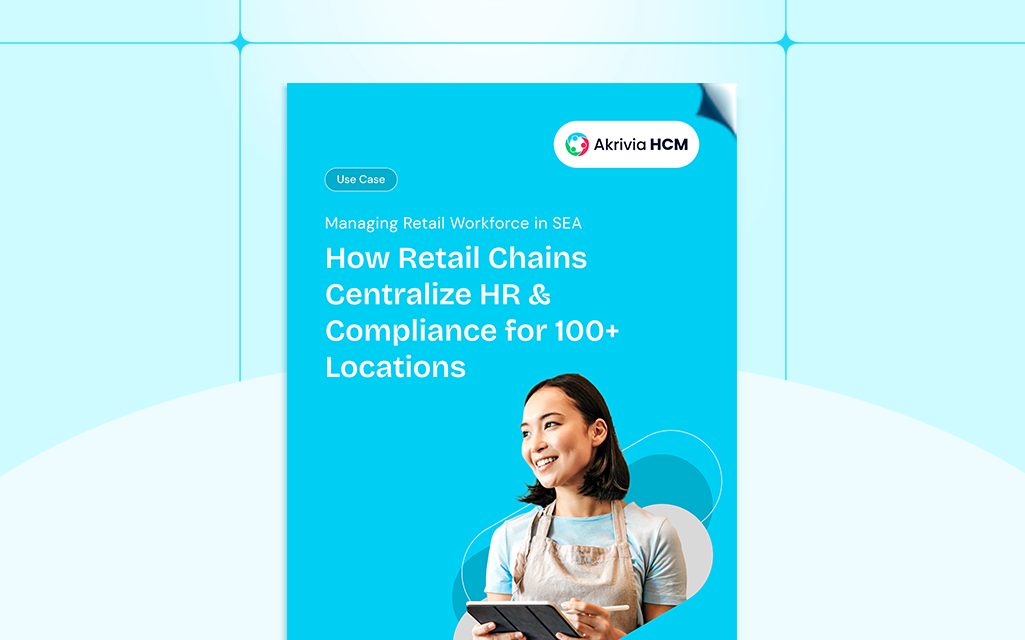
desc-How Retail Chains Centralize HR & Compliance for 100+ Locations
category:Retail,SEA
Introduction
Centralized workforce control across distributed locations is made increasingly difficult by retail expansion in Southeast Asia. When footprints are grown beyond regions like Manila, Jakarta, or Greater Kuala Lumpur, critical business risks are created by a reliance on manual processes. Without biometric-grade digital validation, actual versus rostered hours cannot be verified by headquarters, which leads to “ghost shifts,” unauthorized overtime claims, and lost sales during peak footfall periods.
A significant compliance burden is generated because SEA labor laws are not uniform. A recipe for compliance audits and labor litigation is created when 13th-month pay, social insurance, and statutory contributions are calculated using non-integrated processes.
To address these operational leakages, the Akrivia HCM model is implemented so that data collection is distributed while global oversight is upheld. Legacy Bundy Clocks are replaced by GPS-fenced mobile check-ins, requiring a facial recognition check to be passed within a predefined radius of the store.
Additionally, calculations are automated by an SEA-localized payroll engine based on regional minimum wage tiers and local labor codes, natively handling night shift differentials and public holidays. Finally, delayed insights are replaced by exception-based management, ensuring regional leaders are instantly notified via push notification if a store-in-charge has not logged in by the start of their shift
FAQs
Q: How is attendance fraud mitigated across multiple store locations?
A: Legacy Bundy Clocks are replaced by GPS-fenced mobile check-ins. Furthermore, a facial recognition check must be passed by staff within a predefined radius of the store.
Q: How are diverse SEA labor laws managed without expensive consultants?
A: Calculations based on regional minimum wage tiers and local labor codes are automated by the SEA-Localized Payroll Engine. Night shift differentials, public holidays, and double pay are natively handled by the system.
Q: How is immediate oversight maintained by regional leaders?
A: Delayed insights are replaced by exception-based management. For instance, regional leaders are instantly notified via push notification if a store-in-charge has not logged in by the start of a shift.
Q: What operational improvements are achieved post-implementation?
A: Within 6 months, payroll processing is reduced from 7-10 days to just 1 day, and 100% attendance accuracy is achieved. Additionally, travel costs are lowered by 30% through the use of a remote audit dashboard.