

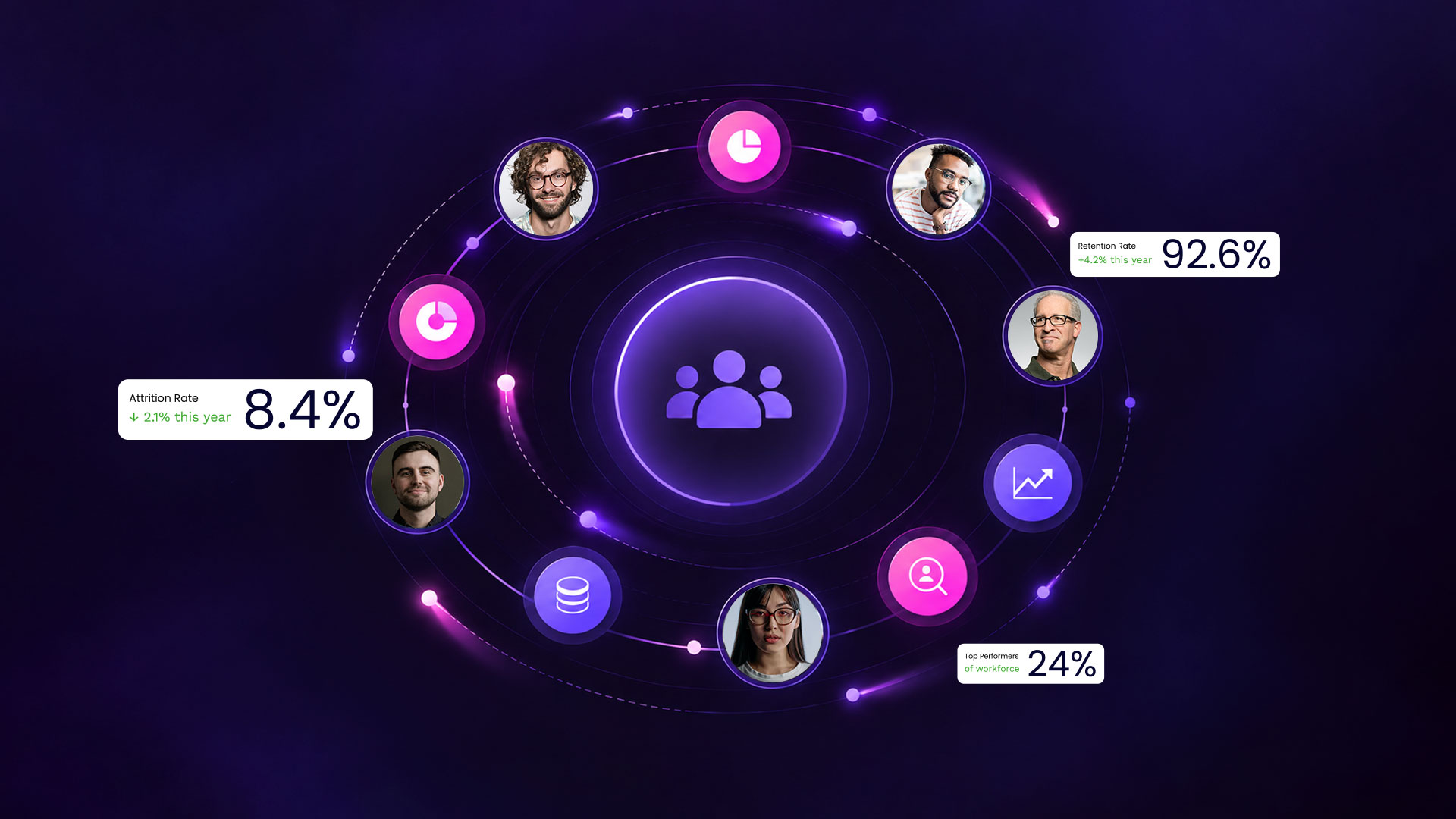
People analytics is the practice of collecting and analyzing employee data to answer real business questions, who’s likely to leave, which hiring channels actually produce strong performers, where pay inequities exist, and what’s driving a team’s engagement score up or down. It sounds like a modern extension of HR reporting. In practice, most organizations that say they’ve adopted people analytics are still doing the reporting part, and stopping there.
The numbers back this up clearly. According to 2025-26 HR analytics benchmarking research, 76% of organizations report having some form of HR analytics in place, but only 6% have reached predictive maturity, the stage where analytics forecasts what’s likely to happen rather than just describing what already did. Organizations that do reach that stage see real payoff: advanced people analytics implementations generate a reported 5.4x to 8.7x return on investment, and mature analytics functions are markedly more likely to make fast, data-driven decisions and to outperform competitors.
This guide covers what people analytics actually is, how it differs from HR analytics and workforce analytics, the maturity model that separates basic reporting from real strategic value, the metrics organizations actually track, and how to start building real capability.
People analytics vs. HR analytics vs. workforce analytics
These three terms get used interchangeably, and in most everyday conversations that’s fine. But there’s a real distinction worth understanding if you’re building a function around this work.
- HR analytics deals specifically with the metrics of the HR function itself: time to hire, training expense per employee, and time to promotion. These are metrics HR manages for HR.
- People analytics is the broader term. It applies analytics to people data more generally and increasingly extends beyond the HR function into questions about organizational performance, team effectiveness, and business outcomes that HR data can help explain.
- Workforce analytics is the most encompassing term, covering everyone who does work for the organization, full-time employees, remote workers, and increasingly gig and contract workers, not just the traditional employee population HR analytics was originally built around.
In practice, most organizations use these terms loosely, and that’s not a problem worth fighting over internally. What matters more is understanding where your organization actually sits on the maturity curve, which is the more useful distinction.
Also read: The importance of HR and people analytics in business
The people analytics maturity model
Most people analytics work falls into one of four stages, and understanding which stage you’re actually in, rather than which stage you’d like to claim, is the honest starting point.
- Descriptive (reporting): What happened. Turnover rate last quarter, headcount by department, time to fill for open roles. This is where the vast majority of organizations sit today, and it’s genuinely useful, but it’s backward-looking.
- Diagnostic: Why it happened. Why did turnover spike in one department but not another. This requires connecting data across systems rather than reading one dashboard in isolation.
- Predictive: What’s likely to happen next. Which employees show attrition risk based on patterns in engagement, tenure, and manager relationship data. This is the stage only about 6% of organizations have genuinely reached.
- Prescriptive: What to actually do about it. Not just flagging that an employee is a flight risk, but surfacing the specific intervention, a compensation adjustment, a role change, a manager conversation, most likely to change the outcome.
The jump from descriptive to predictive isn’t primarily a tooling problem. The platforms capable of predictive analysis already exist and are broadly accessible. The real constraint is data connectivity, data quality, and whether the HR team has the analytical fluency to interpret and act on what the data shows.
The metrics people analytics actually tracks
Certain metrics show up almost universally once an organization starts doing this seriously.
- Turnover and attrition, tracked overall and broken out by high performers specifically, since losing your strongest people costs more than losing average ones. This is the single most tracked HR metric, with 94% of organizations monitoring it in some form.
- Time to hire and time to fill, tracked to understand recruiting efficiency and its downstream effect on team capacity.
- Employee engagement and eNPS, since engaged employees consistently perform better, and their scores often predict retention risk before an exit interview would reveal it.
- Internal mobility rate, a signal of whether the organization is developing talent internally or losing people because growth paths aren’t visible.
- Pay equity metrics, increasingly tracked not just for compliance but because unexplained pay gaps correlate with attrition risk.
- Quality of hire, measured through new hire performance and retention, which closes the loop between recruiting decisions and actual on-the-job outcomes.
Organizations that track 15 or more of these metrics in a connected way report 23% better business outcomes than those tracking only a handful in isolation.
The challenges that keep people analytics stuck at reporting
Three barriers show up consistently across research on why organizations struggle to move past basic reporting.
- Data fragmentation: Only 42% of HR professionals agree their HR technology systems are well integrated for easy data analysis. Among organizations with mature people analytics functions, that number jumps to 87%. Among laggards, it’s just 22%. System integration isn’t a nice-to-have, it’s the single clearest differentiator between organizations that reach predictive analytics and those stuck describing the past.
- Data quality: 74% of organizations cite data quality as a genuine implementation challenge. Predictive models built on inconsistent or incomplete data produce unreliable predictions, which undermines trust in the whole function.
- Analytical skills gap: 69% of organizations report lacking the analytics skills needed to actually use the data they collect. This doesn’t require the HR team to become data scientists, but it does require comfort with probabilities, trade-offs, and translating a statistical pattern into a business decision.
How to get started with people analytics
A phased approach consistently outperforms trying to build predictive capability all at once.
- Assess your current maturity honestly: Most organizations believe they’re further along than the data suggests. Start by mapping what you actually track today against the descriptive-to-prescriptive scale above.
- Audit your data infrastructure before choosing tools: Fragmented, unintegrated systems are the biggest blocker to advancing past basic reporting, so this comes before any new analytics investment, not after.
- Pick two or three business questions, not twenty: Attrition among high performers, time-to-productivity for new hires, or a specific engagement driver are the kind of focused questions that demonstrate value quickly.
- Build data literacy alongside tool adoption: A sophisticated analytics platform delivers little value if the team using it can’t interpret what it surfaces.
- Start with a pilot, then scale: Early, visible wins build the internal case for expanding analytics into more complex use cases.
Explore: A comprehensive guide to Cloud HCM
Conclusion
People analytics stops being a reporting exercise the moment an organization connects its data, trusts its quality, and builds the internal capability to act on what it shows rather than just display it. That shift, from descriptive to predictive, is where the real return sits, and it’s still rare enough that getting there is a genuine competitive advantage rather than table stakes.
Akrivia HCM’s people analytics and custom reporting capability is built around closing exactly this gap, connecting workforce data across the employee lifecycle in one system rather than leaving HR teams to stitch together insights from disconnected tools.
FAQs
What is the difference between people analytics and HR analytics?
HR analytics focuses specifically on HR function metrics like time to hire and training cost; people analytics is the broader term, often extending beyond HR into wider organizational and business performance questions.
What percentage of organizations have reached predictive people analytics maturity?
Only about 6%, despite 76% of organizations having some form of HR analytics in place, according to 2025-2026 industry research.
What are the most common people analytics metrics?
Turnover and attrition, time to hire, employee engagement, internal mobility rate, pay equity, and quality of hire are the metrics most consistently tracked across organizations.