

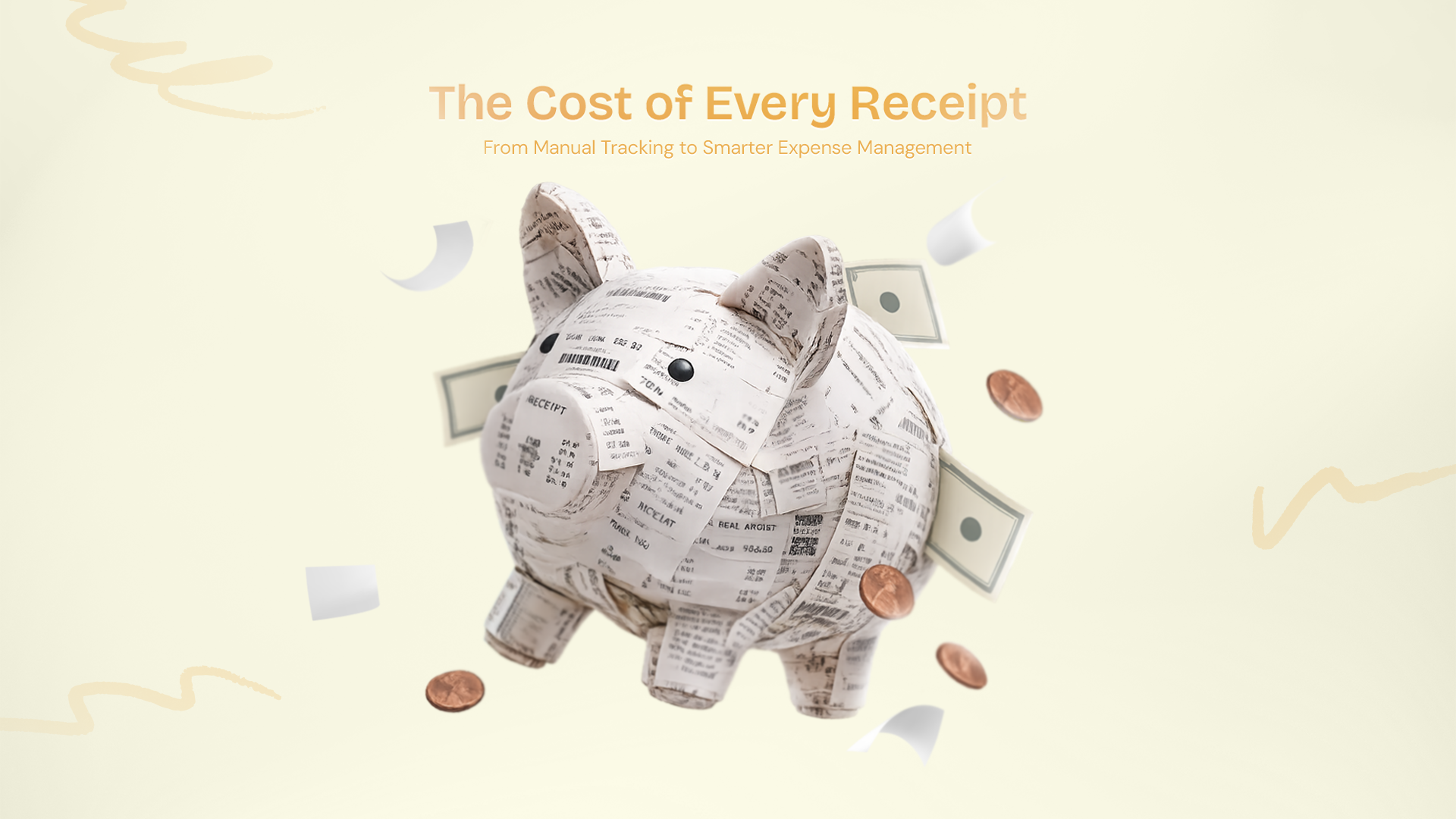
Expense management is one of those HR and finance functions that organizations underestimate until it breaks down. When it works well, employees get reimbursed on time, finance teams have clean audit trails, and management has accurate cost data to make decisions. When it does not work well, employees submit paper receipts, finance teams chase approvals manually, reimbursement takes weeks, and the cost data that reaches leadership is inaccurate and delayed.
For most small and mid-sized organizations, employee expense management still relies heavily on spreadsheets, email approvals, and manual data entry. These approaches work at a small scale. They break down quickly as the workforce grows, the number of expense categories expands, employees start traveling internationally, and compliance requirements tighten. The result is an expense management function that consumes disproportionate HR and finance bandwidth while delivering inconsistent, error-prone results.
This guide is designed to give HR leaders and finance teams a comprehensive understanding of expense management from every angle: what it is, why it matters, how to design an effective expense policy, how to handle employee expense reimbursement efficiently, how to track business expenses accurately, what to look for in expense management software, and how integrating that software with your HRMS transforms the entire function. We also cover regional considerations for organizations operating in India, the GCC, and Southeast Asia.
1. What Is Expense Management and Why Does It Matter for HR?
Expense management refers to the end-to-end process of recording, reviewing, approving, and reimbursing employee business expenses. It covers everything from a field sales representative submitting a fuel reimbursement claim to a senior executive submitting an international travel and accommodation expense report to a team submitting receipts for a client entertainment event.
At its core, it sits at the intersection of HR, finance, and compliance. HR owns the expense policy and the reimbursement experience for employees. Finance owns the approval workflow, the budget controls, and the accounting. And compliance owns the documentation and audit requirements that govern both. When these three functions are not aligned, it becomes a source of friction for everyone involved.
Good expense management delivers clear value across all three functions. For employees, it means submitting expenses is simple and getting reimbursed is fast. For finance, it means expense data is accurate, approvals are documented, and budget overruns are flagged in real time. For compliance, it means every expense claim has a complete audit trail, policy exceptions are recorded, and tax treatment is applied correctly.
When expense management works well, it is almost invisible. Employees submit a receipt from their phone in thirty seconds, see their claim approved within a day, and find the reimbursement in their next salary payment. Finance has a live dashboard showing spend against budget. Leadership can see total travel and entertainment costs by department in real time. That is the standard modern tool makes achievable, and this guide shows you exactly how to get there.
Key Statistics on Expense Management
- According to the Global Business Travel Association (GBTA), organizations with manual processes spend an average of 20 minutes processing a single expense report. Automated platforms reduce this to under 5 minutes.
- Research by Certify (now Emburse) found that a significant majority of employees report that slow expense reimbursement negatively impacts their satisfaction with their employer, making delayed reimbursement a direct employee experience issue.
- Expense fraud and errors account for an estimated 5% of annual revenue for organizations without automated expense controls, according to the Association of Certified Fraud Examiners.
- Organizations that move from manual to automated expense management consistently report significant reductions in processing time, with estimates from platform providers ranging from 50–70%.
- Travel and expense management is widely cited as one of the largest controllable costs for most organizations, making effective expense management a direct business performance lever.
2. The Real Cost of Poor Expense Management
The costs of poor employee expense management extend well beyond the direct financial losses from fraud or overpayment. They are systemic, compounding, and often invisible in standard financial reporting. Understanding these costs is the first step to building the business case for investing in better expense management processes and tools.
2.1 Administrative Overhead
Manual expense management is extraordinarily time-consuming for everyone involved. Employees spend time gathering receipts, filling in spreadsheets, and chasing approval status. Managers spend time reviewing paper-based or email-submitted claims without the data they need to make quick, confident decisions. Finance teams spend time reconciling manually entered data, identifying missing receipts, correcting coding errors, and processing payments individually.
In organizations with hundreds or thousands of employees submitting expenses regularly, this administrative overhead adds up to a significant proportion of HR and finance team capacity. That is capacity that could be spent on strategic work, not expense processing.
2.2 Compliance and Fraud Risk
Without automated expense controls, organizations are heavily reliant on manual review to catch policy violations, duplicate submissions, inflated claims, and fraudulent receipts. Manual review is inconsistent, dependent on individual reviewer judgment, and unable to systematically flag anomalies across thousands of submissions. Expense management software with automated policy enforcement and anomaly detection addresses this risk at the source.
2.3 Employee Dissatisfaction
Slow, complicated, or inconsistently applied expense reimbursement is a genuine source of employee dissatisfaction. Employees who regularly spend their own money for business purposes and wait weeks to be reimbursed, or who find their claims rejected for policy reasons they did not understand, quickly develop negative perceptions of their employer. Expense reimbursement is a tangible, personal touchpoint in the employee experience. Getting it wrong has a disproportionate impact on trust.
2.4 Inaccurate Cost Data
Manual expense management produces inaccurate cost data. When expenses are entered manually, coding errors are common. When receipts are missing, costs are estimated. When approvals are informal, budget controls are bypassed. The result is financial reporting that does not accurately reflect the true cost structure of the business, making it harder for management to make informed resource allocation decisions.
3. Designing an Effective Expense Policy: The Foundation of Good Expense Management
An expense policy is the foundational document that governs employee expense management in any organization. It defines what expenses are reimbursable, at what amounts, with what documentation, through what approval process, and within what timeframes. A well-designed expense policy is the single most important governance tool in expense management, because it sets the rules that expense management software then enforces automatically.
Many organizations have expense policies that are outdated, incomplete, inconsistently communicated, or simply too vague to provide practical guidance. The result is that employees submit expenses they think are legitimate, managers approve them based on personal judgment rather than policy, and finance processes them without consistent controls. When disputes arise, there is no clear standard to refer to.
3.1 What a Good Expense Policy Covers
To maintain strict governance, the following operational areas must be covered clearly and specifically within a comprehensive expense policy:
- Eligible expense categories: Travel (flights, trains, taxis, and fuel), accommodation, meals and entertainment, client-related expenses, professional development, office supplies, and any category-specific rules.
- Spending limits by category: Maximum amounts for meals, accommodation, transportation, and entertainment by employee grade or region. Limits should reflect current market realities, not outdated benchmarks.
- Documentation requirements: What receipts are required, in what format, and within what timeframe after the expense is incurred. Digital receipts should be explicitly accepted.
- Approval workflows: Who approves expenses at different value thresholds. Routine claims under a certain amount are approved by the line manager. Higher-value claims requiring finance or senior management approval.
- Submission timelines: How long employees have to submit expense claims after the expense is incurred. Aged expense claims are a common audit problem.
- Reimbursement timelines: When employees can expect reimbursement after submission and approval. Setting and meeting this commitment is critical to employee trust.
- Non-reimbursable expenses: Explicitly list what is not covered: personal purchases, fines, alcohol above a certain threshold, first-class travel without pre-approval, and any other category-specific exclusions.
- Consequences of policy violations: What happens when an employee submits a false or inflated claim. Clear consequences deter fraud and protect the organization.
For a detailed guide on how to apply expense reimbursement best practices in your organization, read: Employee Expense Reimbursement Best Practices
4. Employee Expense Reimbursement: How to Do It Right
Employee expense reimbursement is the most visible and personally significant part of expense management for employees. It is the moment when the expense policy, the approval process, and the finance function all come together to deliver a tangible outcome: the employee gets their money back. Getting this right consistently builds trust. Getting it wrong consistently erodes it.
4.1 The Core Principles of Good Expense Reimbursement
A highly functioning employee expense reimbursement system is built upon four core operational principles:
- Speed: Best practice is to reimburse employees within the same pay cycle as approval wherever possible. Organizations that can process reimbursements within 5–7 business days of approval consistently see higher employee satisfaction with the expense function, though the achievable timeline depends on payroll cycle frequency and system integration.
- Transparency: Employees should be able to see the status of their expense claims at any point in the process. Unclear or invisible approval workflows are a major source of frustration in employee expense management.
- Consistency: The same expense submitted by two different employees should be processed the same way. Inconsistent application of the policy creates perceptions of favoritism and unfairness.
- Accuracy: Reimbursement amounts must be correct. Underpaying or overpaying expenses due to manual calculation errors is preventable with automated expense software and creates unnecessary disputes.
4.2 Common Expense Reimbursement Problems and How to Fix Them
The most common employee expense reimbursement problems and their solutions:
| Common Problem | Root Cause | Systemic Solution |
| Late reimbursement | Slow approval workflows or infrequent monthly processing batches. | Automate approvals and process expense reimbursements on a rolling, continuous basis. |
| Missing receipts | Lost paper receipts or a lack of clarity regarding required documentation. | Enable mobile OCR receipt capture at the point of purchase with automated missing-document reminders. |
| Incorrect coding | Employees guessing GL codes or misallocating cost centers. | Build smart coding defaults into the software based on the expense category and employee department. |
| Policy disputes | Vague, outdated, or poorly communicated expense policies. | Make the policy easily accessible and surface relevant rules dynamically as employees create claims. |
5. Business Expense Tracking: Getting Visibility You Can Actually Use
Business expense tracking is the process of recording, categorizing, and monitoring all business expenses in real time, at both the individual and organizational levels. Good business expense tracking gives finance teams the data they need to manage budgets proactively, gives management the visibility to identify cost optimization opportunities, and gives HR the documentation needed for compliance and audit purposes.
The challenge with business expense tracking in most organizations is not a lack of data. It is data quality and accessibility. Expense data captured manually in spreadsheets is slow to update, prone to coding errors, inconsistently categorized, and difficult to aggregate meaningfully. By the time a finance manager gets a monthly expense report, the data is already 30 days old and the opportunity to act on it has passed.
Modern expense management software transforms business expense tracking from a monthly retrospective exercise into a real-time operational capability. When every expense is captured digitally at the point of submission, categorized automatically by the system, and approved through a documented workflow, the resulting data is accurate, current, and queryable at any level of granularity the business needs.
For a practical guide on setting up reliable business expense tracking processes in your organization, read: Guide on How to Track Business Expenses
5.1 What Good Business Expense Tracking Looks Like
Effective business expense tracking provides the following capabilities in real time:
- Spend by category: How much is being spent on travel, accommodation, entertainment, and other categories across the entire organization.
- Spend by department or cost center: Which departments are spending the most and whether they are within approved budgets.
- Spend by employee: Which employees are submitting the most expenses and whether their spending patterns are consistent with their role and the expense policy.
- Budget variance tracking: Real-time comparison of actual expense spending against approved budgets, with alerts when budgets are approaching or exceeding limits.
- Vendor and supplier analysis: Which vendors employees are using most frequently, enabling negotiation of preferred rates and identification of opportunities to reduce costs.
- Audit trail: A complete, timestamped record of every expense submitted, every approval action taken, and every payment made, accessible on demand for audit and compliance purposes.
6. Key Features Every Expense Management System Must Have
Not all expense management systems are created equal. When evaluating any platform, these are the features that determine whether it will genuinely solve your problems or simply digitize the same manual processes you already have
For a detailed breakdown of the must-have features, read Expense Management System Features. Below are the non-negotiables:
Mobile Receipt Capture
Employees should be able to photograph a receipt with their smartphone immediately after an expense is incurred and submit it instantly. This dramatically reduces the receipt-keeping problem for most employees. Good expense management software uses OCR technology to automatically extract the vendor, date, and amount from the receipt image, dramatically reducing manual data entry.
Automated Policy Enforcement
This system should automatically flag claims that violate the expense policy: amounts above category limits, missing receipts, duplicate submissions, or expenses submitted outside the allowed time window. Automated flagging removes the burden of policy enforcement from individual approvers and ensures consistent application of policy rules across the entire organization.
Configurable Approval Workflows
Different expense types and amounts should follow different approval paths. A small daily meal claim might auto-approve. A large international travel expense might require line manager and finance sign-off. This system must allow these workflows to be configured precisely to match the organization’s approval hierarchy and expense policy.
Real-Time Budget Tracking
The system should provide department heads and finance managers with real-time visibility of expense spending against budgets. Alerts when budgets are 80% utilized give decision-makers time to act before overruns occur, rather than discovering the problem in the monthly finance report.
Multi-Currency and Multi-Country Support
For organizations operating across India, the GCC, or Southeast Asia, the expense management system must handle multiple currencies, apply correct exchange rates, and support the tax treatment rules of each country where expenses are incurred. This is essential for accurate financial reporting and compliance in multi-country operations.
Analytics and Reporting
The system should provide comprehensive analytics: spend by category, department, employee, project, and period. Reports should be exportable and configurable so that finance can generate the specific outputs needed for internal reporting and external audit requirements.
Integration with Payroll and Accounting Systems
Approved expense reimbursements should flow automatically into payroll for processing, and expense data should sync directly with the accounting system for accurate financial reporting. This integration eliminates the manual re-entry of data between systems that is a major source of errors and delays in manual expense management.
7. Integrating Expense Management Software with HRMS: The Multiplier Effect
The real power of modern expense management is unlocked when expense management software is fully integrated with the HRMS. When these two systems work in isolation, organizations get digital expense management but not intelligent expense management. When they are integrated, the combination delivers capabilities that neither system can provide alone.
HRMS expense integration means that employee data maintained in the HRMS, including name, department, cost center, grade, reporting manager, and employment status, is automatically available in the expense management system. There is no need to maintain separate employee records in two systems. When an employee changes department or reporting line, the change in the HRMS automatically updates their expense approval routing and cost center coding.
In the other direction, expense data from the expense management system enriches the HRMS with cost information that is valuable for workforce analytics: total employee cost including expenses, expense patterns correlated with role or location, and travel and expense data as an input to flexible working and remote work strategy decisions.
For a detailed guide on how to achieve effective HRMS expense integration and what it enables, read: Integrating Expense Management Software with HRMS
7.1 The Benefits of HRMS Expense Integration
- Single source of truth for employee data: Employee records maintained once in the HRMS flow automatically into expense management. No duplicate data entry, no data inconsistencies between systems.
- Automatic approval routing: Approval workflows in the expense management system use the reporting hierarchy from the HRMS. When an employee’s manager changes, their expense approvals automatically route to the new manager.
- Cost center accuracy: Expense coding to cost centers is driven by the employee’s department and location in the HRMS, reducing coding errors significantly.
- Payroll integration: Approved expense reimbursements sync directly into payroll for processing in the next pay cycle. No manual transfer of reimbursement data between systems.
- Leaver management: When an employee is terminated in the HRMS, their access to the expense management system is automatically revoked and any outstanding claims are flagged for resolution.
For a broader understanding of how to leverage HRMS to enhance travel and expense management processes, read: Enhance Travel and Expense Management with HRMS
8. Travel and Expense Management for Distributed and Field-Based Workforces
Travel and expense management becomes significantly more complex when employees are regularly traveling for business or working from field locations. Field sales teams, professional services consultants, healthcare workers visiting client sites, and construction or engineering teams working across multiple project locations all generate high volumes of travel-related expense claims that require efficient, mobile-first management.
For these workforces, expense management software must be genuinely mobile-first: employees need to be able to capture receipts, submit claims, check reimbursement status, and access the policy from their smartphones without needing to return to a desk or office to complete expense administration tasks.
Travel and expense management for frequent travelers also introduces additional complexity: foreign currency transactions, per diem calculations, multi-leg travel itineraries, hotel folio submissions, and corporate card reconciliation. These scenarios require expense management software with robust multi-currency support, automated per diem calculations based on destination country and travel duration, and the ability to import corporate card transactions directly into expense claims.
Organizations with significant travel and expense management volumes should also consider the total cost of business travel, not just the individual expense claims. Travel policy optimization, preferred vendor programs, and advance booking requirements can significantly reduce the total cost of business travel without reducing employee effectiveness. Expense management software that provides analytics on travel spend by route, vendor, and booking lead time gives travel managers the data they need to optimize travel costs systematically.
9. How to Choose the Right Expense Management Software
With the landscape mapped, the practical question is, “Which expense management software is right for your organization?” The market ranges from standalone expense apps to comprehensive platforms integrated with HRMS and accounting systems. Here is a structured approach to making the right choice.
9.1 Define Your Requirements First
Before any expense management software is evaluated, specific organizational requirements must be thoroughly documented. How many employees submit expenses regularly? What categories of expenses are most common? Do you have significant travel and expense volumes? Do you operate across multiple countries and currencies? Do you need integration with a specific HRMS or accounting system? Answering these questions before vendor conversations ensures that you evaluate platforms on fit rather than feature impressiveness.
9.2 Non-Negotiables for Any Expense Management Software
- Mobile receipt capture: If the mobile experience is weak, adoption will be low regardless of back-end features.
- HRMS integration: The platform should connect natively or via API with your HRMS.
- Configurable approval workflows: Must match your hierarchy and policy exactly.
- Automated policy enforcement: Flags violations before they reach the approver.
- Multi-currency support: Essential for multi-country operations.
- Analytics and reporting: Real-time dashboards for finance and management.
9.3 Evaluating Vendors
When evaluating vendors, require scenario-based demonstrations using your actual expense types and workflows not a generic product walkthrough. Platforms that handle your real scenarios cleanly in a demo are far more likely to deliver in production.. Platforms that handle your actual scenarios cleanly in a demo are far more likely to deliver in production. Ask about implementation timelines, data migration approach, and ongoing support model. And check references from organizations of similar size and complexity.
For a broader framework to evaluate any option against your specific organizational needs, read Pick the Best Expense Management Software for Your Company
10. Expense Management in India, the GCC, and Southeast Asia
Expense management requirements vary across geographies, and organizations operating in India, the GCC, or Southeast Asia must ensure their software and processes address the specific compliance and operational requirements of each market.
Expense Management in India
In India, expense reimbursement has significant tax implications that vary depending on the employee’s chosen tax regime. Under the old tax regime, certain reimbursements, including fuel, telephone, and leave travel allowance, may qualify for tax exemption up to defined limits. Under the new tax regime, most such exemptions are not available in exchange for a lower flat tax rate. HR and finance teams must determine each employee’s tax regime election before applying expense reimbursement tax treatment and should verify current exemption limits with a qualified tax advisor, as rules are subject to amendment.
For a comparison of the leading expense management software options in India, read Best Expense Management Software in India.
Expense Management in the GCC
In the GCC, expense management for a largely expatriate workforce often involves significant international travel costs, relocation expense reimbursements, and home leave allowances. End-of-service gratuity calculations in the UAE and other GCC markets sometimes incorporate expense allowances, requiring careful documentation of the components of total compensation. Organizations in the GCC also often operate across multiple entities and legal structures, requiring expense management software that can handle multi-entity approvals and reporting.
Expense Management in Southeast Asia
Southeast Asia’s diversity of tax regimes, statutory contribution requirements, and labor regulations creates expense management complexity for regional organizations. In Singapore, expense reimbursements must be correctly coded for IRAS reporting purposes. In Malaysia, certain expense reimbursements have specific GST treatment. In the Philippines, DOLE compliance requirements extend to some expense-related benefits. Expense management software operating in SEA must be flexible enough to accommodate these country-specific rules without requiring extensive customization.
11. Building the Business Case for Expense Management Software
For HR and finance leaders looking to secure investment in expense management software, the business case is usually straightforward once the current costs are quantified. The challenge is that many of these costs are hidden: they show up as HR and finance team time, as payroll processing complexity, as audit preparation effort, and as employee dissatisfaction rather than as a line item labeled ‘expense management inefficiency.’
Building the business case for expense management software requires quantifying:
- Current processing time cost: Calculate the average time HR, finance, and employees spend per expense report, multiply by the number of expense reports per year, and apply the fully loaded cost rate of each role. This alone often justifies the investment.
- Reimbursement delay cost: Estimate the employee dissatisfaction and trust impact of slow reimbursement. If delayed expense reimbursement contributes to even 1-2 preventable resignations per year, the retention cost alone may exceed the software investment.
- Compliance risk cost: Assess the potential cost of a tax authority audit finding errors in expense reimbursement tax treatment. The cost of a single significant audit finding often exceeds several years of expense management software subscription fees.
- Fraud and error cost: Estimate the annual cost of expense fraud and manual processing errors based on the industry benchmark of 5% of total expense spending. Even a fraction of this figure recaptured through automated controls represents significant savings.
Conclusion: Expense Management Done Right Builds Trust, Saves Time, and Reduces Risk
Expense management is one of those operational functions that touches every employee in the organization. Done well, it is invisible: employees submit expenses, get reimbursed quickly, and move on. Done poorly, it creates friction, erodes trust, and consumes disproportionate HR and finance bandwidth.
The path from poor to excellent expense management follows a consistent pattern: start with a clear expense policy that reflects current business realities. Build a reimbursement process that is fast, transparent, and consistent. Implement expense management software that automates policy enforcement, receipt capture, approval workflows, and business expense tracking. Integrate that software with your HRMS for single-source employee data and seamless payroll processing. And ensure your approach reflects the specific compliance requirements of the markets you operate in, whether that is India, the GCC, or across Southeast Asia.
The result is an expense management function that saves time for everyone involved, reduces compliance risk for the organization, improves the employee experience, and gives management the accurate cost data they need to make better business decisions.
Simplify Expense Management with Akrivia HCM
Akrivia HCM’s expense management module gives HR and finance teams across India, the GCC, and Southeast Asia everything they need to manage employee expenses accurately, efficiently, and in full compliance. Mobile receipt capture, automated policy enforcement, configurable approval workflows, real-time analytics, and seamless HRMS and payroll integration, all in one unified platform.
- Mobile-first receipt capture with OCR, so employees submit expenses in seconds from anywhere
- Automated policy enforcement that flags violations before they reach the approver
- Real-time expense analytics and budget tracking for finance and management visibility
- Native HRMS integration for accurate employee data, approval routing, and payroll reimbursement
- Multi-currency and multi-country support for India, UAE, GCC, Singapore, Malaysia, and SEA
FAQs
What is expense management and why does HR need to own it?
Expense management is the end-to-end process of recording, approving, and reimbursing employee business expenses. HR owns it because the policy directly impacts employee experience, expense reimbursement is part of total compensation, and poor expense management is a measurable driver of employee dissatisfaction.
What should an expense policy include?
A good policy covers eligible expense categories, spending limits by category and employee grade, documentation requirements, approval workflows, submission and reimbursement timelines, non-reimbursable expenses, and consequences for policy violations. It should be clear, current, and easily accessible to all employees.
How does expense management software improve employee expense reimbursement?
It speeds up reimbursement by automating approval workflows, enabling digital receipt submission, and integrating directly with payroll for processing. Employees can track claim status in real time, managers receive automated notifications for pending approvals, and finance processes reimbursements faster with less manual effort.
What is the difference between expense management software and an HRMS?
An HRMS manages the full employee lifecycle, including payroll, attendance, performance, and HR data. Expense management software specifically handles expense submission, approval, tracking, and reimbursement. The two are most powerful when integrated: employee data from the HRMS drives expense approval routing, and approved reimbursements flow automatically into HRMS payroll.
How does travel and expense management differ from standard expense management?
Travel and expense management handles the additional complexity of business travel: multi-currency transactions, per diem calculations, corporate card reconciliation, multi-leg itineraries, and travel policy optimization. Organizations with frequent business travelers need expense management software with specific travel features beyond standard receipt capture and approval workflows.
What are the most important features in expense management software?
The non-negotiables are mobile receipt capture with OCR, automated policy enforcement, configurable approval workflows, real-time budget tracking, multi-currency support, HRMS and payroll integration, and comprehensive analytics. Any platform missing these core features will create workarounds rather than solving your expense management problems.