
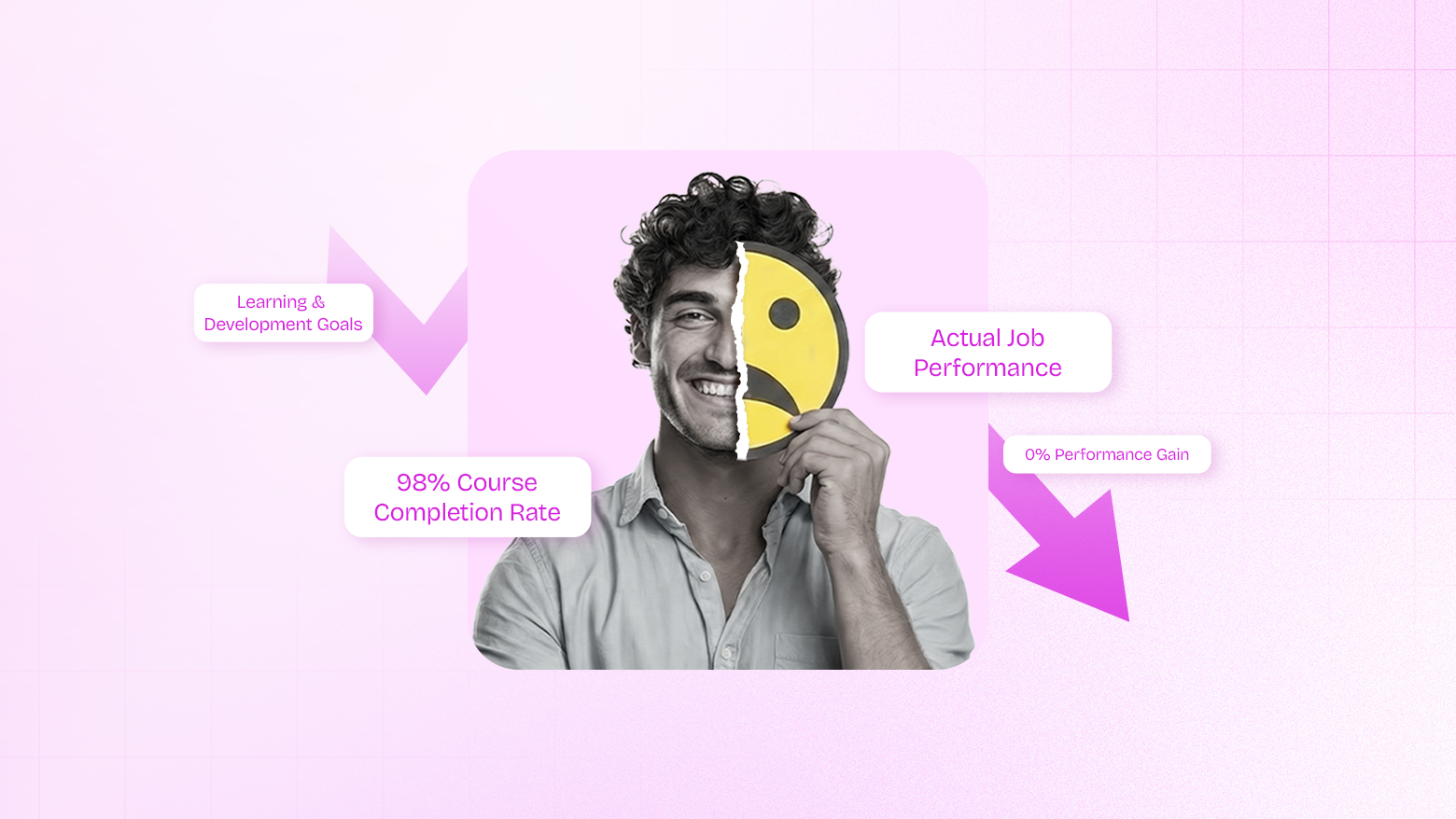
The skills gap isn’t growing because employees can’t learn, it’s growing because learning isn’t connected to performance.
McKinsey’s HR Monitor 2025 shows a striking mismatch: HR leaders believe employees receive 22 days of training each year, yet employees say they receive only 12.
Even more concerning, 32% of employees admit they don’t have the skills needed to perform their current roles effectively.
This disconnect reveals a deeper issue, organizations aren’t struggling with a talent shortage; they’re struggling with fragmented systems where learning, performance, and upskilling operate in silos.
To close the gap, companies must move beyond one-off training programs and adopt integrated learning-performance frameworks that deliver continuous development, measurable capability growth, and clear visibility across the workforce.
The Perception vs. Reality Gap in Learning and Development
Many HR leaders genuinely believe their learning and development systems are functioning well, yet employees experience learning very differently. This perception gap leads to misaligned expectations, reduced trust, and inconsistent development outcomes.
- HR teams often overestimate training exposure by focusing on scheduled programs, budgets, or LMS completions rather than on what employees perceive as meaningful learning. Employees assess training based on what is practical, relevant, and applied in their day-to-day responsibilities. This difference widens the gap between organizational intent and real impact.
- Employees also report lower learning because many traditional programs remain theoretical, lack role alignment, or occur infrequently. Without reinforcement, follow-ups, or hands-on practice, employees feel they are not gaining actual capability, even after a training session.
- This disconnect has measurable consequences, such as declining productivity, lower morale, and rising frustration among employees who feel unprepared to meet the expectations placed on them.
A 45% gap between HR perception and employee reality is not merely a data point; it is a sign of systemic misalignment that modern organizations must address.
Why Siloed L&D and Performance Fail Modern Organisations
Most companies still treat learning and performance as two separate functions, leading to inconsistent development cycles. When performance reviews and learning paths are not connected, skill gaps remain hidden or unaddressed.
- Traditional HR systems focus on annual reviews, isolated goals, and standalone learning programs. This creates a fragmented approach where performance expectations are documented, but the required learning support does not directly follow. Employees are left knowing where they need to improve but without the structured guidance needed to build those capabilities.
- The result is predictable that skill gaps stay unresolved, productivity stagnates, and employees become disengaged. Without integrated visibility, HR teams also struggle to identify patterns, evaluate competency readiness, or track skill progression over time.
Modern organizations require agility, data-driven decisions, and continuous capability building. Siloed systems simply cannot support these needs.
To close the skills gap, learning and performance must operate as a unified ecosystem rather than independent modules.
How Integrated L&D + Performance Management Closes the Skills Gap
Integrated systems ensure that every performance review translates into a targeted learning action. Employees get clarity on what to improve, how to improve, and how progress will be measured.
- Linking performance management with learning enables organizations to build personalized, role-specific development paths.
- Instead of generic training programs, employees receive learning recommendations based on actual performance gaps identified during check-ins or appraisals. This alignment increases relevance, effectiveness, and accountability.
- Automated skill assessments play a key role here by providing real-time insights into employee readiness. These assessments measure competencies, behavioral strengths, and knowledge gaps, allowing the system to suggest appropriate learning modules immediately.
With integrated platforms, organizations can also monitor whether employees are applying learned skills on the job. This is crucial because true development is not about course completion but about measurable capability improvement.
Find out the Top 10 Best Performance Management Software in India
The Business Impact of Fixing the Skills Gap
Addressing workforce skill deficiencies delivers measurable benefits across productivity, engagement, and long-term strategic planning.
| Business Impact | Description |
| Enhanced organisational efficiency |
|
| Greater agility and market responsiveness |
|
| Higher employee confidence & retention |
|
| Increased productivity & performance quality |
|
| Strengthened workforce planning |
|
| Reduced recruitment & training costs |
|
| Improved customer experience |
|
| Stronger organisational culture & continuity |
|
Explore more about Learning and Development in HRM: An Ultimate HR Guide
Where Most Companies Go Wrong
Many organizations invest heavily in training but fail to evaluate whether employees actually gain competence. Without data-backed insights, learning and development becomes a cost center rather than a strategic growth driver.
- One common mistake is relying too heavily on classroom-style sessions or one-time workshops. While these formats provide exposure, they rarely lead to sustained skill development without reinforcement or practical application.
- Another limitation is the absence of competency measurement. If organisations do not track before-and-after competency levels, it becomes impossible to understand whether training programs are effective. Employees may attend sessions and receive certificates, but this does not confirm capability improvement.
- Learning and development programs also fail when they are designed without a deep understanding of actual role requirements. Many training modules remain generic, outdated, or mismatched with what employees truly need to perform effectively. The result is wasted time, reduced engagement, and minimal business impact.
Modern organizations must shift from training attendance metrics to capability-building metrics. This requires structured learning paths, role-driven content, continuous feedback loops, and integrated systems that measure real outcomes.
How Akrivia HCM Solves the Skills Gap Problem
Akrivia HCM offers a unified Performance + LMS ecosystem designed to align goals, skills, and learning. It enables organizations to build transparent, measurable, and role-driven development frameworks.
- With an integrated architecture, Akrivia HCM connects performance goals directly to skill requirements and learning paths. When a performance review identifies a gap, the platform automatically recommends relevant courses, microlearning modules, or assessments. This reduces manual effort and ensures timely development interventions.
- The skill matrix and competency builder features provide clear visibility into the skills required for each role. This helps managers and employees understand expectations with precision. AI-driven recommendations enhance this further by analyzing appraisal data and suggesting personalized learning journeys.
- Continuous check-ins enable real-time performance tracking, while learning nudges encourage consistent development throughout the year. This moves learning and development from a one-time event to an ongoing habit embedded in everyday workflow.
Akrivia HCM’s analytics dashboards offer detailed insights into training days, course completions, skill acquisition, and job readiness. Organizations can finally measure capability outcomes, not just participation. This ensures employees do more than attend training, they acquire measurable, verifiable competence that strengthens overall performance.
The Future of Work: Continuous Learning Embedded in Daily Performance
The modern workforce requires continuous development, not annual cycles of reviews and training. Integrated systems will define future-ready organizations by enabling real-time learning and performance alignment.
- As industries evolve and job roles become more dynamic, continuous learning is essential. Employees expect development opportunities that fit naturally into daily work rather than being scheduled far apart.
- Performance, learning, and development will not function as separate HR modules. They will operate as a unified engine driving capability, culture, productivity, and business growth.
- Organizations that adopt integrated systems will be better positioned to navigate technological shifts, market uncertainty, and emerging skill demands.
Organizations must build environments where performance drives learning and learning drives performance. This integrated approach will not only close the skills gap but also create agile, confident, and future-ready teams capable of meeting the global evolving business landscape.
Akrivia HCM eliminates the disconnect between learning and performance. By unifying goals, skills, and capability-building into one intelligent workflow, it ensures employees don’t just complete training, they apply it, improve, and grow. With AI-driven learning paths, competency mapping, and continuous performance insights, organizations can finally close the skills gap with speed and precision.
Ready to build a workforce prepared for today—and ready for tomorrow?
Explore how Akrivia HCM’s integrated Performance + LMS pillar enables organizations to close skill gaps, accelerate capability building, and drive consistent, on-the-job performance improvement.
FAQs
What causes the widening skills gap in organizations?
Rapid role changes and outdated learning content make employee skills fall behind. Continuous skill assessments help keep development aligned with business needs.
How can managers identify real skill gaps in their teams?
Through structured reviews, competency ratings, and 360° feedback. Akrivia HCM consolidates these insights to show exact gaps for every role.
What type of learning strategy improves performance fastest?
Microlearning and on-the-job, role-aligned modules drive faster skill adoption because employees apply what they learn immediately.
Why do traditional training programs fail to change behavior?
Because they focus on information delivery rather than practice. Behavior changes only when learning is reinforced through coaching and real-world application.
How often should organizations update skill frameworks?
At least annually, or whenever business priorities shift, to ensure skill expectations stay aligned with industry and organizational changes.