Most organizations have a talent problem they are paying to create.
A business unit head opens a role. The default motion is to post it externally. The TA team sources, screens, and interviews external candidates over six to eight weeks. An offer is extended. The new hire joins and spends three to six months reaching full productivity. The total cost lands somewhere between 50 and 200% of the annual salary for that role.
Meanwhile, somewhere else in the same organization, an employee with the exact skills that role requires has been quietly looking for a growth opportunity for four months. Nobody told them the role existed. Nobody checked whether they were qualified. And within the next 90 days, they accept an external offer from a competitor who did notice them.
This is not an unusual story. It is the default outcome when organizations lack the infrastructure to see their own talent clearly.
Internal talent marketplace adoption grew significantly between 2024 and 2025. Organizations that make internal moves retain those employees at materially higher rates than those who do not create internal pathways. Internal hires typically reach full productivity faster than external hires. And the cost of filling a role internally is consistently lower than the cost of filling the same role externally.
The gap between knowing this and doing it is not motivation. Most talent leaders want to hire internally first. The gap is infrastructure. Skills data that does not exist. Managers who hoard talent. Job visibility that reaches the external market before it reaches the internal workforce. This guide names those gaps and provides a practical framework for closing them.
What an internal talent marketplace is (and isn’t)
The term internal talent marketplace has accumulated enough vendor marketing around it to obscure what it actually means in practice.
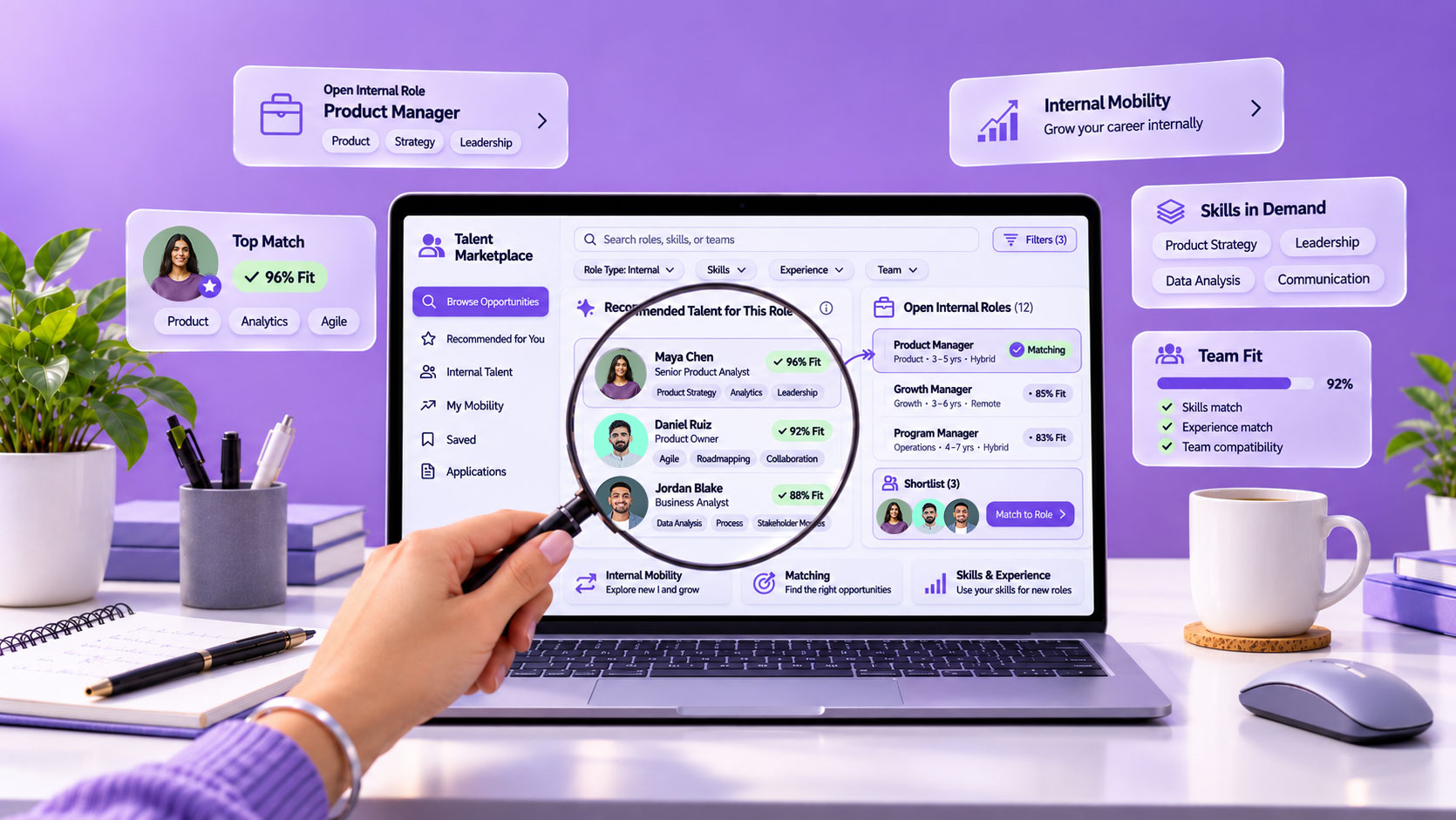
An internal talent marketplace is a system, supported by process and technology, through which employees can discover open opportunities within the organization and express interest in them, and through which talent acquisition and people managers can search internal employee skills and experience before going to the external market.
It is not a separate software product you have to buy. It is not a one-time initiative. It is not a job board that exists alongside your normal hiring process. And it is not a program for high-potential employees only.
The organizations that build effective internal talent marketplaces do not always use specialized marketplace technology. Many start with structured process changes layered on top of existing HRMS and ATS capabilities. The technology eventually helps at scale, but the process is what makes it work. Technology built on top of broken process produces a better-organized version of the same broken process.
An internal talent marketplace that works has three components operating simultaneously. Employees know what opportunities exist inside the organization before they look outside it. Managers and TA teams can see what skills and experience exist in the internal workforce before they write an external job description. And the culture actively encourages movement rather than hoarding.
Without all three, you have a job board. With all three, you have a genuine internal talent ecosystem.
The hidden cost of hire-out bias
Hire-out bias is the organizational tendency to reach for external candidates as the default rather than the exception. It is not deliberate discrimination against internal candidates. It is a structural outcome of how most hiring processes are designed.
Hire-out bias is built into the sequence of a standard hiring process:
- The external posting goes live at the same time as, or before, any internal notification.
- The external pipeline generates applications within days, building momentum toward external candidates before internal interest is assessed.
- Hiring managers, under pressure to fill fast, anchor on the first credible candidates they see, who are usually external.
- Internal candidates, even when qualified, enter late and are judged against an externally anchored standard
The economic cost compounds in three ways:
- Direct hiring cost. External hiring consistently costs more than internal moves once fully loaded costs, agency fees, sourcing, interview time, onboarding, and time-to-productivity are counted.
- Retention cost of the employee who left. When an organization loses a high performer because it never surfaced an internal opportunity, it pays twice: to replace the leaver and to fill the new role externally. Lack of growth opportunity is one of the most-cited drivers of voluntary attrition.
- Productivity cost of the new hire. An internal move is day-one productive. An external hire needs months to reach the same output, during which the team runs below capacity
Also read: Internal mobility and best practices
Why internal mobility fails before it starts: the three structural gaps
Most internal mobility initiatives fail not because the idea is wrong but because the structural prerequisites are missing when the initiative launches.
The skills data gap
An internal talent marketplace cannot function if the organization does not know what skills its employees have. Most HRMS systems hold job titles, tenure, and performance ratings. Very few hold a current, structured, and searchable skills inventory.
The skills data gap has two dimensions:
- Coverage: what share of employees have current, verified skills in the system. In most organizations this is low; skills are entered at hire and never updated, or they sit in resumes that were never parsed into searchable fields.
- Structure: whether skills follow a consistent taxonomy. If one employee lists ‘project management,’ another ‘PMP certified,’ and a third ‘delivery management,’ no search can surface them together reliably
Without structured, current skills data, internal talent marketplace searches return incomplete results. Managers conclude that internal candidates do not exist. They go external. The data gap reinforces the hire-out bias.
Explore: 7 steps to create a learning and development strategy
The manager buy-in gap
The single most common reason internal mobility initiatives stall is manager resistance. Managers who have invested in developing a team member are reluctant to support that employee moving to another part of the organization, even if the move is good for the employee and the organization.
This resistance is rational from the individual manager’s perspective. They lose a high performer, face a productivity gap while the role is filled, and receive no direct organizational credit for the development investment they made. The incentive structure rewards retention within the team, not talent flow across the organization.
Changing this requires explicit changes to how managers are measured and recognized.
Organizations that get this right typically:
- Track each manager’s contribution to internal talent flow as a leadership metric.
- Make talent development visible in succession-planning conversations.
- Remove the penalty a manager faces when a high performer moves on
Without this structural change, any internal talent marketplace will be undermined by the managers who control the information and the conversations that determine whether internal candidates know about and are encouraged to pursue open roles.
The job visibility gap
If employees do not know a role exists until it has already been posted externally, they cannot be internal candidates for it. The job visibility gap is the failure to give internal employees first or simultaneous access to open opportunities before the external market sees them.
The standard hiring process creates this gap by design. A role opens, a job description is written, and the default action is to post it on LinkedIn or through a recruitment agency. An internal notification may follow, but by then the external pipeline is already generating momentum.
Closing the visibility gap requires a deliberate first-posting process: every role, before it reaches the external market, is made visible to internal employees through a mechanism they actually see and use. This does not mean holding external posting indefinitely. It means giving internal candidates a meaningful window, typically five to seven business days, to express interest before the external search begins.
Prerequisites before you build anything
Before any internal talent marketplace initiative is launched, four things must be true.
Structured skills data must exist for enough of the workforce to make internal search meaningful
A minimum viable skills inventory covering the employee population most likely to be considered for internal moves is the foundation. This does not require perfect data across the entire organization before starting. It requires enough structured data that internal searches return useful results rather than empty queries.
A first-posting policy must be in place and enforced
Without a documented and followed process that gives internal candidates first or simultaneous visibility into open roles, the marketplace has no supply of opportunities for employees to discover. The policy must be explicit, understood by hiring managers, and tracked by TA.
Manager incentives must be realigned
If managers are penalized for losing talent to internal moves, they will suppress internal mobility regardless of what the policy says. Realigning manager incentives to reward talent development and internal contribution is a prerequisite, not a parallel workstream.
Employees must know the marketplace exists and how to use it
An internal talent marketplace with no demand is not a marketplace. Employees who do not know they can search internal opportunities, express interest in roles, or flag their career preferences will not do any of those things. Communication is a prerequisite, not a launch deliverable.
Read more: Recruitment in HR: the complete guide to hiring right
Rolling out a pilot without a big-bang tech overhaul
The most common internal talent marketplace failure mode is designing a perfect system that never launches because the technology dependencies are too complex. The most effective approach is a constrained pilot that proves the economics before investing in full infrastructure.
A 90-day pilot can be structured across three phases.
Days 1 to 30: build the minimum viable infrastructure.
- Pick one business unit of 100 to 300 employees where attrition is high and TA spend is significant. This becomes the pilot boundary.
- With the HRMS team, build a structured skills inventory for every employee in the group, using a simplified taxonomy of 20 to 30 skill categories.
- Set up one channel employees actually see, a shared channel, a weekly digest, or an intranet section, where every open role posts internally five business days before it goes external.
- Brief managers on the first-posting policy and their part in it.
Days 31–60 after: “Days 31 to 60: run the pilot with active facilitation.
- Every opening in the unit follows the first-posting process.
- TA runs an internal skills search before writing the external job description.
- Internal candidates who express interest get a structured conversation with the hiring manager within three business days.
- Log every internal application, interview, and hire, and note where the search confirmed a genuine external need.
Days 61–90 after: “Days 61 to 90: measure and build the business case.
- Calculate the cost delta between internal fills and the equivalent external fills.
- Compare time-to-fill, internal versus external.
- Survey internal movers on their intent to stay.
- Present the findings to leadership with a recommendation to scale or expand
The metrics that prove it is working
Four metrics tell the story of whether an internal talent marketplace is functioning or just existing.
Internal fill rate: The percentage of open roles filled by internal candidates. This is the primary output metric. Track it by business unit, by role level, and by function. A rising internal fill rate in the pilot unit that holds over time is the clearest evidence the marketplace is working.
Internal time-to-fill: How long it takes to fill a role through an internal move versus an external hire. Internal fills should be faster because candidates already understand the organization. If internal time-to-fill is longer than external, the process has friction that needs to be identified and removed.
Retention rate of internally mobile employees: Employees who make internal moves and stay for 12 or more months are the core retention story. Compare the 12-month and 24-month retention rates of internally mobile employees against those of employees who received no internal opportunity. This metric makes the business case for the CFO.
Internal application rate: The percentage of internal employees who actively applied for or expressed interest in an internal role in a given period. A low internal application rate signals that employees either do not know the marketplace exists or do not believe it is a credible path to career growth. Both are solvable problems once the rate is being measured.
What good looks like
Five markers of a mature internal talent marketplace:
- The default TA motion is to search internal skills data before writing an external job description. External posting happens after internal search, not simultaneously or first.
- Managers are measured and recognized for talent development and internal mobility contribution, not just for retention within their team.
- Every employee can see open opportunities in the organization through a channel they check regularly, before those opportunities are visible to external candidates.
- Skills data is updated at least annually for every employee through a structured process that is part of the performance or development cycle rather than a one-time HR project.
- Internal mobility rates and the retention outcomes of internal moves are tracked and reported to HR leadership on a quarterly basis as standard workforce metrics.
Conclusion
The business case for internal talent marketplaces is not a future projection. It is a current reality for organizations that have built the infrastructure to support them. Lower cost-per-hire. Faster time-to-fill. Higher retention among internally mobile employees. Less attrition driven by employees who left because they could not see a path forward inside the organization.
The gap between knowing this and doing it is three structural problems that most organizations have not solved: skills data that does not exist in searchable form, managers who are incentivized to hoard rather than develop, and job visibility that reaches the external market before it reaches the internal workforce.
None of these problems require a new software platform to solve first. They require deliberate process changes, a constrained pilot to prove the economics, and metrics that make the results visible to leadership.
For organizations looking to strengthen internal talent mobility, having the right HR technology is essential.
FAQs
What is the difference between internal mobility and an internal talent marketplace?
Internal mobility is employees moving between roles. An internal talent marketplace is the system of skills data, job visibility, and process that makes those moves happen at scale rather than by chance.
How long does it take to build one?
A pilot in one business unit can run in 30 days on your existing HRMS. Full organizational scale usually takes 6 to 12 months, depending on skills, data quality, and how much manager behavior must change.
What is a first-posting policy?
It makes every open role visible to internal employees, typically for five to seven business days, before it posts externally, giving internal candidates a real window to apply.