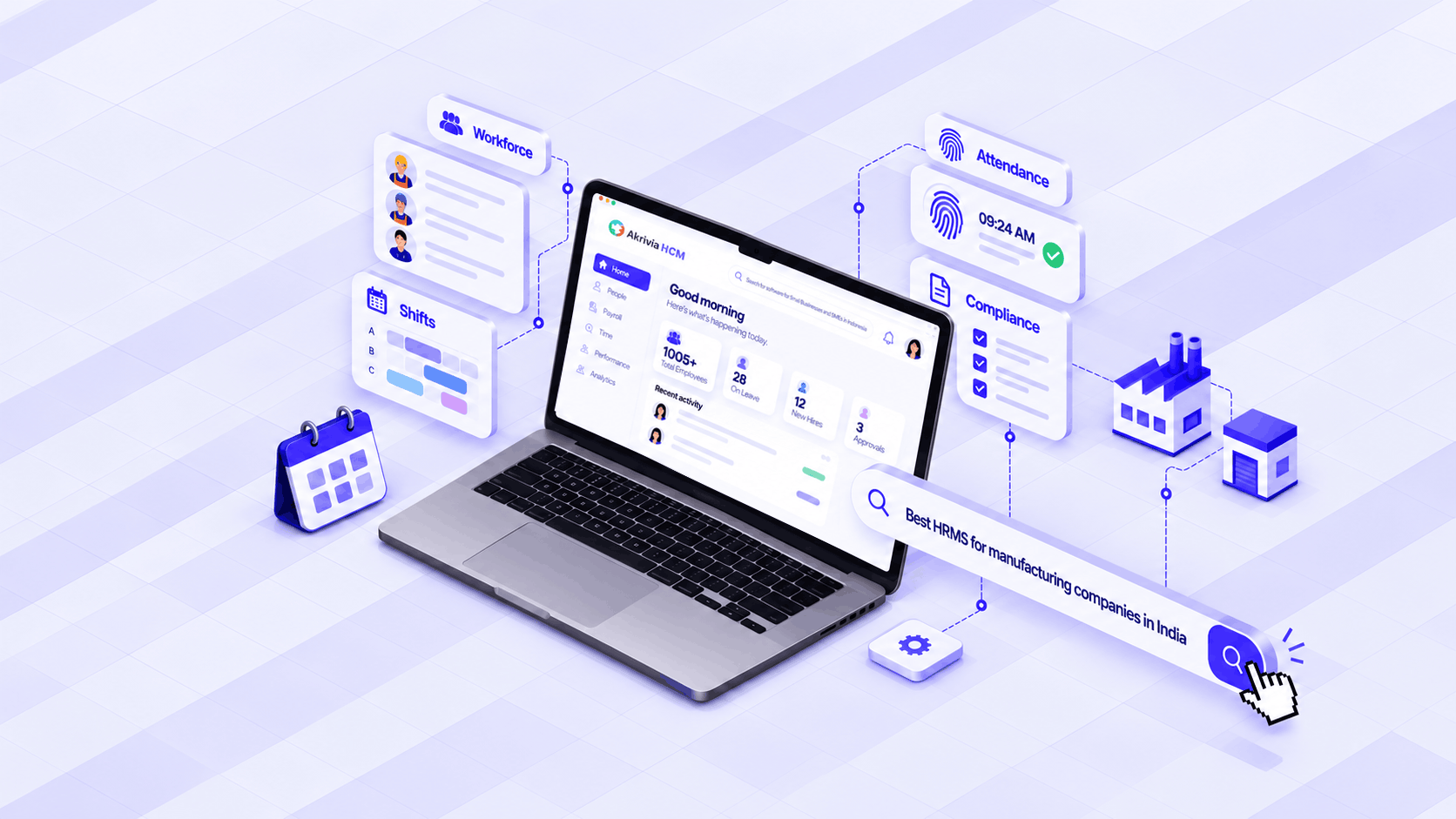
A factory HR team runs on three clocks. The shift clock decides who is on the line and for how long. The wage clock decides what each person is paid, including overtime, allowances and statutory deductions. The inspection clock decides whether the records behind both can be produced when an officer asks. A good HRMS for manufacturing companies in India keeps all three in sync. A weak one forces your team to reconcile them by hand, plant by plant.
That job has just become harder. The four labour codes took effect on 21 November 2025, and from 17 September 2026, the EPF wage ceiling in India rose from ₹15,000 to ₹25,000, which pulls a large share of shop floor wages into a higher contribution base. This guide explains what a plant needs from software in 2026 and compares the platforms Indian manufacturers most often shortlist, starting with the one built for multi-shift, multi-state operations.
What a plant needs that an office does not
Most HR software a manufacturer evaluates was designed around office employees: a laptop, a fixed day, a monthly salary. A plant breaks every one of those assumptions. These are the requirements that separate an HRMS for manufacturing companies in India from a general one.
- Multi-shift scheduling: shift management software that handles fixed and rotating shifts, shift swaps, night shift rules, and weekly offs without a spreadsheet roster.
- Attendance from the shop floor: biometric, face, or geofenced punches syncing to the HRMS, with overtime computed from the raw data.
- Overtime that follows the law: under the new labour codes, overtime must be paid at not less than twice the normal rate of wages.
- Multi-state statutory payroll: payroll runs on state-specific rules across India, so PF, ESI, professional tax, and labour welfare fund differ by state, and a group with plants in three states runs three rulebooks.
- Contract and temporary workforce: contractor workers on site need enrollment and wage and challan tracking that sits alongside your own payroll.
- Mobile access for people without a corporate email: payslips, leave, and shift timings on a phone, ideally in regional languages.
Also read: Best HR software in India
Three changes landing on the shop floor
Three recent changes make this a good moment to review your system.
- The revised wage definition under the labour codes requires basic pay to make up at least half of total remuneration, which changes the PF, gratuity, and overtime bases in the payroll teams run today.
- The EPF wage ceiling of ₹25,000 brings employees earning between ₹15,001 and ₹25,000 into a higher contribution base, which hits the many plants where operators, helpers, and technicians sit in that band. ESI still applies only up to the ₹21,000 threshold, so workers earning between ₹21,001 and ₹25,000 are now covered by PF but not ESI.
- Flexible working patterns, such as 12-hour days in a four-day week, are now possible as long as weekly hours stay within the 48-hour limit. They need rostering and overtime rules that can model them, and the daily overtime treatment should be confirmed against your state’s final rules.
HRMS for manufacturing companies in India at a glance
| Platform | Shift and overtime | Biometric and device attendance | Multi-state statutory payroll | Best fit |
| Akrivia HCM | Native | Syncs with HR portal | Native | Mid-market to enterprise plants |
| Darwinbox | Native | Yes | Native | 1,000 and above |
| PeopleStrong | Native | 50 plus device connectors | Native | 1,000 to 10,000 |
| greytHR | Yes | Confirm in demo | Native | SME to mid-size plants |
| Keka | Standard | Confirm in demo | Strong, multi-state | Office heavy, 50 to 500 |
Read more: Best HRMS and HRIS in India.
Akrivia HCM: one system from the gate to the payslip
Of the platforms compared here, Akrivia HCM comes first because it is built to connect the shop floor to payroll without a middle layer of spreadsheets. It is a unified hire-to-retire platform, so recruitment, onboarding, core HR, attendance, payroll, performance, learning and analytics share one employee record.
For a plant, that means:
- Built-in shift management software with fixed and flexible daily schedules.
- Attendance as the source of truth for overtime, with biometric attendance synced to the HR portal and geofencing or geotagging for field and gate punches.
- Payroll linked directly to attendance, shifts, and leaves, with automated wage calculation and overtime monitoring.
- Multi-state statutory rules in one engine: PF, ESI, and professional tax across applicable states, labour welfare fund, TDS under both regimes, and gratuity provisioning in the same payroll engine.
- The four labour codes are reflected in the engine from November 2025, including the revised wage definition and overtime at twice the normal rate.
- Multiple legal entities managed from one dashboard, so a group with several plants and companies is not charged a surcharge for each.
- Multi-country payroll for manufacturers with a plant, sales office, or subsidiary in the Gulf, Malaysia, Singapore, or Indonesia.
- Akrivia CoPilot analytics for attrition, overtime cost, and headcount across plants.
- WhatsApp-based self-service, which helps where app adoption is low among shop-floor staff.
The honest trade-offs: Akrivia HCM is priced by headcount, modules and countries, so you need a conversation to get a number, and a standard deployment typically takes 6 to 12 weeks. For a single small workshop with one shift and no growth plans, that is more platform than needed.
Darwinbox
Darwinbox is a strong enterprise platform with serious attendance capability. It supports selfie and face recognition punches, configurable geofences, biometric devices, shift management software, overtime and native Indian payroll. It tends to appear in evaluations at around 1,000 or more employees.
Where to look closer:
- Multi-plant rollouts can take longer than a mid-size group expects, so ask for a realistic timeline by plant.
- Pricing is quote-based and driven by headcount and modules, which can weigh on a mid-market budget.
- Test how deeply it handles contractor workers on site before you assume it does.
PeopleStrong
PeopleStrong positions itself strongly around blue collar and manufacturing needs. It lists direct connectors for more than 50 biometric devices, multi-state payroll with automatic PF, ESIC and professional tax, statutory form generation, mobile access for frontline workers in several Indian languages, and a contractor compliance dashboard.
Where to look closer:
- It is aimed at larger enterprises, so a plant with a few hundred people may find the platform heavier than necessary.
- Scoping a multi-plant deployment is a project in itself, with timelines that scale with the number of sites.
- Cross-border payroll beyond India should be tested in a demo if you operate abroad.
greytHR
greytHR is widely used HR software manufacturing India SMEs adopt, and it presents itself as a strong fit for manufacturers. Its manufacturing offering covers shift and overtime management, leave tracking, a mobile employee portal, and loan workflows for blue-collar workers. It is simple to adopt and priced for the SME segment.
Where to look closer:
- Biometric device integrations and contractor workforce depth are not highlighted publicly, so ask for a live demonstration.
- Complex multi-entity, multi-plant structures and cross-border payroll sit outside its core.
- As headcount and plant count grow, check how reporting and approvals scale.
Keka
Keka is one of the best-regarded HR platforms for user experience, with clean design, strong performance management and published pricing. Its strength is the office-based, India-focused business with 50 to 500 employees.
Where to look closer:
- A shop floor workforce on multiple shifts with biometric devices needs thorough testing, since the platform is built around office teams.
- Multi-entity payroll creates workarounds as complexity grows.
- Payroll is India only, so a manufacturer with an overseas unit needs another vendor.
The plant wall: where office-first HR tools stop
Many manufacturers start on an office tool and run into the plant wall as the shop floor grows. It shows up as small workarounds that quietly multiply:
- Attendance is downloaded from biometric machines and uploaded to the payroll system every cycle.
- Overtime is calculated in Excel because the shift management software cannot apply different rules by shift or plant.
- Contract workers are tracked in a separate file, and the contractor challans are chased by email.
- Each state’s professional tax and welfare fund are maintained manually.
- Monthly attrition, overtime cost, and headcount reports are assembled from three exports.
If three or more of these sound familiar, the problem is rarely a missing feature. It is a platform that was designed for a different kind of workforce.
What to test in a plant demo
When you evaluate any HRMS for manufacturing companies in India, put the same ten minutes of questions to every vendor, using your own data.
- Import one week of raw punch data from your actual biometric machines and compute overtime.
- Show overtime at twice the normal rate and the revised wage definition on a real salary structure.
- Run multi-state payroll for employees across two states with different professional tax and welfare fund rules.
- Show how contractor workers and their statutory compliance are tracked.
- Switch an employee between two shifts in the middle of a month and show the effect on pay.
- Demonstrate payslip and leave access from a basic Android phone in a regional language.
Conclusion
The best HRMS for manufacturing companies in India is the one that keeps the shift clock, the wage clock, and the inspection clock in sync across every plant and state you operate in. With the labour codes in force and the EPF wage ceiling now at ₹25,000, the cost of getting overtime, wage definitions, and contributions wrong has risen.
Akrivia HCM is built for manufacturers that have outgrown office-first tools: multi-shift attendance, native multi-state payroll, multi-entity control and multi-country reach in one system.
Book a free demo and bring a week of your own attendance data to see it at work.
FAQs
Who pays PF for contract workers in India?
The contractor is the employer of record, but the principal employer can be held liable for missed contributions. Track contractor challans monthly.
Is biometric attendance legally required in factories?
No statute names biometric devices. Factories must keep attendance and wage records, and biometric punches are one accepted way to produce them.
Do fixed-term workers get gratuity under the new codes?
Yes, fixed-term employees can claim gratuity after one year of continuous service. Check your payroll provisions for it.
How long does a multi-plant HRMS rollout take?
A standard single-site deployment typically takes 6 to 12 weeks. Multi-plant groups usually phase sites over several months.