

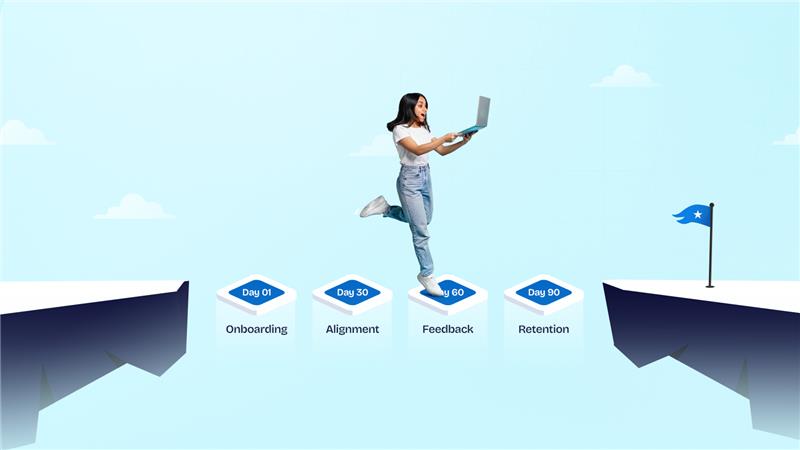
The hiring race does not end with an offer letter, it begins on Day 1. While organisations invest heavily in sourcing and employer branding, the real retention battle is fought during the first 90 days. This period silently determines whether talent integrates, performs, or disengages.
Findings from McKinsey’s HR Monitor 2025 reinforce this concern: only 56% of offers are accepted, and 18% of new hires exit during probation.
Across industries, companies are witnessing the same pattern: strong hiring pipelines followed by sudden exits during probation. This drop-off, known as the probation cliff, is now one of the biggest threats to early tenure retention.
Fixing it requires more than better hiring; it demands a structured retention strategy rooted in the end-to-end employee lifecycle management.
The Probation Cliff Explained: Why New Hires Drop Off Early
The probation cliff reflects the sharp rise in exits caused by gaps between hiring promises and on-the-job reality. Probation period attrition is rarely sudden; it builds quietly through missed expectations and weak engagement.
- Early employee attrition often begins when new hires struggle to understand priorities, success metrics, or cultural norms. Without clear management, confidence drops and disengagement grows.
- During the first few weeks, expectations formed during interviews meet real working conditions. When unexpected mismatches occur, motivation declines. Poor early-stage employee engagement, delayed feedback, and unclear KRAs accelerate dissatisfaction.
Many employees do not voice concerns during probation. Instead, they disengage internally, leading to resignations that feel abrupt but are driven by weeks of silent disconnect.
Why Traditional HR Systems Fail the First 90 Days
Most organisations face serious HR retention challenges because traditional HR systems are not built for early-tenure engagement and clarity. The first 90 days should prioritize structured onboarding, guided learning, and clear goal setting, yet many systems treat these as disconnected processes.
- Fragmented HR systems force teams to manage onboarding, learning plans, and early goals across multiple tools. This fragmentation delays alignment, creates confusion for new hires, and weakens accountability during the most critical adjustment phase.
- Manual processes also make probation milestone tracking inconsistent. Missed 30-, 60-, or 90-day check-ins mean new employees lack direction, feedback, and learning reinforcement. Without HR automation for onboarding, early disengagement often goes unnoticed.
- Traditional tools also fail to combine behavioural signals, learning progress, goal clarity, and feedback into a single view. This lack of insight prevents proactive retention decisions during probation.
Traditional HR tools depend heavily on manual tracking. Organisations can reduce these inefficiencies by automating recruitment workflows, ensuring smoother coordination across hiring and onboarding stages.
Find out the Top 11 Ways to Automate Your Recruitment Process
The Business Impact of Early-Tenure Attrition
Early-tenure attrition creates long-term damage beyond immediate resignations. It directly affects cost structures, productivity, and organisational credibility.
| Impact Area | Description |
| Financial costs |
|
| Productivity loss |
|
| Team disruption |
|
| Managerial strain |
|
| Employer brand damage |
|
| Forecasting inaccuracy |
|
How Akrivia HCM Reinvents the First 90 Days
Akrivia HCM addresses early-tenure challenges by creating a unified ecosystem for onboarding, learning, performance, and engagement. It provides actionable insights, structured workflows, and automation that support both HR teams and new hires throughout the probation phase.
With real-time onboarding analytics, HR teams and managers gain clarity into risks early there by strengthening employee engagement during probation.
A Single Dashboard for All New-Hire Insights
Onboarding dashboards provide a consolidated view of tasks, goals, learning progress, and manager check-ins. This improves new hire visibility from Day 1.
- Using Custom made dashboards managers and leaders can track progress against expectations, identify delays, and deliver timely feedback reducing confusion and disengagement.
- These dashboards eliminate blind spots created by disconnected systems, enabling faster intervention and smoother onboarding journeys.
First-90-Day Performance & Analytics
The first 90 days of performance tracking allows organisations to monitor goal progress, behavioral alignment, and learning adoption.
- With onboarding analytics for HR teams, drop-off points become visible early. This data supports timely coaching rather than reactive exits.
- Built-in employee sentiment tracking adds qualitative insight, helping HR detect workload imbalance, role clarity issues, or cultural misalignment.
Analytics offer an additional layer of understanding by analysing feedback, survey responses, and employee interactions. This helps HR identify issues such as a lack of support, misaligned workloads, or cultural disconnects.

Integration of Onboarding + Learning + Performance + HR
Akrivia HCM integrates onboarding, learning, performance, and HR workflows to create a seamless onboarding ecosystem. This eliminates silos and improves coordination across stakeholders.
- New hires gain access to learning paths directly connected to their performance goals. As they complete modules, progress reflects automatically in the performance dashboard, maintaining alignment between skill-building and expected outcomes.
- HR teams benefit from consistent data flows. Instead of juggling multiple systems, they access a unified platform that reduces errors, enhances compliance, and improves operational efficiency.
Check out the Step-by-Step Guide to the Performance Management System
Turning Day 1 Excitement into Long-Term Commitment
Strong employee engagement during probation transforms first-day enthusiasm into sustained performance. Consistency, clarity, and support drive long-term employee retention.
- Regular manager check-ins and structured goals reduce uncertainty. Employees gain confidence in their role and contribution.
- Continuous employee feedback during probation reinforces belonging.
- Over time, consistent engagement transforms Day 1 excitement into lasting employee equity. Organisations experience higher retention, improved performance management, and better cultural stability.
Preparing for 2026: Why Fixing the First 90 Days Matters Now
As organisations prepare for 2026, the ability to retain, develop, and scale talent will depend heavily on how effectively new hires are supported in their first 90 days.
Early-tenure experiences shape employee confidence, performance, and long-term commitment. When this phase lack’s structure or visibility, organisations risk higher attrition and unstable workforce planning.
By focusing on structured onboarding, measurable milestones, and data-driven insights, organisations can reduce early exits and create a predictable foundation for growth.
Akrivia HCM enables this shift by providing a single, integrated platform that supports new hires from Day 1 while delivering real-time insights to HR leaders.
With a clear roadmap for onboarding, measurable milestones, and a unified platform for all HR functions, by addressing the probation cliff early, organisations can build a stable, future-ready workforce, one that is prepared to meet the talent demands of 2026 and beyond.
FAQs
How does Akrivia HCM support probation milestone tracking?
Akrivia HCM automates 30-, 60-, and 90-day checkpoints with reminders, dashboards, and documented feedback, ensuring consistent probation management.
Can HR teams identify flight risk during probation?
Yes. Sentiment data, engagement signals, and performance trends help flag early disengagement before resignations occur.
Does Akrivia HCM replace existing HR tools?
No. It integrates seamlessly with existing ATS and HR systems, strengthening workflows without disruption.
How do onboarding analytics improve early retention?
Analytics highlight bottlenecks, skill gaps, and engagement drops, enabling timely interventions during probation.
Is Akrivia HCM suitable for growing organisations?
Absolutely. The platform scales with workforce size and supports structured onboarding across departments and geographies.