
Most Malaysian businesses do not leave Kakitangan angry. They leave quietly, after a spreadsheet moment.
Someone in finance pulls up the monthly software costs and realizes that E-Payroll, E-Leave, E-Claims, and E-Attendance, each billed separately, each scaling with headcount, have quietly added up to more than what a full-suite HR platform would cost. And the full-suite platform would also include the performance management, recruitment, and reporting modules that Kakitangan does not offer at any price tier.
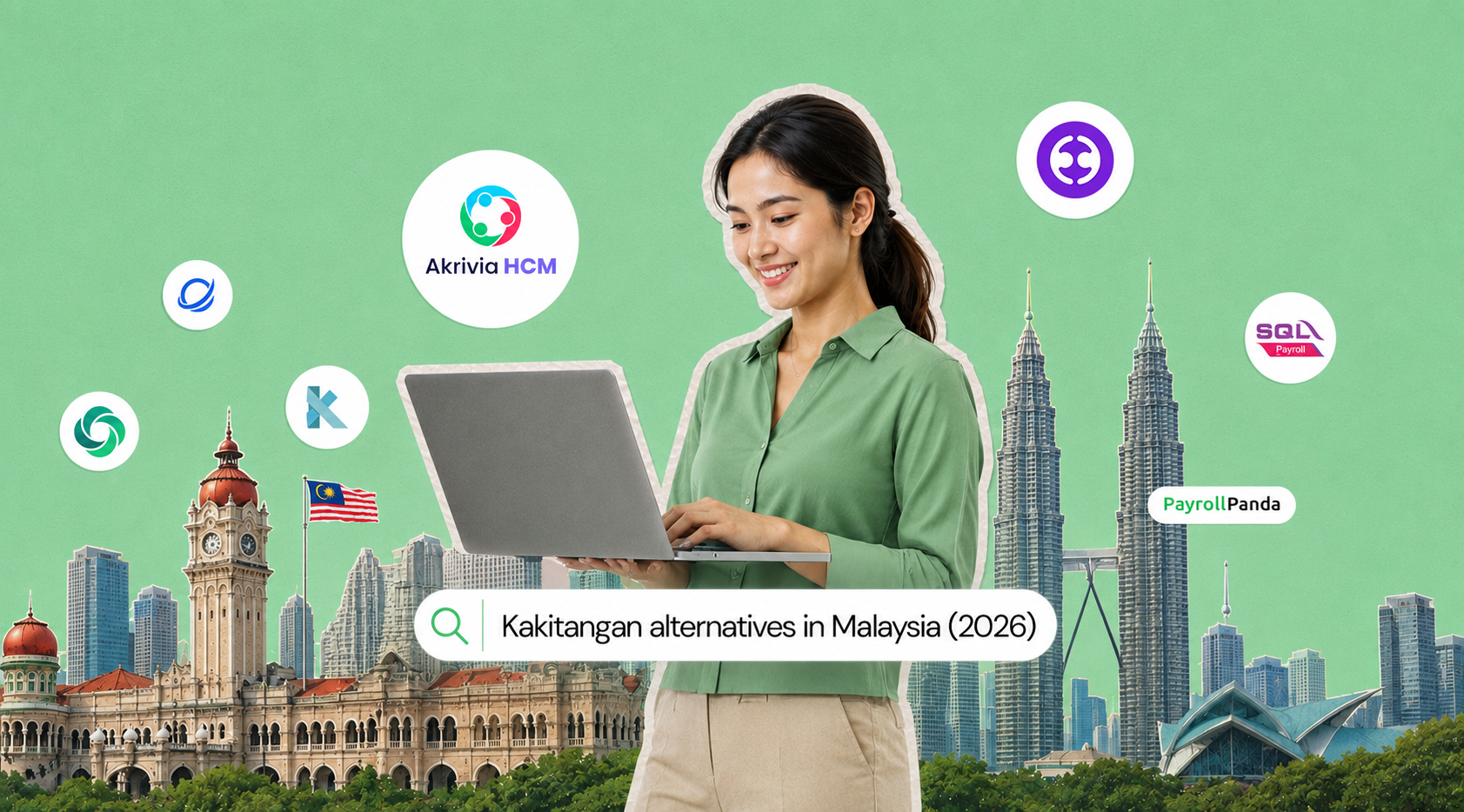
That is the moment the search for Kakitangan alternatives in Malaysia 2026 usually begins. Not a dramatic failure. A quiet realization that the modular model made sense at ten employees and stopped making sense somewhere around one hundred.
This guide is written for exactly that moment. Here is an honest look at what Kakitangan still does well, four clear signals that it is time to move on, and which platform actually fits where your business is going.
What Kakitangan Still Does Well
To be clear before comparing anything: Kakitangan is a solid, locally built payroll system that Malaysian SMEs have relied on for years. Three things it genuinely gets right:
- EPF, SOCSO, EIS, and PCB compliance is reliable: Statutory tables update automatically, bank integration works cleanly with major Malaysian banks, and EA Form and Borang E generation are handled without manual intervention
- Modular entry is genuinely accessible: The free tier for small headcounts and the low base pricing for small teams make it one of the most affordable ways for micro-businesses to get off spreadsheet payroll
- It is built for Malaysia: PDPA compliance, local bank formats, LHDN-aligned CP39 submissions; the local depth is real and tested
If you are a ten to thirty person business with simple payroll and your primary concern is statutory accuracy at low cost, Kakitangan still makes sense. This guide is for everyone else.
Check out: Best Payroll Software in Malaysia
When Your HRMS Needs Go Beyond Kakitangan
If two or more of the following apply to your business, it may be time to consider a more scalable HRMS.
- Rising monthly software costs: Once your workforce reaches around 80–100 employees, Kakitangan’s modular pricing can climb past roughly RM 500 per month, at which point bundled HRMS platforms often become more cost-effective.
- Business expansion across multiple entities: Managing more than one legal entity requires multi-entity capabilities that Kakitangan does not provide.
- Fragmented HR operations: Using separate tools for payroll, attendance, claims, and performance creates disconnected data and additional manual work.
- International workforce growth: If you’re hiring outside Malaysia, you’ll need multi-country payroll support, which Kakitangan does not offer.
Picking the Right Platform for Your Stage
| Your Situation | Best Choice |
| Growing mid-market, multi-entity payroll or regional expansion, need unified HR + native compliance | Akrivia HCM |
| Need simple, free Malaysian payroll, nothing else | PayrollPanda |
| Small team wanting modern, clean integrated HR | Swingvy |
| Want full Kakitangan-equivalent plus recruitment and performance | BrioHR |
| Already running SQL accounting, want finance-payroll integration | SQL Payroll |
| Expanding to Singapore or Australia alongside Malaysia | Employment Hero |
Read: Top 10 HR Software in Malaysia
Breaking Down the Alternatives
The six platforms below cover very different ground. Rather than treating them as interchangeable options, here is the honest verdict on who each one is actually right for.
Akrivia HCM
Akrivia HCM is a hire-to-retire platform where every module lives in the same system and talks to every other module in real time. Attendance feeds into payroll automatically. Performance data connects to compensation reviews. Recruitment pipelines flow into onboarding without re-keying data. People analytics pull from every module and surface on one dashboard.
For Malaysia specifically:
- EPF, SOCSO, EIS, PCB, and HRDF all automated natively within the payroll engine, with auto-updating statutory tables, EA Form generation, Borang E, CP39, and e-CP39 LHDN submissions built in
- Multiple Malaysian legal entities and pay groups managed from one dashboard, without per-entity pricing penalties that compound as you grow
- Multi-country payroll covering Malaysia, Singapore, UAE, India, and the broader GCC and Southeast Asia natively in one platform, no separate local vendors and no parallel reconciliation
- AI-powered people analytics and Akrivia CoPilot for workforce insights that go far beyond what any payroll-first tool delivers
- Employee self-service portal where employees manage their own payslips, leave applications, and personal records without HR involvement at every step
Akrivia is not the right answer for a 30-person business looking for a Kakitangan. It is the right answer for a 200 to 1,500 employee business that has outgrown what SME-focused HR software was designed to handle, and needs a platform that grows with them rather than requiring another migration in 18 months.
PayrollPanda
If the Kakitangan issue is purely pricing and your actual need is payroll compliance with no extra layers, PayrollPanda solves the problem immediately. The free base plan covers unlimited payroll runs with full full EPF, SOCSO, EIS, and PCB compliance, LHDN-approved CP39 submissions, and EA Form generation. It integrates with Jibble for basic attendance tracking. Setup takes a day, not a week.
The honest trade-off: PayrollPanda is payroll only. There is no leave management, no claims, no performance, no recruitment, and no path to multi-country payroll. It is the right answer if you are simplifying, not scaling. For businesses that need to grow their HR function alongside headcount, PayrollPanda gets you off the modular pricing treadmill but puts you back on spreadsheets for everything else.
Swingvy
Where Kakitangan is functional and locally precise, Swingvy is modern and visually clean. For small HR teams or businesses without a dedicated HR manager, Swingvy’s interface reduces the learning curve significantly. EPF, SOCSO, EIS, and PCB are handled natively, leave and claims sit alongside payroll, and the mobile app is genuinely easy for employees to adopt without a training session.
The honest trade-off: Swingvy works well for teams under 100 employees with straightforward HR needs. Past that, the ceiling becomes visible, complex leave policies require workarounds, multi-entity payroll is not supported, and there is no meaningful recruitment or performance management layer. It is an upgrade in experience from Kakitangan, not an upgrade in depth.
SQL Payroll
If your finance team runs on SQL accounting and has no intention of changing that, SQL Payroll is the natural continuation. The payroll and accounting integration is tight, the EPF, SOCSO, EIS, and PCB compliance depth is genuine, and multi-branch payroll management from one dashboard is handled reliably. Accountants in Malaysia are broadly familiar with SQL, which reduces onboarding friction.
The honest trade-off: SQL Payroll is built for finance-first businesses that prioritize compliance and accounting integration over modern HR. The interface is legacy, remote access is limited, and there is no recruitment, performance, or L&D layer. If your reason for leaving Kakitangan is that you need more than payroll, SQL Payroll moves you sideways, not forward.
Employment Hero
Employment Hero earns serious consideration only when multi-country payroll is the primary driver for switching. It is one of the few platforms that genuinely covers Malaysia, Singapore, and Australia from one system, with recruitment, performance, and employee benefits built in alongside payroll. For businesses where the regional footprint already exists or is imminent, it removes the parallel local vendor problem that Kakitangan creates.
The honest trade-off: Malaysian EPF, SOCSO, EIS, and PCB compliance is delivered through a partner integration rather than a native engine, which can mean slower updates when LHDN or PERKESO tables change. Pricing scales into enterprise territory quickly. And if your regional ambitions extend beyond Singapore and Australia, into UAE, India, or broader Southeast Asia, Employment Hero’s coverage becomes patchier. It solves the two-country problem well. It does not solve the four-country problem.
BrioHR
For most businesses leaving Kakitangan, BrioHR is the most natural next step. It covers everything Kakitangan does, native EPF, SOCSO, EIS, and PCB payroll compliance, Malaysian bank integration, leave, claims, and attendance, and adds what Kakitangan does not: a proper recruitment module, structured performance management, GPS-based clock-in for distributed teams, and Singapore CPF compliance alongside Malaysian payroll in the same system.
The pricing structure is also simpler. Instead of four separately billed modules scaling with headcount, BrioHR uses a per-employee model that is easier to model in a three-year TCO calculation.
The honest trade-off: BrioHR is strong for Malaysia and Singapore. For businesses expanding beyond those two markets, into UAE, India, or further, it runs out of native payroll coverage. Performance and L&D modules are present but not as deep as what mid-market HR teams need once talent management becomes a strategic priority rather than an admin function.
Explore: BrioHR Alternatives in Malaysia
Conclusion
Kakitangan’s modular pricing model is honest and transparentyou pay for what you use. The problem is that what you use tends to grow faster than expected, and the modules you eventually need most, proper performance management, recruitment, multi-entity payroll, and regional expansion capability, are not available at any Kakitangan price tier.
The best Kakitangan alternative in Malaysia 2026 depends entirely on your next stage, not your current one. Most SMEs upgrading within the same scale will find BrioHR the cleanest path. Businesses crossing into mid-market territory with regional ambitions will find that Akrivia HCM is the last HRMS they will need to buy for the next five years.
FAQs
Did EPF become mandatory for foreign workers in Malaysia?
Yes, from October 2025, 2% employee and 2% employer. Check your platform applied this update correctly for all foreign employee payroll runs.
What is the current SOCSO wage ceiling in Malaysia?
RM 6,000 per month since October 2024, up from RM 4,000. Platforms with native compliance updated this automatically, others required manual correction.
Can you cancel Kakitangan without a long-term contract?
Standard plans are month-to-month with no lock-in. Run one parallel payroll cycle on your new platform before fully cutting over.
Does Malaysian payroll software reflect the 2022 Employment Act changes?
It should. The 2022 amendments expanded maternity leave to 98 days, introduced 7 days of paternity leave, extended coverage to all employees, and reduced the maximum working week from 48 to 45 hours. Ask any vendor to confirm their leave module reflects this before signing.