

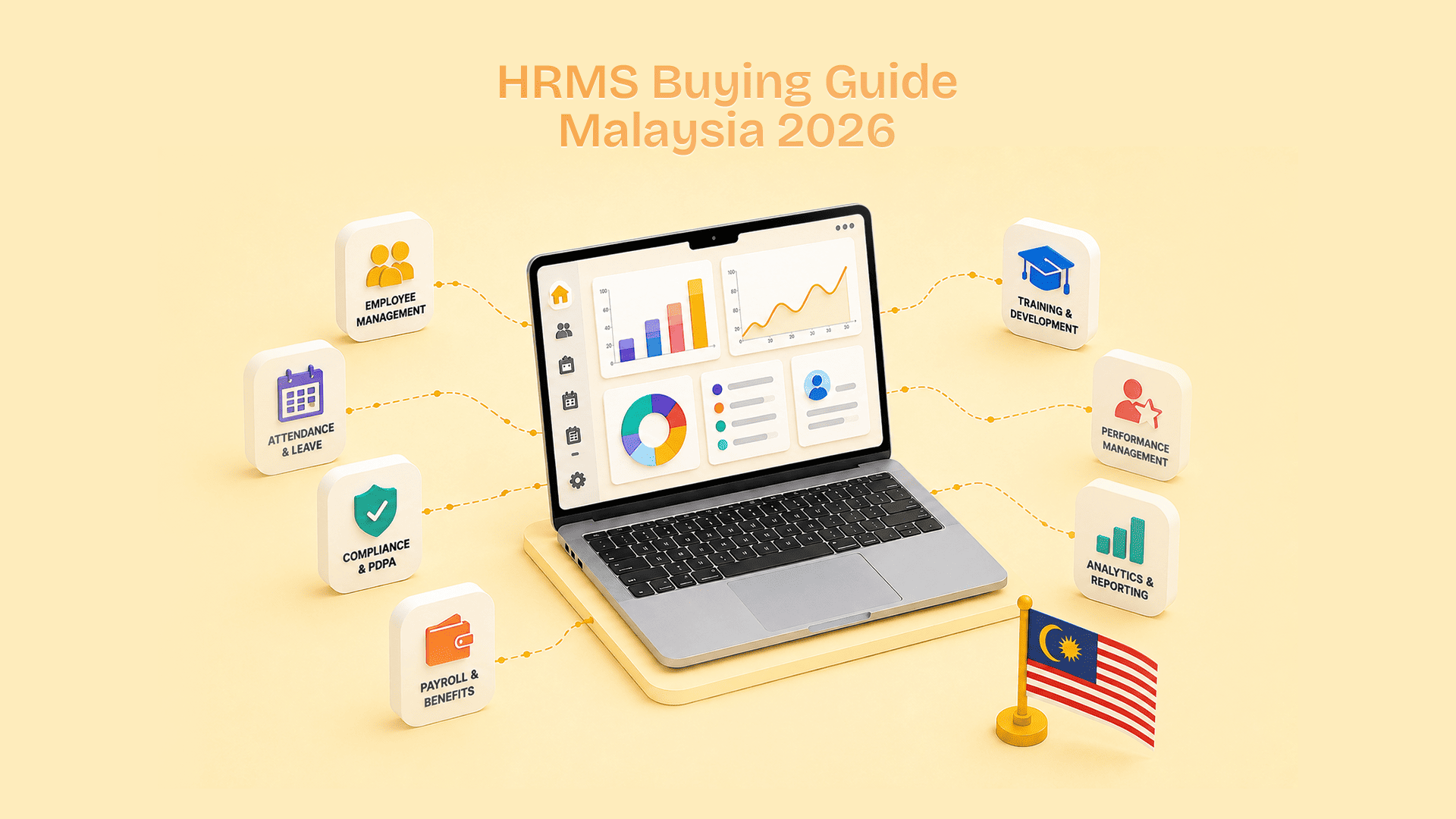
Malaysian HR teams making an HRMS decision in 2026 are doing so in the most complex compliance environment the market has seen in years.
Four significant regulatory changes landed within 18 months of each other. Foreign worker EPF became mandatory at 2% employer and 2% employee from October 2025. SKBBK Lindung 24 Jam, SOCSO’s new 24-hour non-work-accident coverage, came into force from June 2026 with a phased employee contribution starting at 0.75% of monthly wages, voluntary for Malaysians and PRs with opt-out available until 31 August 2026 via the LINDUNG Faedah Portal, and mandatory for foreign workers with no opt-out. The PDPA 2024 amendments introduced mandatory 72-hour breach notification and expanded data subject rights. The Employment Act 2022 amendments extended mandatory coverage to all employees regardless of salary.
Every one of these changes requires an HRMS to have updated its payroll engine correctly. Every vendor claims it has. This guide gives Malaysian HR buyers the framework to verify those claims before signing anything.
Step 1: Scope Your Actual Malaysian Business Needs First
Answer these questions before talking to any vendor.
- Headcount and growth trajectory: How many employees do you have today, and what is your realistic headcount in 24 months? An HRMS that works well at 100 employees sometimes hits operational limits at 300. Ask every vendor for reference customers at your projected headcount, not your current one.
- Foreign worker count: How many foreign workers does your organization employ? Foreign worker EPF at 2% employer and 2% employee from October 2025 plus mandatory SKBBK Lindung 24 Jam from June 2026 creates a compliance configuration requirement for every foreign employee in your system. Confirm these are handled correctly per foreign worker category before shortlisting any platform.
- Entity structure: How many Malaysian legal entities does your organization operate? Non-compliance with HRD Corp carries a fine of up to RM 10,000 and up to one year imprisonment. If each entity has its own KWSP employer registration, PERKESO number, and HRD Corp levy account, you need a platform that manages all entities from one instance without per-entity pricing penalties.
- Bank relationships: Which Malaysian banks do you use for payroll crediting? Maybank, CIMB, Public Bank, RHB, Hong Leong, and AmBank all use specific file formats. Confirm your bank’s file format is natively supported before comparing subscription prices across vendors.
- Regional expansion timeline: Do you have operations or concrete plans to hire in Singapore, Indonesia, UAE, or India within 24 months? If yes, shortlist only platforms with native multi-country payroll. Adding a separate local vendor in each new market creates reconciliation overhead that compounds with every new country.
- PDPA sensitivity: Does your organization handle employee personal data at a scale or sensitivity level where PDPA 2024 amendment compliance, role-based access controls, consent management, and 72-hour breach notification are board-level governance requirements rather than just IT checklist items? If yes, confirm PDPA compliance architecture is native in the standard plan, not gated behind an enterprise upgrade.
Step 2: Must-Have vs Nice-to-Have for Malaysian HRMS Buyers in 2026
Malaysian HRMS demos are designed to impress. This section gives you the filter.
Non-negotiable must-haves for 2026:
EPF at 13% employer for employees earning RM 5,000 and below, 12% above that threshold, and 11% employee contribution, calculated using the Third Schedule contribution table rather than flat percentages. Foreign worker EPF at 2% employer and 2% employee as mandatory from October 2025. SOCSO at table-based rates with the RM 6,000 wage ceiling effective October 2024. EIS at 0.2% each with the same RM 6,000 ceiling. PCB using LHDN monthly deduction tables with EA Form generation by 31 March and Borang E submission by 31 March. SKBBK Lindung 24 Jam at the Phase 1 employee contribution of 0.75% of monthly wages, fully employee-funded, with opt-out for Malaysians and PRs and no opt-out for foreign workers. The employer’s standard SOCSO contribution (the separate Employment Injury and Invalidity scheme) continues unchanged at its existing rate. HRD Corp levy at 1% of monthly wages for employers with 10 or more Malaysian employees in specified industries. Employment Act 2022 amendments covering extended coverage to all employees, 98-day maternity leave, and revised overtime definitions. PDPA 2024 amendments with role-based access controls, consent capture, data processing logs, and 72-hour breach notification readiness. All of these must be native and auto-updated when government tables change.
Nice-to-haves that vendors will lead with in demos:
AI-generated job descriptions. Pulse survey widgets. Gamification for performance check-ins. 400-plus pre-built report templates. Sentiment analysis on exit interviews. These are legitimate features. Evaluate them after every must-have above is confirmed live and native in the current platform version.
Also read: Best HRMS and HRIS in Malaysia
Step 3: TCO Framework Before Shortlisting
Malaysian HR software pricing is rarely what the per-employee rate suggests.
Five questions that must be answered in writing before any vendor goes on your shortlist:
Does billing start at contract signature or at go-live? A 60-day implementation on an annual contract worth RM 60,000 means RM 10,000 paid before a single employee uses the system. This is one of the largest hidden costs in Malaysian HRMS contracts and one of the least discussed.
Is SKBBK Lindung 24 Jam from June 2026 native and included in your base subscription, or charged as a configuration update? The SKBBK employee contribution of 0.75% of monthly wages must be accurately deducted, ensuring compliance with PERKESO’s expanded out-of-office medical and accident coverage. Platforms treating this as a billable update add to your compliance cost every time a new scheme launches.
What is the per-entity cost for Malaysian group companies? Per-entity charges are rarely disclosed upfront. A three-entity Malaysian group can face surcharges of RM 20,000 to RM 60,000 annually on platforms that price this way.
What are Year 2 and Year 3 subscription prices? Vendors with annual uplifts built into contracts can increase your cost significantly over three years without any increase in what you use. Ask for the exact escalation percentage and a cap, in writing.
Is the SKBBK opt-out management for Malaysians and PRs handled in the system? Malaysian citizens and PRs can opt out of SKBBK until 31 August 2026 via the LINDUNG Faedah Portal. An HRMS that cannot track which employees have opted out creates a compliance record-keeping gap from day one.
Step 4: Malaysian HRMS Shortlisting Scorecard
Score every platform before scheduling any demo. Use 2 for native and live, 1 for available at additional cost, and 0 for not available.
Section 1: Statutory compliance (max 24)
| Criterion | Score (0/1/2) |
| EPF Third Schedule native, auto-updated | |
| Foreign worker EPF 2% (Oct 2025) applied | |
| SOCSO table-based, RM 6,000 ceiling | |
| EIS 0.2% each, RM 6,000 ceiling | |
| PCB LHDN tables auto-updated | |
| SKBBK Lindung 24 Jam native | |
| SKBBK opt-out tracking for MY/PR | |
| HRD Corp levy 1% native | |
| EA Form and Borang E generation | |
| Employment Act 2022 coverage | |
| 98-day maternity leave configured | |
| Auto-update on all regulatory changes |
Section 2: Malaysian operational fit (max 14)
| Criterion | Score (0/1/2) |
| Major MY bank file formats native | |
| Attendance feeds directly into payroll | |
| Multi-entity in one instance | |
| No per-entity surcharge | |
| PDPA 2024 role-based access controls | |
| PDPA consent management native | |
| 72-hour breach notification readiness |
Section 3: Commercial terms (max 10)
| Criterion | Score (0/1/2) |
| Billing starts at go-live, not signature | |
| Implementation fee in writing | |
| Year 2 and 3 pricing confirmed | |
| Annual uplift capped in contract | |
| SKBBK update in subscription, not billable |
Section 4: Scalability (max 8)
| Criterion | Score (0/1/2) |
| Multi-country payroll native | |
| Full HR suite included | |
| People analytics in base platform | |
| LMS native |
Total score: ___ / 56. A platform scoring below 40 carries material compliance or commercial risk for a Malaysian business at any scale. Platforms scoring above 48 are genuinely shortlist-worthy. Complete this scorecard for every vendor before scheduling a demo.
Step 5: Demo Questions That Break Malaysian Vendor Scripts
These ten questions break through scripted Malaysian HRMS demos and reveal the compliance gaps and operational limitations that vendor presentations never show.
- Run a live payroll calculation for a foreign worker earning RM 4,000 basic salary per month. Show me the EPF, SOCSO, EIS, SKBBK, and PCB deductions applied in this month’s payroll run.
This tests five compliance items simultaneously. The foreign worker EPF at 2% employer and 2% employee, SOCSO table-based, EIS at 0.2% each, SKBBK at the 0.75% employee contribution (employee-funded), with the employer’s separate standard SOCSO contribution applied unchanged, and PCB at the correct LHDN bracket. A platform that runs this correctly on a live foreign worker payslip without manual adjustments is current. One that hesitates on SKBBK or defaults the foreign worker to the pre-October 2025 EPF exemption is not.
- When PERKESO issued the SKBBK Lindung 24 Jam circular for June 2026, how was this applied in your payroll engine and when did it take effect for your clients?
Native auto-update platforms will have a specific date and a version release note. Platforms that treated it as a professional services configuration will describe a client notification and configuration process. The difference in those two answers tells you everything about how future regulatory changes will be handled.
- Show me how a Malaysian employee’s SKBBK opt-out is recorded and tracked in your system if they submitted via the LINDUNG Faedah Portal before 31 August 2026.
Malaysian citizens and PRs can opt out of SKBBK via the LINDUNG Faedah Portal until 31 August 2026. A platform without an opt-out tracking field creates a manual record-keeping gap for every employee who exercised this right. If the vendor says “we do not have a specific opt-out field, you can use a custom field,” that is a manual workaround, not a native compliance feature.
- We have three Malaysian legal entities. Show me how payroll is processed across all three from one login without switching between separate instances.
Tests whether multi-entity is native or requires separate logins per entity. If the demo requires logging out and into a different account for each entity, that is a separate implementation model regardless of how it is priced.
- Our PDPA compliance team requires an audit log of every access to employee personal data. Show me that log and confirm it is available in the standard plan, not only in the enterprise tier.
Tests PDPA 2024 amendment compliance at the data governance level. A vendor that says “that feature is available in our enterprise tier” is confirming that your standard plan does not meet 2024 PDPA data processing log requirements.
- Show me the bank file output for our Maybank salary crediting. Can you also generate the CIMB format for our subsidiary that banks with CIMB, from the same payroll run?
Tests whether bank file format generation is native for your specific banking relationships and whether multiple bank file formats can be produced from one payroll run for a multi-entity organization.
- The Employment Act 2022 extended mandatory coverage to all employees regardless of salary. Show me where an employee previously excluded from EA coverage because their salary exceeded the old RM 2,000 threshold is now configured in your system.
Tests Employment Act 2022 amendment implementation. Platforms that have not updated their EA coverage configuration are still treating some employees as EA-excluded when they are now legally covered.
- We plan to open an office in Singapore within 12 months. What happens to our HR and payroll setup when we do?
Tests multi-country payroll capability. Vendors that say “we can connect you with a Singapore partner” are confirming they cannot handle it natively. The answer you want: “the same payroll engine that handles your Malaysian EPF and PCB also handles Singapore CPF, SDL, and IR8A natively.”
- What is your average support ticket resolution time during month-end payroll processing, and can you share documented SLA performance data from the last three months?
Tests the support model under payroll week pressure. Ask for actual SLA performance data, not a promised SLA. Vendors who cannot produce this are relying on a promise rather than a track record.
- If we sign today, when exactly does billing start and what go-live date are you committing to in writing?
Asking both questions together forces clarity on the billing start date and realistic go-live timeline simultaneously. The gap between these two dates, if any, is a direct cost that belongs in your Year 1 TCO model.
Explore: HR and Payroll Software Pricing in Malaysia
Step 6: Malaysian HRMS RFP Checklist
Use this for formal procurement processes.
Section 1: Malaysian Statutory Compliance
Require written confirmation of native support for: EPF Third Schedule calculations at correct employer rates, foreign worker EPF at 2% to 2% from October 2025, SOCSO table-based at RM 6,000 ceiling, EIS at 0.2% each, SKBBK Lindung 24 Jam at current Phase 1 rates with opt-out tracking for Malaysians and PRs, PCB using current LHDN monthly deduction tables, HRD Corp levy at 1% for eligible employers, EA Form and Borang E generation. Require auto-update SLA in writing for all regulatory changes, specifically including time from government circular to system update.
Section 2: Malaysian Payroll Architecture
Require confirmation of: major Malaysian bank file format generation natively (Maybank, CIMB, Public Bank, RHB minimum), attendance-to-payroll direct feed without manual import, multi-entity payroll from one instance without per-entity pricing, Employment Act 2022 coverage configuration for all employees, overtime at 1.5x normal days and 2x rest days with correct stacking for public holiday overlap.
Section 3: PDPA 2024 Amendment Compliance
Require: role-based access controls limiting employee data to authorized users by role, data processing activity logs for all access and modification events, employee consent capture and management system, 72-hour breach notification process documentation, data processing agreement compliant with Malaysian PDPA requirements.
Section 4: HR Module Coverage
Specify modules required at go-live versus activated within 12 months. Request pricing for both scenarios. Confirm whether modules are in the base subscription or separately licensed. Confirm LMS and people analytics module availability specifically.
Section 5: Commercial Terms
Require in writing: billing start date at go-live not contract signature, three-year pricing with annual uplift cap, SKBBK and all future regulatory update cost model confirmed in subscription, implementation and data migration cost written and itemized, bank file format integration included, custom reporting self-service or vendor-ticketed, data export process at contract end.
Section 6: Implementation
Require: project plan with milestone dates and named go-live definition, parallel payroll run for minimum one full Malaysian payroll cycle before cutover, named implementation project manager, post-go-live hypercare period of minimum 30 days.
Section 7: References
Require two Malaysian customer references at similar headcount and entity complexity with permission to contact directly. For manufacturing, retail, or healthcare businesses, require a reference from the same industry. Ask specifically about SKBBK implementation experience and how the vendor handled the foreign worker EPF change from October 2025.
Where Akrivia HCM Fits This Framework
Running Akrivia HCM through the scorecard above for Malaysian mid-market buyers:
- On statutory compliance, EPF Third Schedule calculations at the correct employer rates, foreign worker EPF at 2% to 2% from October 2025, SOCSO table-based with the RM 6,000 ceiling, EIS, PCB using LHDN tables, SKBBK Lindung 24 Jam from June 2026 including opt-out tracking for Malaysians and PRs, HRD Corp levy, EA Form, and Borang E are all automated natively with automatic regulatory updates.
- On operational fit, major Malaysian bank file formats are generated natively. Attendance feeds directly into payroll. Multiple Malaysian legal entities are managed from one dashboard without per-entity pricing penalties. PDPA 2024 amendment compliance including role-based access controls, consent management, and data processing activity logs is included in the standard platform architecture.
- On commercial terms, billing starts at go-live. SKBBK and all regulatory updates are included in the subscription. Three-year pricing is confirmable before signing.
- On scalability, multi-country payroll covering Malaysia alongside Singapore, UAE, India, Indonesia, and broader GCC and Southeast Asia is native. Performance management, recruitment, LMS, and AI-powered people analytics are included in the platform.
Conclusion
Buying an HRMS in Malaysia in 2026 is not the same decision it was 18 months ago. SKBBK Lindung 24 Jam, foreign worker EPF, PDPA 2024 amendments, and Employment Act 2022 changes have all landed in the same evaluation window. Every platform claiming Malaysian compliance must be verified against these specific changes, not just the statutory framework that existed before them.
The framework in this guide removes the guesswork. Scope your needs before demos. Filter on must-haves before nice-to-haves. Run TCO before shortlisting. Score every vendor on the same criteria. Ask the ten demo questions before moving to commercial discussions. Build your RFP around Malaysian-specific requirements.
The right HRMS for your Malaysian business should pass every stage of this framework based on your headcount, entity complexity, and growth trajectory. Akrivia HCM is built for Malaysian mid-market businesses that need all three in one unified, natively compliant platform.
FAQs
Can Malaysian employees opt out of SKBBK Lindung 24 Jam?
Yes, Malaysian citizens and PRs can opt out via the LINDUNG Faedah Portal until 31 August 2026. Foreign workers have no opt-out option. Your HRMS must track which employees have opted out to maintain accurate contribution records per employee.
What changed in Employment Act coverage after the 2022 amendments?
The 2022 amendments extended EA coverage to all employees regardless of monthly salary, removing the previous RM 2,000 threshold. Maternity leave extended to 98 days. Paternity leave became mandatory at 7 days. Any HRMS not updated for these changes may still be applying pre-2022 leave entitlement rules to affected employees.
Is the HRD Corp levy mandatory for all Malaysian employers?
No, the HRD Corp levy applies to employers with 10 or more Malaysian employees in specified industries, including services, manufacturing, mining, construction, and agriculture. Government bodies, statutory bodies, and NGOs are excluded. Confirm your industry classification before configuring the HRD Corp levy in any HRMS.
How long does Malaysian HRMS implementation typically take for a 200-employee company?
Cloud-native platforms with standard configurations typically go live in four to eight weeks for core payroll, leave, and attendance. Adding performance, recruitment, and analytics extends this to ten to sixteen weeks. Always confirm the billing start date against the go-live date before signing, as the gap between these two dates is a direct Year 1 cost.