

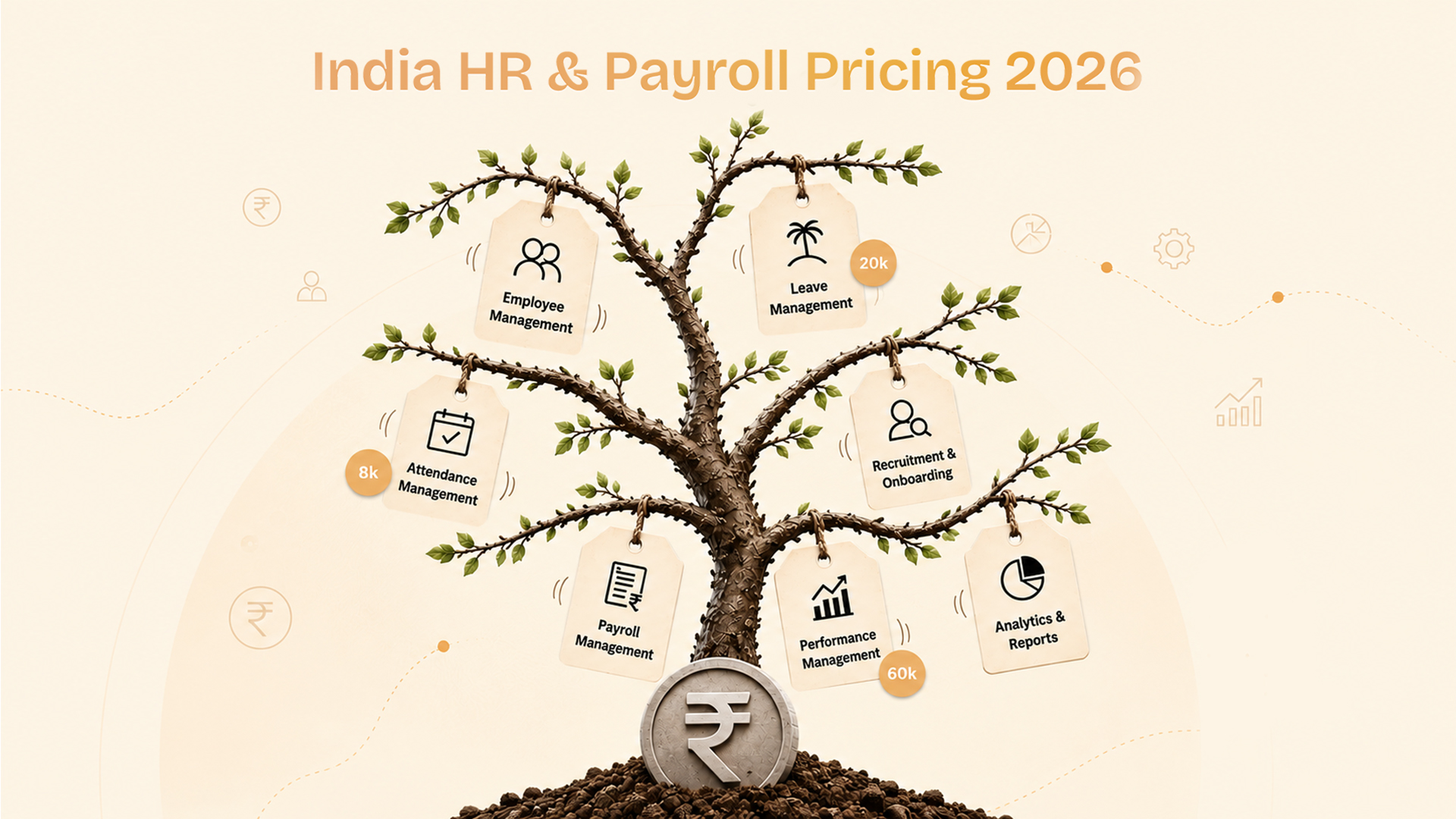
The first question most Indian HR and finance teams ask when evaluating software is: how much does it cost?
It is the wrong question to start with.
Not because pricing does not matter. It matters enormously. The problem is that the number a vendor shows on their pricing page, in a proposal, or during a demo is almost never the amount that appears on your Year 1 invoice. The first-year total cost of ownership for HR software in India is often 1.5 to 2 times the advertised subscription price after factoring in setup fees, data migration, biometric integration, support upgrades, and the gap between implementation and billing.
The right question is not “how much does this cost per employee per month?” It is “what will we actually pay in total across the first three years, for the specific modules we need, at our current entity structure and headcount?”
This guide gives you the framework to answer that question for any HR or payroll platform in India, before you commit to anything.
The Three Pricing Models Indian HRMS Vendors Use
Not all Indian HR software vendors price the same way. Understanding the model before comparing numbers prevents the most common budgeting mistake: comparing ₹60 per employee from one vendor against ₹6,999 per month from another without knowing what is actually included in each.
Model 1: Per-Employee Per-Month (PEPM)
You pay a fixed monthly fee based on your number of active employees. In India, pricing typically ranges from ₹30 to ₹450 per employee per month, depending on the platform and the modules you choose.
This model is predictable when headcount is stable. It becomes expensive as headcount grows because the cost scales linearly. A 300-person company paying ₹150 per employee per month is paying ₹5.4 lakh annually before any add-ons. At 500 employees on the same rate, that is ₹9 lakh.
Watch out for: minimum employee counts that mean you pay for 100 employees even if you have 80, and mid-month joining clauses where new hires trigger a full month of billing from day one.
Model 2: Flat Monthly Fee With Headcount Bands
You pay a fixed monthly fee for a defined employee range. For example, one flat fee may cover up to 100 employees, with a higher fee applied once you exceed that limit. This model works well for companies close to the upper end of a band because the effective cost per employee decreases. However, it can be expensive for smaller teams that are well below the employee limit.
Watch out for: Differences between annual and monthly billing and employee limits that trigger the next pricing tier. A single new hire can increase your monthly fee from ₹6,999 to ₹9,999.
Model 3: Custom Enterprise Contracts
Negotiated annually or over multi-year terms based on headcount, module scope, entity count, support tier, and geographic coverage. No published rates. All pricing through sales discovery. Common among enterprise-grade Indian HRMS platforms and mid-market platforms that serve complex multi-entity or multi-country customers.
Watch out for: billing start at contract signature rather than go-live, auto-renewal clauses with short opt-out windows, and annual escalation percentages that are contractually built in rather than subject to negotiation at renewal.
The Seven Hidden Costs That Double Your First-Year Bill
This is where most Indian HR software budgets break down. Each of these costs is real, common, and rarely disclosed proactively in the sales process. Together they can add 50 to 100% to your base subscription cost in Year 1.
- Implementation and Setup Fee
A one-time fee for configuring the platform to match your organization’s structure, salary components, leave policies, approval workflows, and other requirements. Costs can range from ₹15,000 for basic cloud deployments to ₹5 lakh or more for complex enterprise implementations. Always ask for this fee in writing before signing the proposal, as it is rarely included in the quoted subscription price. - Data Migration Cost
Moving employee records, payroll history, leave balances, and statutory data from your previous system or from Excel into the new platform. Industry estimates for mid-market Indian companies run from ₹25,000 to ₹1.5 lakh depending on data volume and source format. If your Excel sheets have been maintained by multiple HR managers over several years, expect the higher end. - Billing Start Date Gap
Several Indian enterprise platforms begin billing at contract signature, not at go-live. A 90-day implementation on an annual contract worth ₹5 lakh means ₹1.25 lakh paid before a single employee uses the system. This is one of the most significant hidden costs in Indian HRMS contracts and one of the least discussed in sales conversations. - Per-Entity Charges
Businesses with multiple legal entities, such as group companies, holding companies, or organizations with separate manufacturing and trading entities, may be charged an additional fee for each entity beyond the first. This is usually added on top of the standard headcount-based subscription and can cost ₹50,000 to ₹2 lakh per year for each additional entity. These charges are often disclosed only during contract negotiations. - Biometric and Integration Fees
If your attendance system involves biometric hardware, expect ₹5,000 to ₹15,000 per device for integration setup depending on device age and communication protocol. Older devices using legacy formats sometimes require custom API bridges that add ₹30,000 to ₹1 lakh in one-time development cost. - Annual Renewal Uplift
Most enterprise HRMS contracts in India include an annual price increase of 8% to 15%. Some vendors also offer discounted pricing in the first year, which reverts to the standard rate at renewal. As a result, a ₹4 lakh Year 1 contract could increase to ₹5 lakh to ₹6 lakh in Year 2 without any change in the features or services you use. Always request Year 2 and Year 3 pricing in writing before signing the contract. - Support Tier Upgrades
Most HRMS platforms include standard support through email and ticketing in their base plans. Features such as a dedicated account manager, priority response during payroll processing, or phone support are usually available only with a paid premium support plan. For businesses where payroll is business-critical, investing in premium support can help avoid costly delays. Include this expense in your budget from the beginning
Read: India Payroll Compliance Guide: PF/ESI/TDS
How to Calculate True TCO: A Formula Indian HR Teams Can Apply to Any Vendor
Total Cost of Ownership for HRMS in India is not complicated once you know what to include. Use this formula before comparing any two vendors:
TRUE YEAR 1 COST =
Base subscription (annual) + implementation and setup fee + data migration cost + Biometric integration cost + Premium support upgrade (if needed) + Any add-on modules not in base plan + (Billing start gap × monthly rate × implementation months)
TRUE YEAR 3 COST =
Year 1 cost + (Year 2 subscription × renewal uplift %) + (Year 3 subscription × renewal uplift %) + Per-entity charges × entity count × 3 + Headcount growth cost (additional employees × PEPM × 12 × 2)
Worked example: 300-employee Indian company, standard HRMS configuration:
Assumptions: one legal entity, payroll plus leave plus attendance plus performance, moderate headcount growth of 10% annually, no multi-country requirement.
Platform A (flat-fee model), 300 employees, one entity:
Year 1 — Base subscription ₹1,44,000 + implementation ₹75,000 + data migration ₹50,000 + biometric ₹20,000 + support upgrade ₹30,000 = ₹3,19,000
Year 2 — Subscription only, +10% price uplift +10% headcount growth on ₹1,44,000 base ≈ ₹1,74,000 (one-time fees do not recur)
Year 3 — Subscription +10% uplift +10% growth ≈ ₹2,06,000
3-Year TCO ≈ ₹6,99,000
Platform B (enterprise custom model), 300 employees, one entity:
Year 1 — Base subscription ₹6,00,000 + implementation ₹3,00,000 + data migration ₹75,000 + billing-start gap (4 months × monthly rate) ₹2,00,000 + support (included) ₹0 = ₹11,75,000
Year 2 — Subscription ₹6,00,000 +12% uplift +10% growth ≈ ₹7,39,000
Year 3 — +12% uplift +10% growth ≈ ₹9,11,000
3-Year TCO ≈ ₹28,25,000
The subscription price of Platform B may look similar to Platform A in the proposal. The three-year TCO is nearly four times higher. This gap does not appear anywhere in the vendor’s pricing materials.
Five India-Specific Factors That Move Your Quote Up or Down
- Number of Indian states your workforce spans
Professional tax applies across roughly 21 states and union territories with different slabs, frequencies, and portals. A platform that handles multi-state PT natively requires no additional configuration cost. One that treats PT as a manual process or a custom add-on creates recurring operational costs in HR time and error correction. - Entity count in your Indian group structure
The number of legal entities in your organization can significantly affect your HRMS costs. Many platforms charge extra for each additional entity or require separate implementation and configuration. If your business operates three or more legal entities in India, choosing a platform that supports multi-entity management within a single instance can save ₹2 lakh to ₹5 lakh per year. - Module scope at signing versus actual need
Purchasing modules such as performance management, recruitment, or learning management at the time of signing can increase your upfront costs if you do not plan to use them immediately. Platforms that let you activate modules as your needs grow help reduce Year 1 costs by ensuring you pay only for the features you actually use.
- New labor code and income tax act compliance
India’s four new labour codes came into force on 21 November 2025 (with central and state rules rolling out through 2026), and the new Income Tax Act took effect on 1 April 2026. A platform that has not been updated to support these changes can increase compliance risk, leading to penalties, rework, and additional implementation costs. Before signing, ask the vendor for written confirmation that the platform complies with both regulations. - International expansion timeline
If your business expects to open operations in the UAE, Malaysia, Singapore, or India’s other major destination markets within 24 months, the cost of managing separate local payroll vendors in each market needs to be factored against the cost of a platform that covers all of them natively. Over a three-year horizon, multi-vendor international payroll typically costs significantly more than a unified platform that handles multiple countries from one instance.
Check out: Best Payroll Management Software in India
How Akrivia HCM’s Pricing Is Structured Differently
Akrivia HCM does not publish standard pricing tiers because every implementation is tailored to the organization’s size, structure, and business requirements. The ideal setup for a 300-employee, single-entity IT company differs significantly from that of a 1,000-employee manufacturing group with multiple legal entities and a GCC office. This approach ensures businesses pay for the capabilities they need rather than a one-size-fits-all package.
What Akrivia’s pricing model does differently from most Indian HRMS vendors:
- Billing starts at go-live, not contract signature: Unlike many HRMS vendors that begin billing as soon as the contract is signed, Akrivia HCM starts charging only when the platform goes live. This eliminates the gap between contract signing and implementation, ensuring you pay only when your team is actively using the platform.
- No per-entity surcharges for Indian group structures: Multiple legal entities, pay groups, and pay cycles are managed within one instance without per-entity pricing penalties. For businesses with two or more Indian entities, this single factor can deliver ₹1 to 3 lakh in annual savings compared to platforms that charge per entity.
- Multi-country payroll is included in one contract: Akrivia HCM supports payroll across India, the UAE, Malaysia, Singapore, Indonesia, and other GCC and Southeast Asian countries within the same platform. Businesses that rely on separate payroll vendors in different countries can consolidate payroll into a single solution, reducing vendor management effort, simplifying payroll operations, and lowering overall administrative costs.
- Modular activation as you grow: 40+ modules across 9 products can be activated incrementally. You do not pay for performance management in Month 1 if your HR team is not ready to deploy it until Month 6. This directly reduces effective Year 1 cost without reducing the platform’s long-term capability.
- No custom report fees: Standard and custom reporting is available within the platform through self-service configuration. You can create and customize reports without relying on vendor support or incurring additional professional services fees.
Conclusion
HR software pricing in India in 2026 is more than the number shown on a pricing page. The true cost includes the base subscription, implementation fees, billing start date, per-entity charges, annual renewal increases, and support upgrades over the life of the contract. It also depends on whether the platform is fully updated to comply with the latest labour and tax regulations.
The businesses that get this right do not just compare per-employee rates. They apply a TCO formula, ask for Year 2 and Year 3 pricing in writing, confirm the billing start date before signing, and score every vendor against a consistent set of cost transparency criteria.
For Indian businesses with 200 to 2,000 employees, Akrivia HCM is designed to reduce hidden costs through a transparent pricing model. It offers billing from the go-live date, modular activation, multi-country payroll under a single contract, and support for multi-entity operations without unnecessary complexity, helping businesses pay only for what they need.
Get a tailored pricing model built around your specific headcount, entity structure, and module requirements.
Book a free demo at AkriviaHCM and see exactly what you will pay before you commit to anything.
FAQs
Do Indian HRMS vendors charge extra for new labor code compliance updates?
Most cloud-native platforms include regulatory updates in the base subscription. However, some on-premise or legacy platforms charge professional services fees to apply new labor code configuration changes. Always confirm in writing whether the November 2025 labor code and April 2026 income tax act updates are included in your plan or billed separately.
Can I negotiate the annual renewal uplift in an Indian HRMS contract?
Yes. Most enterprise HRMS vendors in India include annual price increases of 8% to 15% by default. Negotiating a lower cap, such as 3% to 5%, before signing the contract can significantly reduce your total cost over the next few years. Make sure the agreed renewal rate is documented in the contract rather than relying on a verbal commitment.
What is the typical implementation timeline for HR software in India for a 300-person company?
Cloud-native platforms with standard configurations typically go live in six to ten weeks for core HR plus payroll. Adding performance, recruitment, and analytics modules extends this to twelve to sixteen weeks. Enterprise platforms can run six to nine months. The implementation timeline directly determines your billing start gap cost if the vendor bills from contract signature.
Is professional tax compliance included in standard Indian HRMS plans or an add-on?
It varies significantly. Most India-built platforms include PT in the base payroll module. Some charge separately for multi-state PT configuration beyond the vendor’s home state. If your workforce spans more than two or three Indian states, confirm in writing which states are included and what configuration cost applies to adding new states as you expand.





1 comment
In this blog, the breakdown of HR payroll software pricing in India clearly explains cost factors and essential features, helping businesses choose a solution that fits their budget and operational needs.