
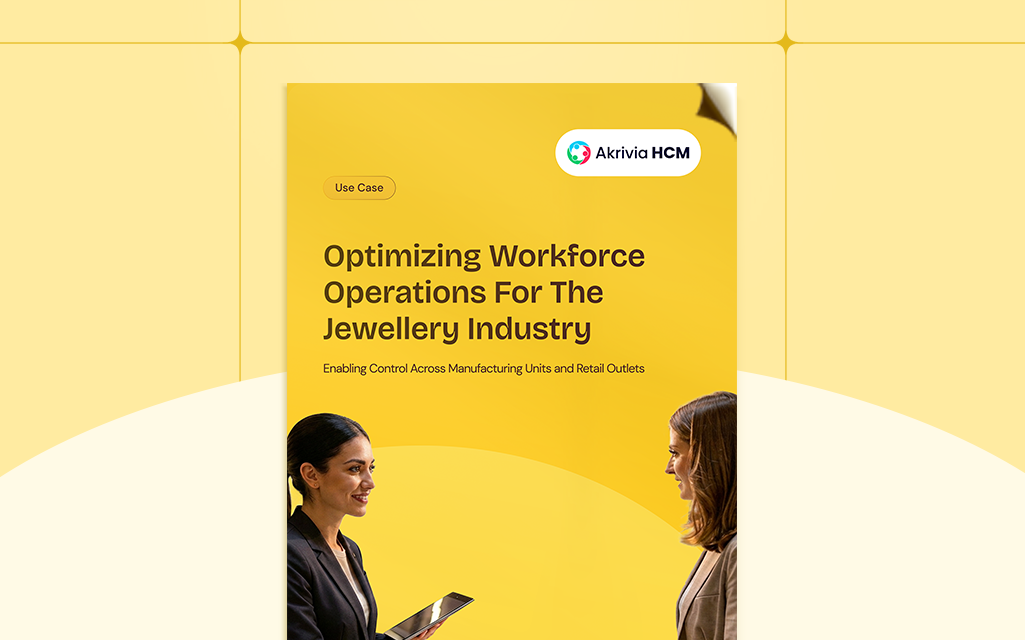
desc-Enabling Control Across Manufacturing Units and Retail Outlets
category:Retail
Introduction
As jewellery businesses grow, workforce management has evolved from basic administration to coordinated, real-time operations across diverse environments. Often, showroom staffing is dependent on manual coordination, resulting in peak sales hours being lost when shifts are not aligned with high-revenue windows. Concurrently, skilled artisans are left underutilized on the production floor when delays in shift allocation occur, which negatively impacts delivery timelines.
Furthermore, immediate action is required for unplanned absences; however, without real-time visibility, calls and manual coordination are heavily relied upon by managers to find replacements. Over time, revenue, productivity, and the customer experience are directly impacted by these operational inefficiencies.
To address these challenges, the Akrivia Jewellery Workforce Model is implemented. Real-time workforce operations are managed across showrooms and production units. Accurate attendance tracking is ensured with location-based validation, and consistent staffing is maintained during peak business hours
FAQs
Q: How are last-minute absences managed?
A: Immediate notifications are triggered by Exception-Based Management if an employee has not checked in at the start of a shift.
Q: How is attendance accuracy maintained across multiple locations?
A: Geo-verified attendance is utilized to validate locations, ensuring accurate tracking across showrooms and manufacturing units.
Q: Can complex payroll structures be streamlined?
A: Yes, factory wages, overtime, and showroom incentives are managed within a single system to enable transparent payouts.
Q: How are staffing gaps prevented during peak times?
A: Showroom staffing is aligned with peak footfall, and production manpower is aligned with batch schedules through demand-based rostering.