
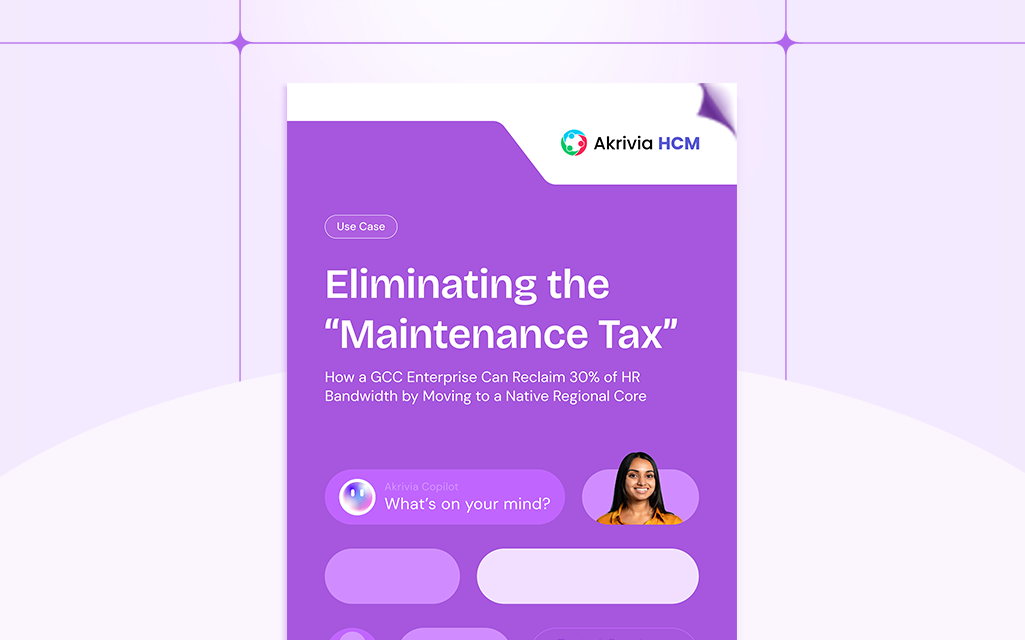
desc-How a GCC Enterprise Can Reclaim 30% of HR Bandwidth by Moving to a Native Regional Core
category: GCC
Introduction
For years, a massive “architectural overhead” has been faced by GCC organizations operating on “Global Standard” HCM suites. While powerful, it is frequently discovered that these platforms lack regional depth, meaning expensive external consultants and custom “patches” are required every time a local labor law changes.
In this use case, the transition away from this fragmented approach to a “Native Regional Core” is detailed. It is demonstrated how local labor laws and statutory reporting can be built directly into the platform’s core, ensuring that data silos are destroyed and real-time compliance is effortlessly maintained.
Key Insights Discovered Inside:
Consultant Dependency Ended: The need for outside help and shadow budgets is entirely eliminated by moving all employee touchpoints into a single, unified engine.
Statutory Outputs Automated: Regional requirements, such as WPS, Mudad, and GOSI contributions, are generated as direct system outputs rather than manual workarounds.
Validation Time Slashed: Pre-payroll validation time is successfully reduced from 5-7 business days down to a mere 4 hours.
Strategic Bandwidth Recovered: Manual data entries are brought down to zero, allowing 50% of HR team bandwidth to be dedicated to strategic initiatives rather than administrative upkeep.
FAQs – Eliminating the “Maintenance Tax”
Q: What is meant by the “Maintenance Tax”?
A:The “Maintenance Tax” is incurred when expensive external consultants must be hired to patch standard global HR systems every time regional labor laws change.
Q: How is statutory compliance managed differently?
A: Local labor laws are built directly into a Native Regional Core. All statutory files (like WPS, GOSI, and Mudad) are generated directly by the system, eliminating manual workarounds.
Q: How are End of Service Benefits (EOSB) handled?
A: The calculation for EOSB and regional pension schemes is entirely automated by the system using live, real-time data.
Q: What operational improvements can be expected?
A: Pre-payroll validation time is reduced from 5-7 business days to just 4 hours. Additionally, HR team bandwidth is successfully shifted to a 50/50 balance between administration and strategy.