
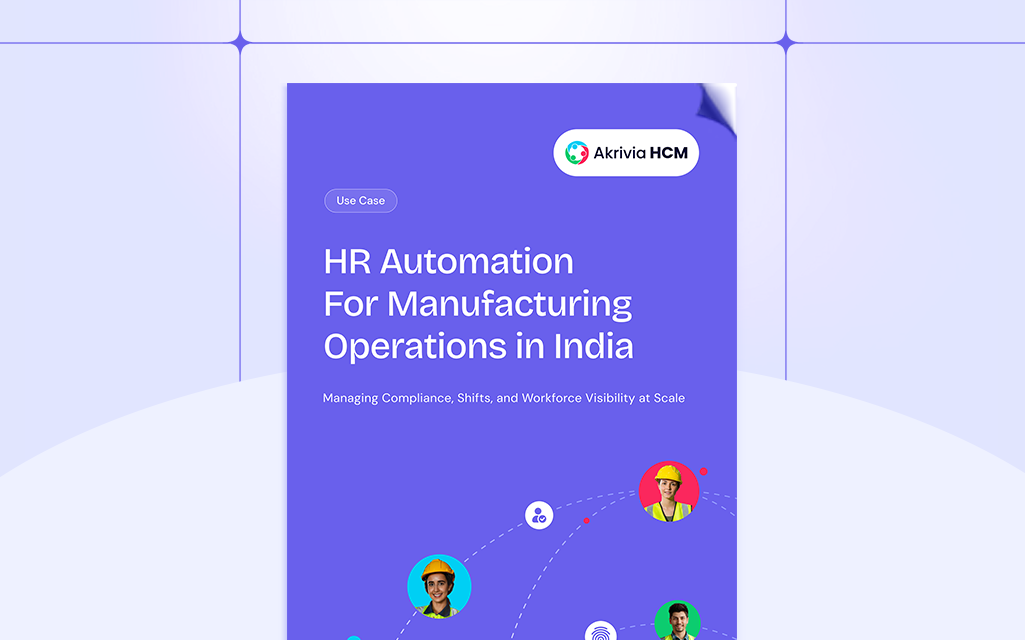
desc-Managing Compliance, Shifts, and Workforce Visibility at Scale
category: Manufacturing, India
Introduction
As Indian manufacturing plants expand capacity and move toward continuous production cycles, workforce management is made increasingly complex. Despite automations on the production floor, workforce management often remained fragmented, operating with disconnected biometric systems, rigid ERPs, and manual contractor tracking. A hardware-software disconnect is experienced because biometric attendance data is not synced with payroll or rostering in real time, causing delayed production decisions.
Furthermore, compliance risks are increased because traditional ERPs struggle with rotating shifts, state-specific overtime rules, and mandatory rest-period enforcement under the Factories Act. Additionally, inflated billing and ghost workers are created by contract labor blind spots, as permanent employees are tracked internally while contract labor data is managed by external vendors.
To address these critical risks, a compliance-first workforce architecture is implemented by Akrivia HCM. Factory entry gates are integrated with biometric attendance, ensuring the gate only opens if the worker is assigned to a specific shift. Furthermore, labor law violations are prevented by Smart Rostering, which automates shift rotations and blocks non-compliant assignments. Manual spreadsheets are eliminated as PF, ESI, and overtime are auto-calculated by the Automated Payroll Engine based on state-specific rules.
Finally, manpower planning is aligned with production schedules through integrated workforce planning, and real-time visibility is provided to HR and plant leadership via unified dashboards.
FAQs
Q: How are ghost workers and unauthorized entry prevented?
A: Biometric attendance is integrated with factory entry gates, ensuring access is only granted if a worker is actively assigned to that specific shift.
Q: How is adherence to the Factories Act ensured?
A: Shift rotations are automated by Smart Rostering, and any assignments that violate labor laws, such as mandatory rest periods, are automatically blocked.
Q: How are state-specific wage calculations handled?
A: Calculations for PF, ESI, and overtime are processed in real time by an Automated Payroll Engine based on specific state rules, completely removing the need for manual spreadsheets.
Q: How is coordination improved between HR and production?
A: Manpower planning is aligned with production schedules through centralized rostering, and shared workforce visibility is established between the two teams.