
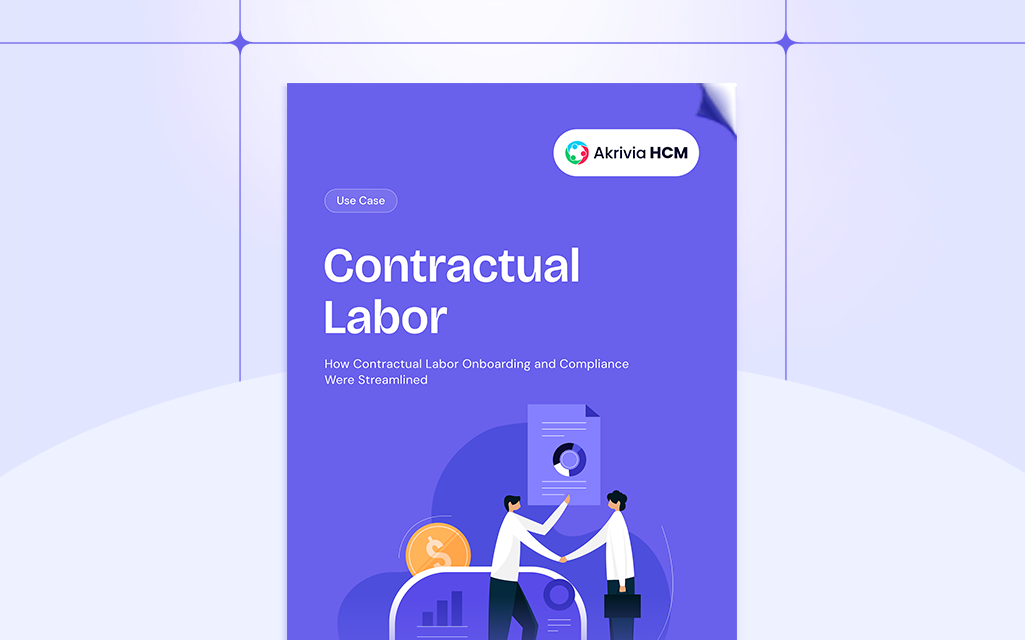
desc-How Contractual Labor Onboarding and Compliance Were Streamlined
category: Employee Foundation, Payroll
Introduction
In a time when companies are seeking both agility and flexibility in their workforce, the use of contractual labor has become quite imperative. However, walking over the ever-evolving landscape of contemporary business, particularly related to contractual labor, has always been a treacherous domain.
To tread over this gig economy which is majorly characterized by short-term or contract-based labor, organizations need more holistic HRMS software to manage a fluid workforce. This use case will showcase how organizations based in India, SEA, and the GCC region can navigate the complexities of the gig economy.
What makes contractual labor important?
To thrive in a competitive environment, organizations need to be adaptable and scalable, and contractual labor packs in tons of potential. These engagements help organizations tap into specialized skills. They can scale up or down with ease, which is absolutely essential for time-sensitive projects.
Nevertheless, as with any business strategy, there comes a set of challenges, complexities, and intricacies that demand timely attention. So, let us take you through a scenario that showcases the key challenges that an organization operating in the Southeast Asia region can face, followed by the implementation of the right solutions by Akrivia HCM.
Scenario
A multinational company operating in Indonesia and Vietnam, and having its headquarters in Singapore, was handling a workforce comprising both full-time and contractual laborers.
Along with this, the pool of contractual laborers flocking towards the Southeast Asia region offered better skillsets and experience.
Nevertheless, for the HR management, the lack of a specialized approach to handling the banner of contracts was turning out to be a major hurdle. The laws pertaining to contractual labor in countries like Indonesia are stringent, making it difficult to navigate the compliance conundrum.
The complexities of labor laws
FAQs – Managing Contractual Labor
Q: What SEA contractual labor challenges are faced by organizations?
A: Stringent and varying labor laws are encountered, making compliance difficult. Additionally, a lack of transparency regarding contractor tasks is frequently experienced, which hinders strategic decision-making.
Q: How are regional compliance risks mitigated?
A: The cloud HRMS platform is configured to adhere to specific regional regulations. Regular back-end statutory updates are automatically ensured so that non-compliance incidents are completely eliminated.
Q: Can contractor onboarding be accelerated?
A: Yes, a structured onboarding module is utilized. Through this system, the average onboarding time is reduced from 21 days to just 2 days.
Q: How are high contractor attrition rates reduced?
A: Dynamic engagement tools, such as 360-degree feedback and performance monitoring, are deployed. As a result, attrition rates are brought down by 30%